SEO can involve hundreds of tasks.
You can spend hours researching keywords, optimizing pages, fixing technical issues, updating old content, building internal links, earning backlinks, improving Core Web Vitals, publishing new articles, optimizing your Google Business Profile, tracking rankings, analyzing competitors, and monitoring conversions.
But does every SEO task contribute equally to your results?
Usually, no.
This is where the 80-20 rule in SEO becomes useful.
The 80/20 rule, also known as the Pareto Principle, is a general productivity and prioritization concept. Applied to SEO, it means that a relatively small number of SEO activities, pages, keywords, content assets, or improvements may generate a disproportionately large share of the results.
It is important to understand that the 80/20 rule is not an official Google SEO rule or ranking factor. Google does not state that following an 80/20 formula will improve rankings.
Instead, SEO professionals can use the principle as a framework for deciding where to spend time, resources, and budget first.
For an SEO agency serving businesses across the United States, this can make the difference between simply completing SEO tasks and focusing on activities that contribute to organic traffic, qualified leads, conversions, and revenue.
The 80-20 rule in SEO means identifying the relatively small percentage of SEO activities that are responsible for a significant percentage of your results and prioritizing them.
The exact ratio does not have to be literally 80/20.
On one website, 20% of pages might generate 80% of organic traffic.
On another, 10% of keywords might generate most conversions.
For another business, a handful of service pages may generate most qualified leads.
The principle is simple:
Find what is already producing meaningful results, understand why it works, and prioritize opportunities that can create the greatest business impact.
This changes how SEO is approached.
Instead of asking:
“What SEO tasks can we complete this month?”
ask:
“Which SEO improvements are most likely to create meaningful results for this business?”
That is a much more strategic question.
No.
The 80/20 principle should not be confused with Google’s official SEO guidelines or best practices.
Google does not have an official “80/20 SEO rule.”
There are, however, established SEO principles that should guide optimization, including:
The 80/20 principle sits above these activities as a prioritization framework.
For example, technical SEO remains important. However, an SEO professional can use 80/20 thinking to determine which technical problems should be fixed first.
If a critical indexing issue prevents important service pages from appearing in search, resolving that issue may deserve higher priority than spending several hours making minor metadata changes.
SEO has a resource problem.
Businesses usually have limited:
At the same time, SEO provides an almost unlimited list of potential improvements.
You could always:
The challenge is deciding what should happen first.
This is where prioritization becomes essential.
A strong SEO strategy does not necessarily involve doing more work.
It involves identifying the work that matters most.
Imagine an e-commerce website has 1,000 indexed product pages.
After analyzing Google Search Console and analytics data, you discover that:
Instead of immediately optimizing all 1,000 pages equally, an SEO team can first investigate the highest-performing pages.
Questions might include:
The answers can reveal patterns.
Those patterns can then be applied strategically to other pages.
That is 80/20 thinking.
The principle can be applied to almost every major SEO discipline.
Not every keyword has the same business value.
A website may rank for thousands of keywords but receive meaningful traffic and conversions from only a relatively small group.
For example:
| Keyword Type | Potential Value |
| High-intent service keyword | Very High |
| Commercial comparison keyword | High |
| Relevant informational keyword | Medium to High |
| Broad low-intent keyword | Variable |
| Irrelevant high-volume keyword | Low |
This is why SEO professionals should not evaluate keyword performance based only on search volume.
Consider:
A keyword receiving 200 searches per month can be more valuable than one receiving 10,000 searches if the smaller keyword consistently generates qualified customers.
A common SEO mistake is assuming:
More content = better SEO.
That is not necessarily true.
A website can have 500 blog posts and still struggle to generate meaningful organic traffic.
A smaller website with 50 highly relevant, well-structured resources may perform better.
The 80/20 approach asks:
The next step is to improve and leverage those assets.
Content updating can be one of the highest-leverage SEO activities.
Suppose a website has 200 blog posts.
Instead of manually rewriting all 200, identify pages that:
These pages may represent significant opportunities.
For example, a page ranking in positions 11–20 for a valuable keyword may require fewer resources to improve than creating a completely new page from scratch.
Internal linking is another area where prioritization can produce significant benefits.
Do not simply add links randomly.
Identify:
High-authority pages
These can potentially provide contextual links to important pages.
High-value commercial pages
These are pages you want users and search engines to discover easily.
Supporting informational content
These pages can naturally link to relevant service or product pages.
For example:
Blog → Supporting Guide → Service Page
A well-planned internal linking structure can help users navigate the site while helping search engines understand relationships between pages.
Technical SEO can produce hundreds of potential issues.
An audit might reveal:
But not all issues deserve equal priority.
A useful approach is to classify technical issues according to:
Impact × Urgency × Effort
Fix immediately.
Examples:
Prioritize strategically.
Examples:
Schedule for later.
Examples:
This prevents technical SEO from becoming a never-ending checklist.
Not all backlinks provide the same value.
A website may have thousands of backlinks, but a smaller number of relevant, authoritative links may contribute more to its authority than a large collection of low-quality links.
Instead of focusing solely on backlink quantity, examine:
The goal should be to develop a strong and relevant authority profile, not simply increase the number of backlinks.
Local SEO provides another strong example.
A business might have hundreds of directory listings, but only a handful of activities may have the greatest practical impact.
For a local business, those could include:
For a business targeting Philadelphia, for example, improving its most important service pages and strengthening local relevance may be more valuable than creating dozens of thin location pages.
The same principle applies to businesses targeting New Jersey or multiple U.S. markets.
For local businesses, Google Business Profile performance should also be analyzed through the lens of business outcomes.
Look at:
Instead of treating every profile element as equally important, prioritize improvements that are most relevant to customer discovery and conversion.
SEO should not stop when someone visits your website.
Suppose organic traffic increases by 80%, but leads increase by only 5%.
That indicates a potential conversion problem.
This is why SEO teams should identify which pages generate:
Then optimize those pages.
Potential improvements include:
Sometimes the fastest way to increase SEO-generated revenue is not getting more traffic.
It is converting more of the traffic you already have.
No.
That is an important distinction.
The 80/20 rule should be treated as a heuristic, not a mathematical law.
Some websites may have a more evenly distributed traffic profile.
Others may have extreme concentration.
For example:
The exact distribution depends on:
Therefore, do not force every SEO campaign into an artificial 80/20 ratio.
Use the principle to identify concentration and prioritize accordingly.
Yes, SEO agencies can use the 80/20 principle as part of their strategic prioritization.
However, not every agency formally labels its process as the “80/20 rule.”
Experienced SEO teams often use similar prioritization methods.
For example, an SEO agency serving U.S. businesses may begin a campaign by identifying:
The agency then allocates resources based on potential impact.
This is essentially 80/20 thinking.
A practical agency workflow could look like this:
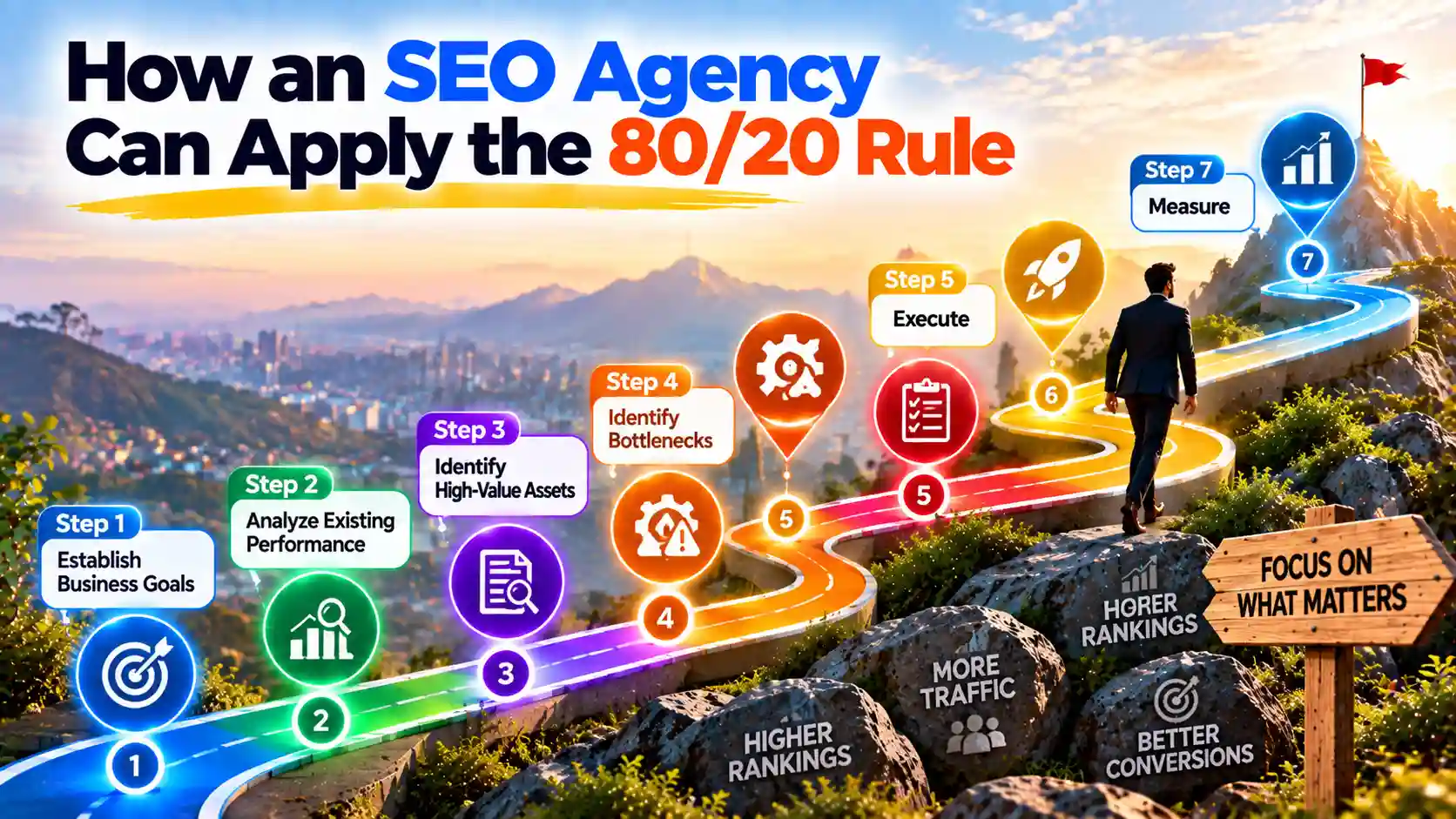
First, determine what the business actually wants.
For example:
Review:
Find:
Look for issues preventing these assets from performing better.
Examples:
Rank opportunities based on:
Potential Impact × Confidence ÷ Effort
This is not an official Google formula. It is simply a practical way to prioritize SEO work.
Work on the highest-impact opportunities first.
After implementation, monitor:
Then repeat the process.
The principle can be particularly useful when building topical authority.
Imagine a website has 100 articles about digital marketing.
Instead of producing another 100 articles, analyze which topics already generate:
Suppose SEO-related content significantly outperforms unrelated social media topics.
That may indicate an opportunity to build deeper topical coverage around SEO.
You might then create supporting content covering:
These pages can be interconnected through internal links.
The result is a more focused topical ecosystem.
Modern search introduces another layer of prioritization.
Businesses increasingly want visibility across AI-powered search experiences.
Instead of producing enormous amounts of AI-focused content, focus on content that answers important customer questions.
Prioritize:
The goal should be to make your website a useful information source.
Do not create content simply because an AI-search keyword sounds popular.
Create content because your customers genuinely need the information.
Reporting is another area where businesses can become overwhelmed by data.
An SEO report might contain:
But executives generally need to understand a smaller set of business-critical metrics.
A practical SEO report should emphasize:
Are we appearing for more relevant searches?
Are qualified organic visitors increasing?
Are organic visitors taking meaningful actions?
Is organic search contributing to revenue?
Which SEO activities are producing the strongest return?
This is another application of 80/20 thinking.
There is no universal answer.
However, for many websites, high-impact SEO work can include:
The exact priorities should come from data.
That is the key.
A useful framework is to classify SEO opportunities into four categories.
| SEO Opportunity | Impact | Effort | Priority |
| Fix critical indexing issue | High | Low | Immediate |
| Improve major service page | High | Medium | High |
| Rewrite low-value old article | Low | Medium | Low |
| Improve important internal links | Medium/High | Low | High |
| Create unrelated blog content | Low | Medium | Low |
| Improve high-converting landing page | High | Low/Medium | High |
| Fix minor metadata issue | Low | Low | Medium/Low |
This helps teams avoid spending disproportionate amounts of time on low-impact activities.
The 80/20 framework is useful, but it can also be misused.
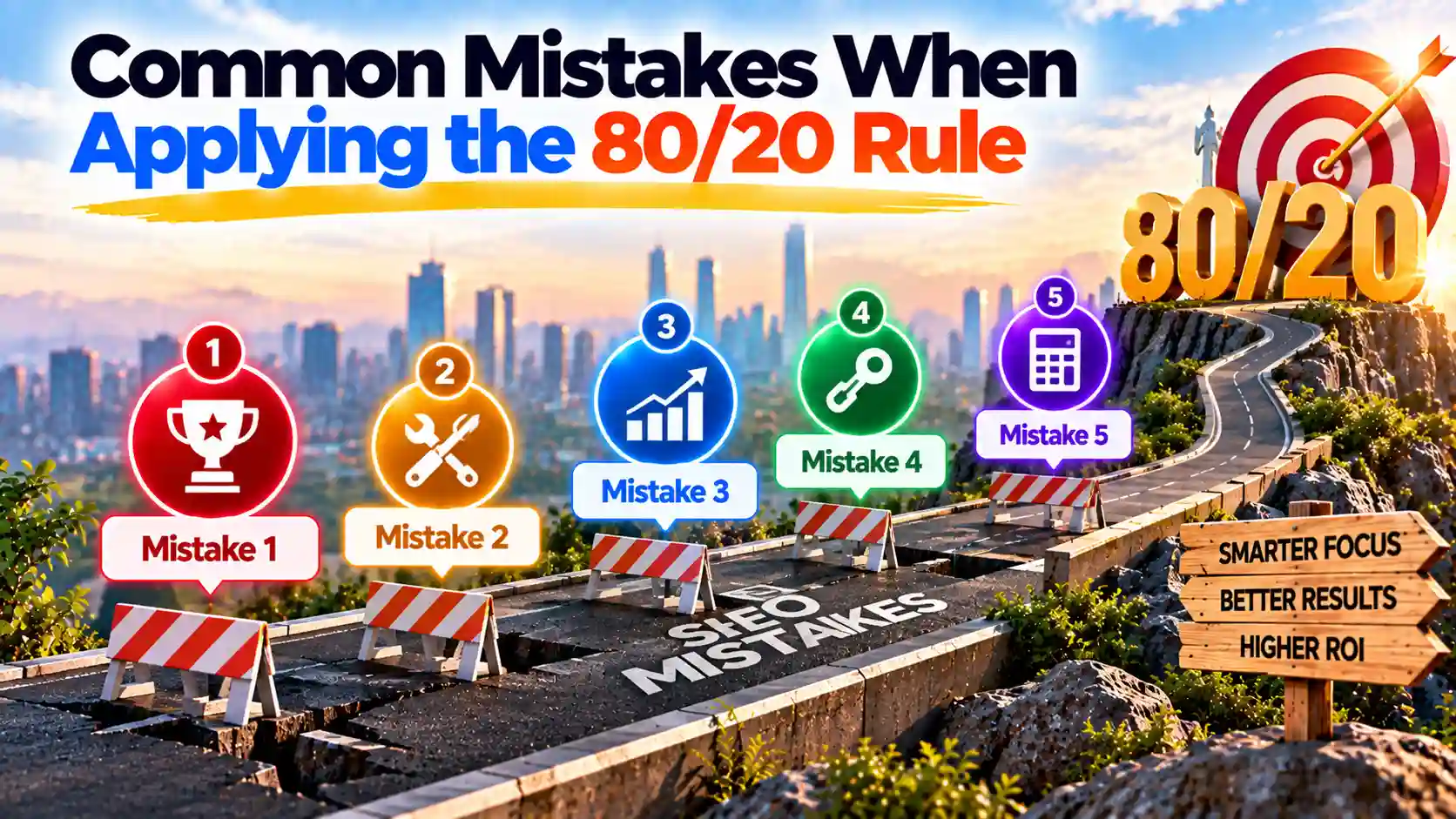
If you focus only on what already works, you may miss emerging opportunities.
SEO requires experimentation.
You should maintain a balance between:
Optimization + experimentation
A high-performing page can still be affected by technical problems.
The 80/20 principle does not mean ignoring fundamentals.
It means fixing the most consequential issues first.
Traffic is not the ultimate objective for most businesses.
A page receiving 10,000 visits and generating zero leads may be less valuable than a page receiving 500 highly qualified visits that generates 30 leads.
Always connect SEO performance to business outcomes.
Search volume alone does not determine SEO value.
A lower-volume keyword with strong commercial intent can be much more valuable.
You do not need to prove that exactly 80% of your results came from exactly 20% of your work.
The principle is about identifying disproportionate impact.
SEO budgets are limited.
This makes prioritization even more important.
Suppose a business has a fixed monthly SEO budget.
Instead of distributing resources equally across:
an agency can concentrate investment around:
The result can be a more focused SEO program.
The same principle extends beyond SEO.
For businesses investing in digital marketing in the United States, marketing performance can vary significantly across channels.
For example, a company might discover that:
This allows marketing teams to concentrate resources on the channels and audiences producing the greatest business impact.
However, the data should determine the allocation.
Do not assume that SEO, Google Ads, social media, or email will automatically follow an 80/20 distribution.
Measure first.
If I were approaching an SEO campaign using this principle, I would structure the process like this:
What does the company actually need?
Traffic?
Leads?
Calls?
Sales?
Revenue?
Identify the:
What is preventing those opportunities from performing better?
Which changes could produce meaningful improvement?
How difficult is each opportunity?
Work on high-impact, realistic opportunities first.
Implement changes carefully.
Compare results against the original baseline.
SEO is iterative.
The 80/20 process should therefore be repeated regularly.
The biggest SEO problem for many businesses is not a lack of things to do. It is spending time and budget on the wrong things.
At MetaSense Marketing, we use a data-driven approach to identify the SEO opportunities with the greatest potential impact on your business. Instead of treating SEO as a checklist of keywords, blogs, and backlinks, we look at the complete picture:
Whether you are a local business, service company, healthcare organization, professional services firm, e-commerce brand, or growing U.S. business, your SEO strategy should be built around business impact, not activity for activity’s sake.
If you’re looking for an SEO agency serving businesses across the United States, MetaSense Marketing can help you identify your highest-impact opportunities and build a focused SEO growth strategy.
Stop spending your SEO budget on activities that simply keep your team busy. Identify the opportunities that matter most, prioritize them, and build a strategy around measurable business outcomes.
Contact MetaSense Marketing today for a personalized SEO analysis and discover where your highest-impact opportunities are.
Let’s identify your 20% and turn it into your next 80% of growth.
The 80/20 rule in SEO is a prioritization framework based on the Pareto Principle. It suggests that a relatively small percentage of SEO activities, pages, keywords, or content may generate a disproportionately large share of organic traffic, leads, conversions, or other results.
It is not an official Google ranking rule.
No. Google does not have an official 80/20 ranking rule.
The principle is used by SEO professionals as a way to prioritize work and resources.
Yes, SEO agencies can use the 80/20 principle to identify high-impact opportunities.
An agency might analyze which pages, keywords, technical improvements, content assets, or conversion opportunities have the greatest potential and prioritize those activities.
Not every agency formally calls this process “80/20 SEO.”
No.
You should not ignore the rest of your website.
Instead, identify high-priority opportunities first while maintaining the health and quality of the broader website.
Yes.
It can be particularly useful for small businesses because they often have limited budgets and resources.
Rather than trying to compete everywhere, a business can identify its most valuable services, locations, keywords, and customer segments and focus its SEO investment accordingly.
Yes, as a prioritization concept.
A local business can identify which services, locations, search queries, Google Business Profile actions, and website pages generate the most valuable customer activity.
Yes.
Content teams can analyze which topics, pages, formats, and articles produce the most meaningful results and then use those insights to guide future content.
No.
Technical SEO remains foundational.
The 80/20 principle simply helps determine which technical issues should receive attention first based on impact and urgency.