You have worked hard to get your website onto Google’s first page.
Maybe one of your pages ranks #1.
Maybe it ranks in the top three for a competitive keyword.
Your organic traffic is growing, your technical SEO is in good shape, and your content is performing well.
Then you search the same topic and notice something unexpected:
Your website isn’t appearing in Google’s AI Overview.
Instead, Google is citing other websites that rank below you, or sometimes websites that don’t appear prominently in the traditional results at all.
So what is happening?
Does ranking #1 no longer matter?
Is your SEO strategy failing?
Do you need special AI schema?
Should you add an llms.txt file?
Do you need hundreds of FAQs?
The answer to these questions is more nuanced.
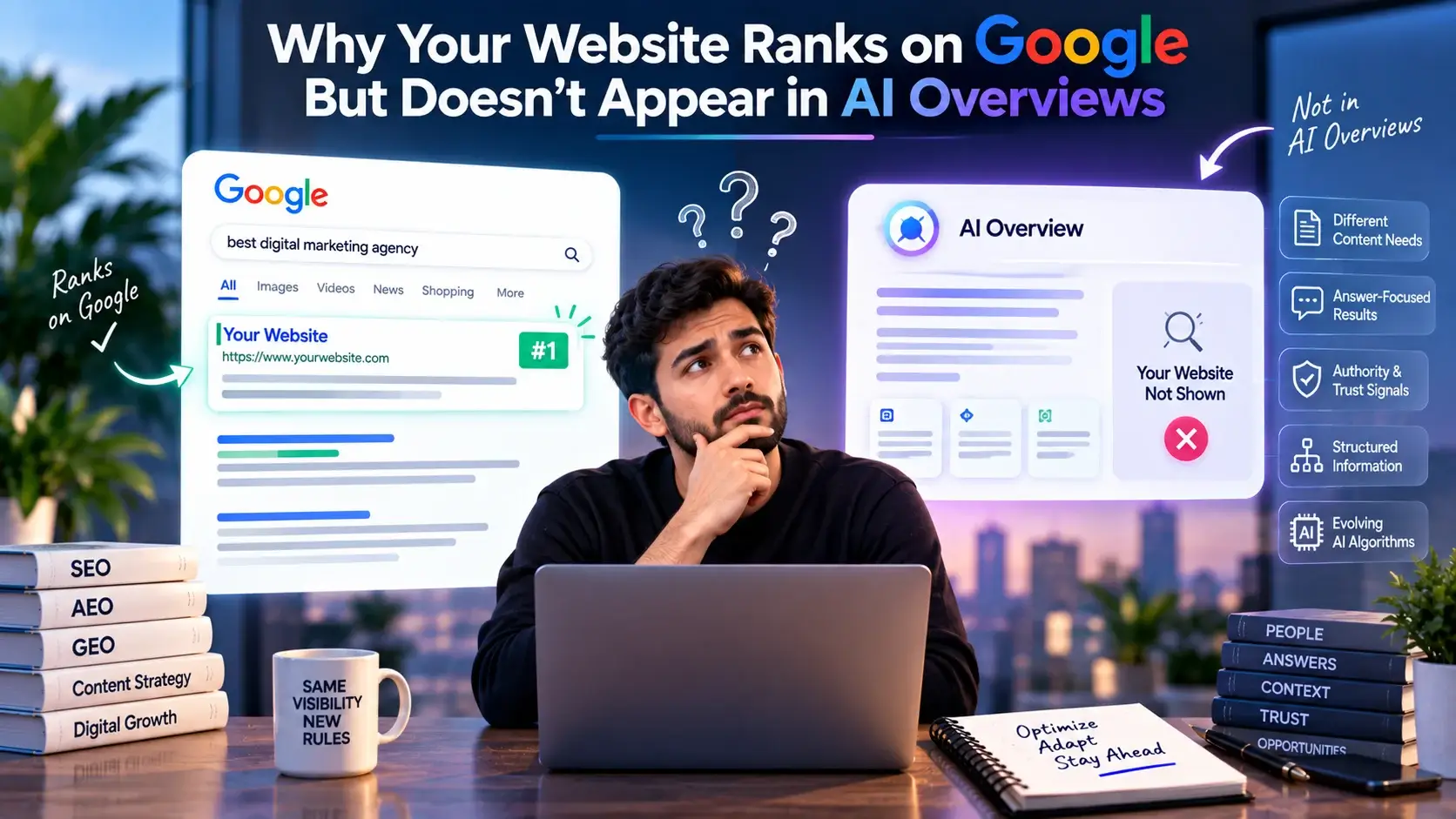
Traditional organic rankings and AI Overview visibility are related, but they are not the same thing.
Google’s AI Overviews are designed to help users understand complex questions by synthesizing information from multiple sources. Google has also described AI Mode as using “query fan-out,” where a complex query can be broken into multiple related searches to explore different aspects of a topic before generating an answer.
That means a page can be an excellent traditional search result while another source may be considered more useful for answering the specific question inside an AI-generated response.
At MetaSense Marketing, this distinction is important when we audit websites for AI-search visibility.
Our approach isn’t simply:
“How do we get this page into an AI Overview?”
The better question is:
“Why would an answer engine choose this page as a source for the answer, and what is missing today?”
This guide explains why ranking and AI Overview visibility can differ, the most common reasons your website may be missing, what you should audit, which AEO tactics are worth using, what not to waste time on, and how businesses can turn existing SEO performance into stronger AI-search visibility.
This is the first concept businesses need to understand.
If your page ranks #1 for a query, Google has determined that the page is relevant and useful enough to deserve a strong organic position for that search.
But an AI Overview has a different job.
Instead of simply presenting a ranked list of results, it may attempt to:
Google has stated that AI Mode can conduct multiple searches related to a user’s original query through query fan-out.
Therefore, the system isn’t necessarily asking:
“Which page ranks #1?”
It may effectively be asking:
“Which sources can help me construct the most useful answer to this question?”
That distinction explains much of the gap between traditional rankings and AI Overview visibility.
There isn’t one universal reason.
Google doesn’t publish a simple formula such as:
“Rank #1 + FAQ + schema = AI Overview.”
AI search systems are considerably more complex than that.
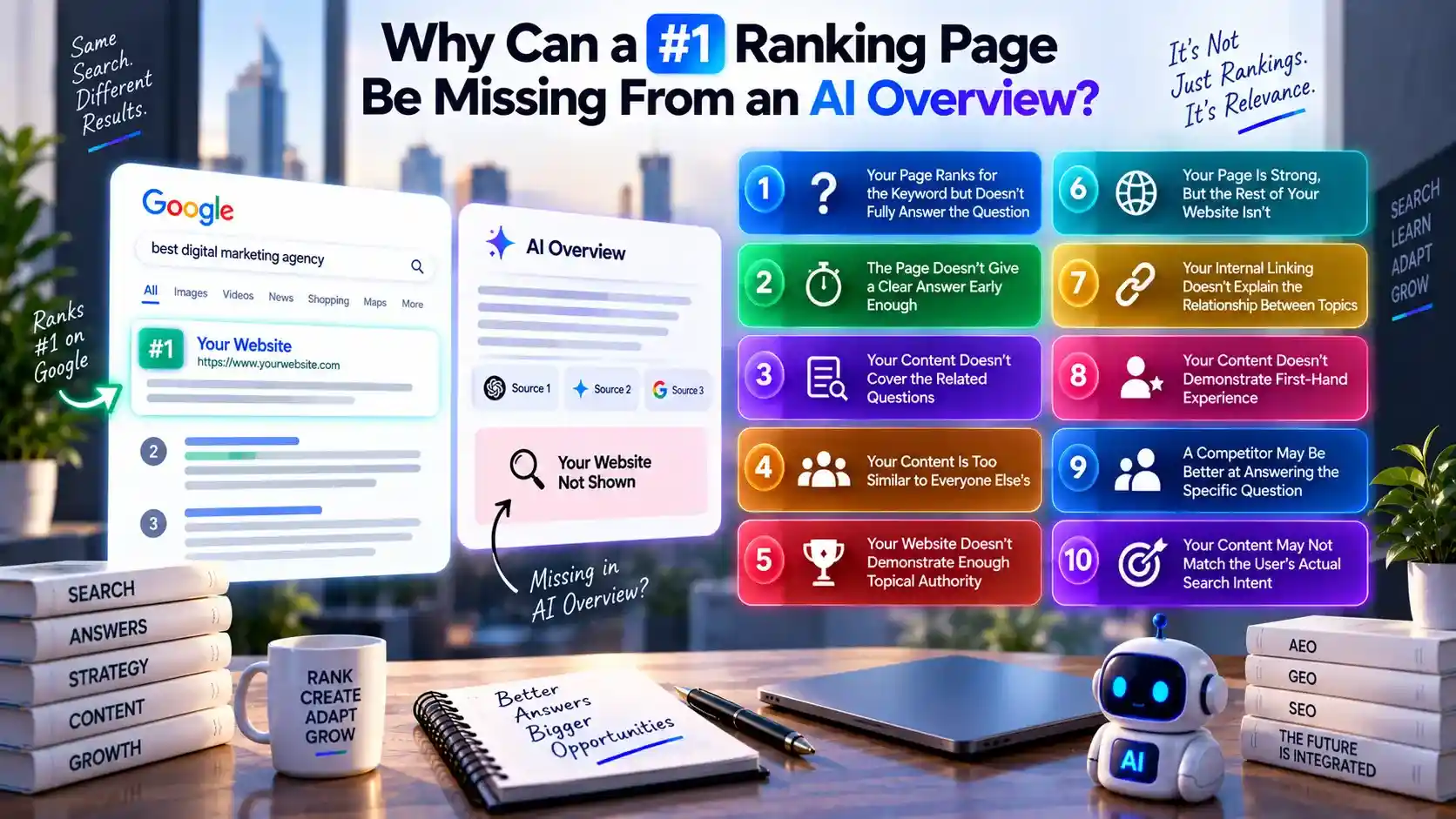
However, when we evaluate the problem from an SEO and content-strategy perspective, several recurring factors are worth investigating.
This is one of the most common problems.
Consider a page ranking for:
“Healthcare staffing agency”
The page might perform well because it has:
But imagine a user asks:
“How do I choose the right healthcare staffing agency for my hospital?”
Your page may rank for the broad keyword but fail to answer the deeper question.
A competing page might explain:
That page may provide more useful material for constructing an answer.
Keyword relevance is not the same as question completeness.
When auditing a page that ranks well but isn’t cited, ask:
“Does this page actually answer what the user wants to know?”
Not:
“Does this page contain the keyword?”
Imagine someone searches:
“How often should an HVAC system be serviced?”
They don’t want to read 800 words before finding the answer.
If your page begins with:
“HVAC systems have become an important part of modern residential and commercial environments…”
and finally answers the question several paragraphs later, you’re making the user work too hard.
A stronger structure might start with:
Most HVAC systems should receive professional maintenance at least once a year, although systems with heavy usage or specific manufacturer requirements may need more frequent service.
Then explain:
This is better for the user.
It also creates clearly identifiable information that can support answer-driven search.
A user rarely asks only one question.
Consider:
“How much does SEO cost?”
The next questions are often:
If your page only answers:
“SEO costs between X and Y.”
it may be less useful than a comprehensive resource that explains the factors influencing pricing.
This is why question clusters are becoming increasingly important.
This is another major issue.
Suppose ten websites publish:
“10 Benefits of Digital Marketing”
and all ten say:
Publishing an eleventh version doesn’t automatically make your website more authoritative.
AI systems can already generate generic summaries.
Your advantage is information that demonstrates:
Google’s current guidance around generative AI search emphasizes creating valuable, unique content rather than relying on special AI optimization tricks.
Ask yourself:
“What does my page provide that a generic AI-generated article cannot easily reproduce?”
That question can fundamentally improve your content strategy.
A single excellent article can rank.
But AI-search visibility often benefits from broader contextual understanding.
Imagine two websites.
One article:
What Is Healthcare Staffing?
A complete healthcare staffing resource center:
Website B provides significantly more context about its relationship to the subject.
That doesn’t mean Website A cannot appear in AI Overviews.
It means Website B has built a much stronger topical ecosystem.
This is closely related to topical authority.
Sometimes we find a page that is genuinely excellent.
The problem is that it exists in isolation.
There are:
Think of your website as a library.
One excellent book is valuable.
But a library with an entire section dedicated to a subject demonstrates much deeper coverage.
That’s why AEO should be treated as a website-wide strategy, not just a page-level optimization task.
Internal linking is more than an SEO ranking tactic.
It helps create an information architecture.
Suppose you have a page about:
Healthcare Staffing
It could naturally connect to:
These links help users navigate related information.
They also create clearer relationships between the topics covered by your website.
When restructuring a site, I don’t ask:
“Where can we insert another internal link?”
I ask:
“What information is the user likely to need next?”
That’s a much more useful approach.
This is increasingly important.
Compare:
“SEO agencies can help businesses improve organic traffic.”
with:
“In one of our client campaigns, we found that restructuring content around customer questions—not simply adding more service keywords—created opportunities for featured snippets and AI Overview visibility while also contributing to significant traffic and lead growth.”
The second statement demonstrates experience.
It tells the reader:
Someone actually did this.
That is valuable.
Businesses should turn their experience into content through:
Your experience is one of the strongest forms of content differentiation.
Sometimes the answer is simple:
Another website has better information.
You may rank #1 for the overall keyword.
But when Google generates an AI Overview, it may select several sources that collectively provide useful information.
One source might be best for:
Another for:
Another for:
Another for:
Another for:
This means your competitors don’t necessarily need to outrank you to become part of the AI-generated answer.
That’s one of the biggest mindset changes SEO professionals need to make.
A keyword can hide multiple intents.
Consider:
“SEO agency”
Someone searching it might want:
Now consider:
“How do I choose an SEO agency?”
That’s clearly more informational and evaluation-focused.
A page designed only to sell SEO services may not satisfy the second query as well as a detailed buyer’s guide.
This is why modern content research needs to go beyond keyword volume.
The difference can be summarized this way:
| Traditional Organic Search | AI Overview |
| Page ranking is central | Source usefulness is central |
| Keyword relevance matters | Question and contextual relevance matter |
| Individual page performance | Multiple sources can be synthesized |
| Ranking position is a major KPI | Citation/reference visibility becomes important |
| Search result click is the primary interaction | Answer may satisfy part of the search before the click |
| Traditional SERP features | AI-generated summaries and supporting sources |
This doesn’t mean Google’s traditional ranking systems have disappeared.
It means the search experience now includes another layer.
Yes, but it isn’t a guarantee.
Strong organic visibility is still valuable because it can indicate that Google considers your content relevant and useful.
However:
Ranking #1 should be viewed as an advantage, not an automatic ticket into an AI Overview.
If your page ranks #1 but doesn’t answer the question comprehensively, another source may be more useful for the AI-generated response.
That is why the right approach is not to abandon traditional SEO.
It’s to strengthen the content and authority behind it.
A practical client example illustrates this difference better than theory.
MetaSense Marketing worked with Berks Plumbing & HVAC Specialist, a plumbing and HVAC business where we focused on improving visibility around the questions and problems potential customers were searching for.
The objective wasn’t simply to rank service pages.
We looked at the broader information journey.
Customers don’t only search:
“Plumber near me.”
They may first search:
These questions represent opportunities.
The strategy involved:
The results included:
The important point isn’t that every website will produce identical results.
The lesson is that stronger question-focused content can create visibility across multiple search experiences at the same time.
The client didn’t need a completely separate website for AI search.
The existing SEO strategy was expanded to better answer customer questions.
Someone searching:
“Why is my water heater leaking?”
may become a customer shortly afterward.
The same content can support:
Customers don’t always use the terminology businesses expect.
The campaign’s more than 2× increase in leads is more meaningful than visibility alone.
If I were auditing such a page for a MetaSense Marketing client, I would follow a structured process.
Don’t start by asking:
“Why aren’t we appearing in AI Overviews?”
Start with:
“For which exact queries are we missing?”
AI Overview visibility varies by query.
One page may appear for one question and not another.
If an AI Overview appears, document:
You’re looking for patterns.
Don’t simply compare word count.
Compare:
Ask:
“What does the cited source provide that our page doesn’t?”
Determine whether your page is actually answering the user’s question.
Sometimes the keyword is correct but the intent is wrong.
Look for missing:
Look beyond the page.
Does the website have supporting content around the topic?
Are those pages internally linked?
Does the website demonstrate expertise?
Make sure the page is connected to relevant supporting resources.
Ask:
Check:
Don’t automatically create another page.
If the current URL already ranks well, improving it may be more logical than splitting authority across multiple URLs.
Create or improve related resources where genuine content gaps exist.
Monitor:
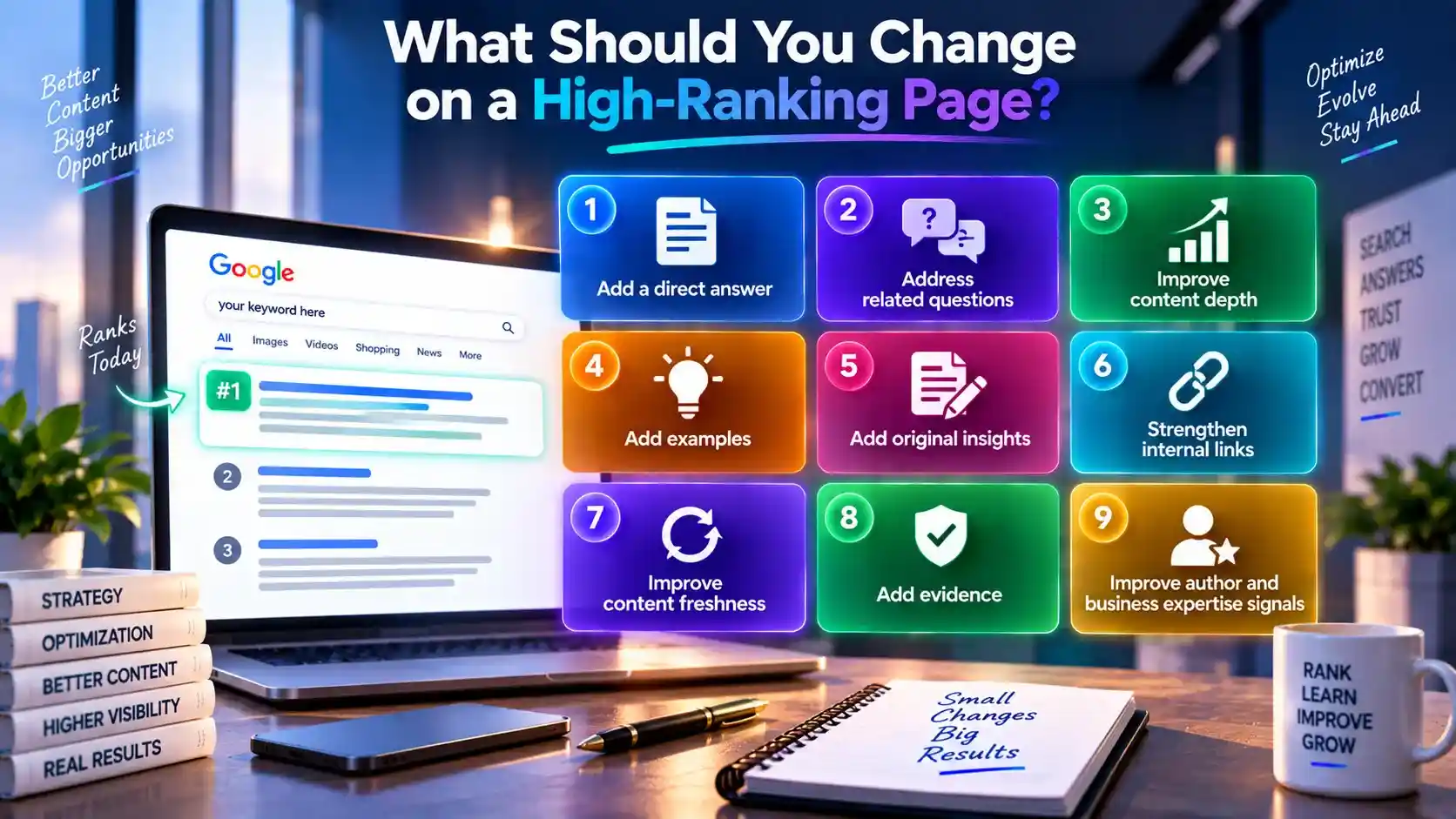
If your page already ranks well, don’t destroy what works.
Instead, look for incremental improvements.
Give the user the key information quickly.
Anticipate the next logical questions.
Add useful information, not filler.
Show readers how the concept applies in real situations.
Bring in your organization’s experience.
Connect the page to related resources.
Update outdated information and statistics.
Support important claims with reliable sources.
Make it clear why the organization is qualified to discuss the subject.
Yes, but with an important qualification.
Don’t add content simply to make the page longer.
Add content when it improves the user’s ability to understand the subject.
For example, if your page answers:
“How much does SEO cost?”
you could add:
That’s useful expansion.
Adding 1,000 words repeating the same point isn’t.
Potentially.
FAQs are useful when they address genuine customer questions.
For example:
Yes. Traditional rankings and AI Overview citations are not identical.
No.
No.
Don’t treat it as a prerequisite for AI Overview visibility.
The FAQ should help users, not exist solely to create additional keywords.
Don’t rely on it as an AI Overview strategy.
Google’s current guidance states that there are no special technical requirements or special schema needed specifically for AI Overviews or AI Mode.
Structured data should be used accurately where appropriate.
But it isn’t a magic switch.
I wouldn’t make llms.txt the focus of an AI Overview optimization campaign.
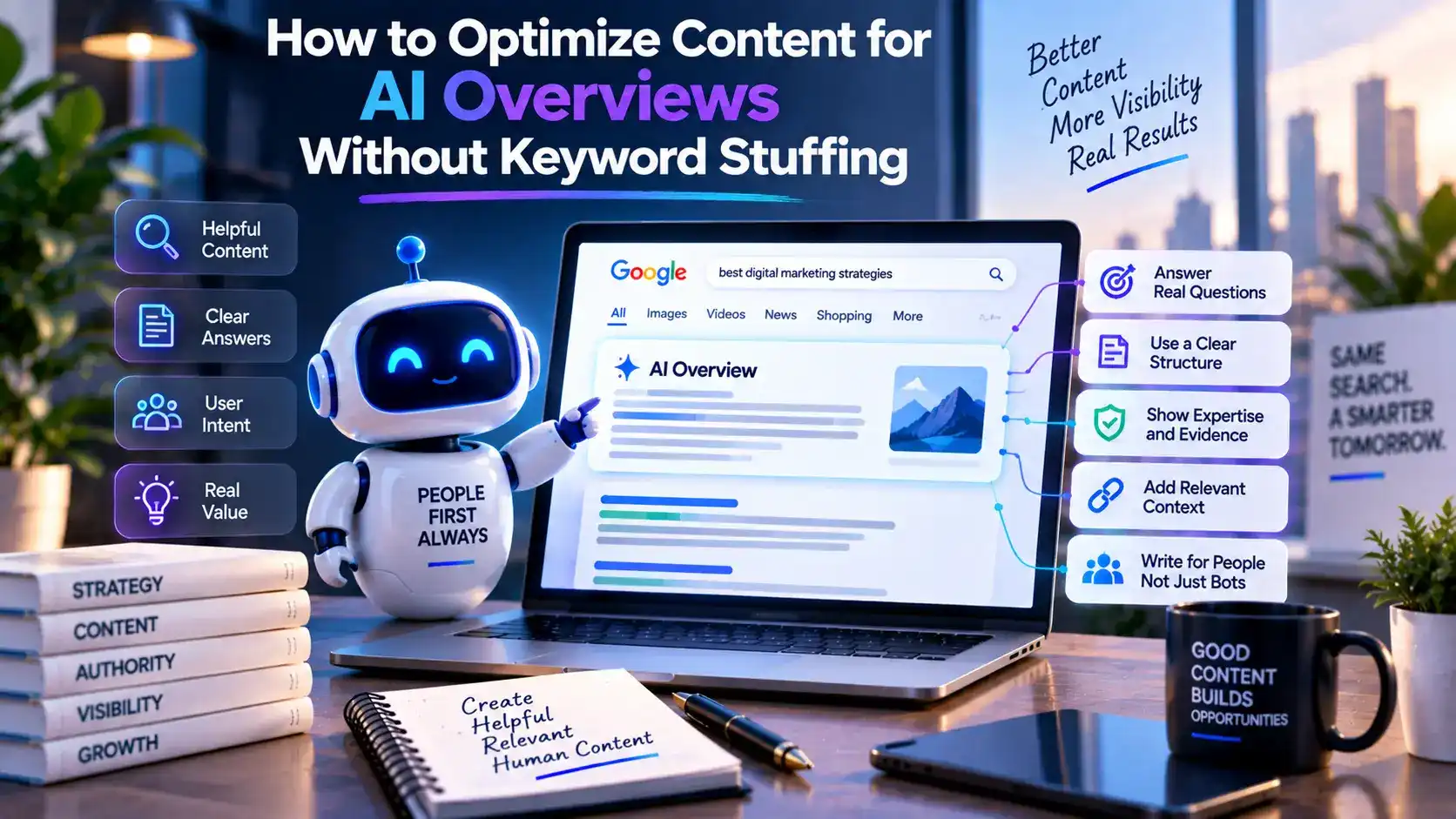
The fundamentals are more important:
If those fundamentals are weak, an additional AI-related file isn’t going to fix the core problem.
AI can be extremely useful in an SEO workflow.
It can assist with:
But businesses should be careful about using AI to produce large volumes of generic content with little human expertise.
The question isn’t simply:
“Was AI used?”
The better question is:
“Does the final content provide genuine value that demonstrates expertise and satisfies the user?”
That distinction matters in both traditional SEO and AI search.
AI can summarize common information extremely well.
So generic information becomes less differentiated.
Consider two articles.
Article A
“SEO is important because it helps businesses increase visibility, traffic, and leads.”
Article B
“In our experience managing SEO campaigns, we found that improving question-based content can uncover search opportunities that conventional service-keyword research misses. One client campaign increased traffic approximately 10× and generated more than twice the previous lead volume.”
Article B contains something that can’t be reduced to generic advice:
Experience.
That’s what businesses should bring into their content.
AI Overview visibility isn’t only a content problem.
Your broader brand authority matters.
Consider a company that has:
Compare that with a website that has 200 blog posts but virtually no external recognition.
The first company has a stronger overall authority profile.
This is why AEO needs to be connected to broader SEO and digital PR strategies.
Modern search systems need to understand what your business is.
For example:
MetaSense Marketing
should be clearly associated with concepts such as:
Similarly, a plumbing business should have clear associations with:
Consistent information across your website and relevant third-party sources helps reinforce these associations.
Imagine two websites.
Website A
Ranks #1 organically but isn’t cited in the AI Overview.
Website B
Ranks #4 organically but is cited in the AI Overview.
Which one has more visibility?
There isn’t always a simple answer.
Website A has stronger traditional search visibility.
Website B has visibility inside the AI-generated answer.
This demonstrates why marketers need to track both.
The future of search measurement won’t necessarily be one universal ranking number.
It will involve multiple forms of visibility.
Google is moving toward more direct measurement of generative AI visibility.
In June 2026, Google announced generative AI performance reporting in Search Console for AI features in Search and Discover. Google says this reporting can provide information such as impressions, pages, countries, devices, and performance over time for generative AI features including AI Overviews and AI Mode. The rollout initially involved a subset of sites.
For SEO teams, this is important.
It means AI visibility is gradually becoming something that can be measured alongside traditional organic performance.
But I would still avoid making citations the only KPI.
The hierarchy should be:
Visibility → Traffic → Qualified Leads → Customers → Revenue
Don’t panic.
Don’t immediately publish 50 new articles.
Instead, investigate.
Ask:
What queries trigger the competitor’s visibility?
Which pages are being cited?
What information are they providing?
Do they have stronger topical coverage?
Do they demonstrate more expertise?
Do they have stronger external authority?
Is their content easier to understand?
Are they answering follow-up questions better?
This turns AI Overview visibility into a competitive research opportunity.
For a MetaSense Marketing client, I would create a comparison like this:
| Area | Your Website | Cited Competitor | Opportunity |
| Primary answer | Strong | Strong | Improve clarity |
| Related questions | Limited | Comprehensive | Expand coverage |
| Original data | None | Yes | Develop research |
| Case studies | Limited | Strong | Add examples |
| Internal linking | Moderate | Strong | Improve topic connections |
| Expertise | Moderate | Strong | Strengthen author/company signals |
| External mentions | Limited | Strong | Build authority |
| Technical SEO | Strong | Strong | Maintain |
| Conversion path | Strong | Moderate | Preserve advantage |
This is much more actionable than simply saying:
“Your competitor appears in AI Overviews.”
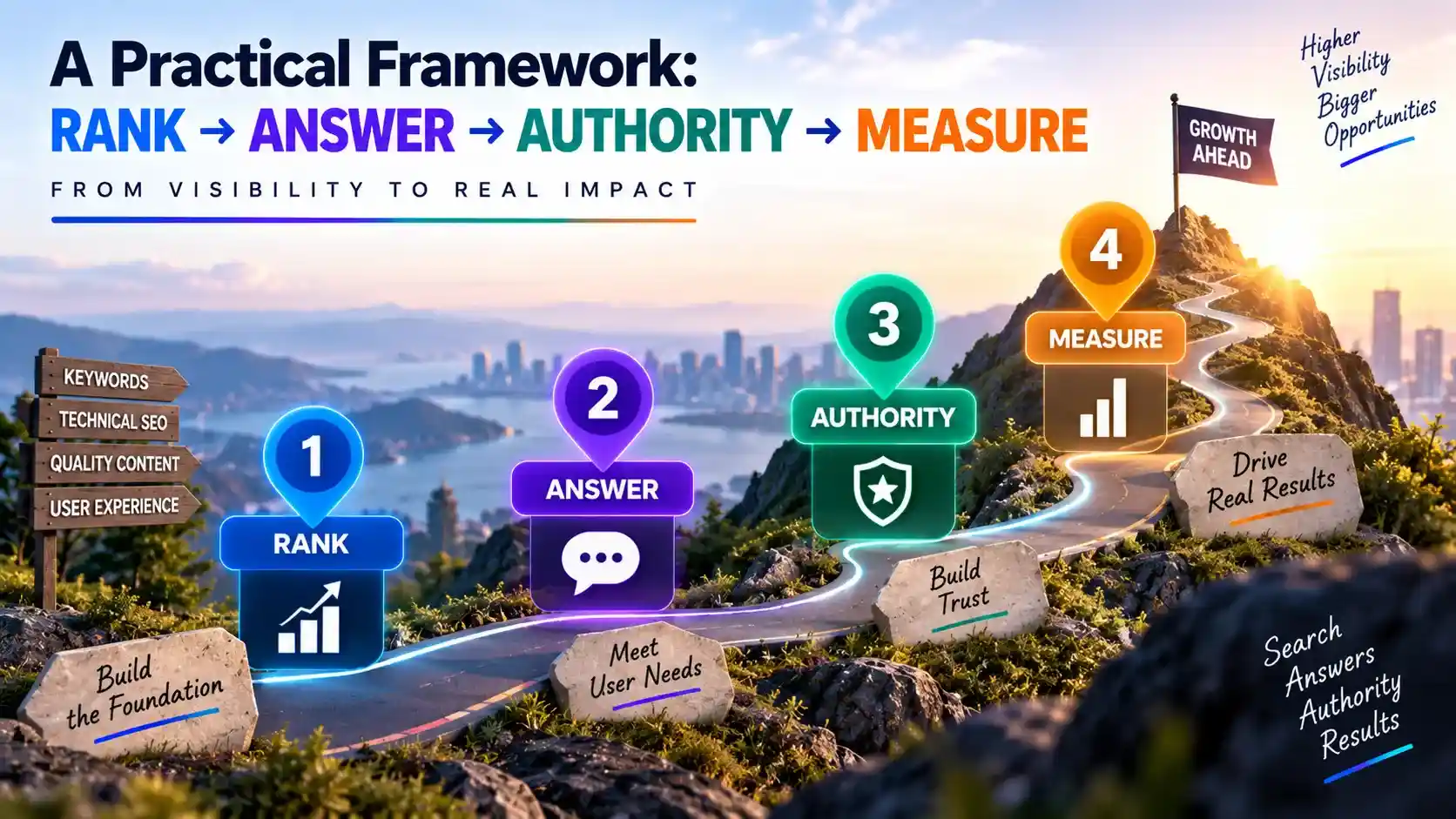
For businesses that already rank well but aren’t appearing in AI Overviews, I recommend thinking through four stages.
Protect the traditional SEO foundation.
Improve the content’s ability to solve user questions.
Strengthen the reason the source should be trusted.
Track:
This creates a practical bridge between SEO and AI search.
If your website ranks well but doesn’t appear in AI Overviews, avoid these knee-jerk reactions:
It may already have valuable authority.
You could simply split your authority.
It won’t solve an information problem.
Question quantity isn’t the objective.
Google doesn’t require special schema for AI Overviews or AI Mode.
More URLs aren’t automatically more authority.
Traditional SEO remains foundational.
If your website ranks #1 but isn’t appearing in an AI Overview, don’t ask:
“What AI SEO trick are we missing?”
Ask:
“What does the cited source provide that our page doesn’t?”
That question changes the entire audit.
Maybe the competitor:
Once you identify the gap, you can improve the actual asset.
Traditional SEO isn’t disappearing.
But the definition of visibility is expanding.
A business can now be discovered through:
Google’s AI search developments reinforce this shift toward longer, more complex and conversational searches.
This means businesses should stop thinking of search as one page of results.
Search is becoming an ecosystem.
This is the mindset I would encourage businesses to adopt.
Don’t approach AI Overview optimization as:
“How can we force Google to cite us?”
Approach it as:
“How can we become one of the most useful, authoritative and relevant sources for this question?”
If your content deserves to be cited, you’ve built something valuable regardless of whether a particular AI Overview appears today.
That’s a much more sustainable strategy.
At MetaSense Marketing, we approach AI-search visibility as an extension of strong SEO, not as a collection of shortcuts.
If your website already ranks well but isn’t appearing in AI Overviews, our approach can begin with a structured diagnostic:
Query Analysis → AI Overview Research → Competitor Comparison → Content Gap Analysis → Search Intent → Topical Authority → Content Restructuring → Internal Linking → Technical SEO → Brand Authority → Measurement
We examine the difference between what your website currently provides and what the search ecosystem appears to value for the specific questions you want to own.
Our work can include:
MetaSense also has iMetaDex™, its patented AI-driven SEO technology, which the company positions as part of its technology-driven approach to improving Google visibility.
The objective isn’t to chase every new AI-search feature.
It is to build a website and digital presence that can perform across an increasingly complex search environment.
If your website ranks on Google but doesn’t appear in AI Overviews, don’t assume your SEO has failed.
Your traditional SEO performance and AI Overview visibility represent different layers of search visibility.
The page may already have:
But it may still need:
The solution isn’t to abandon SEO.
It’s to build on it.
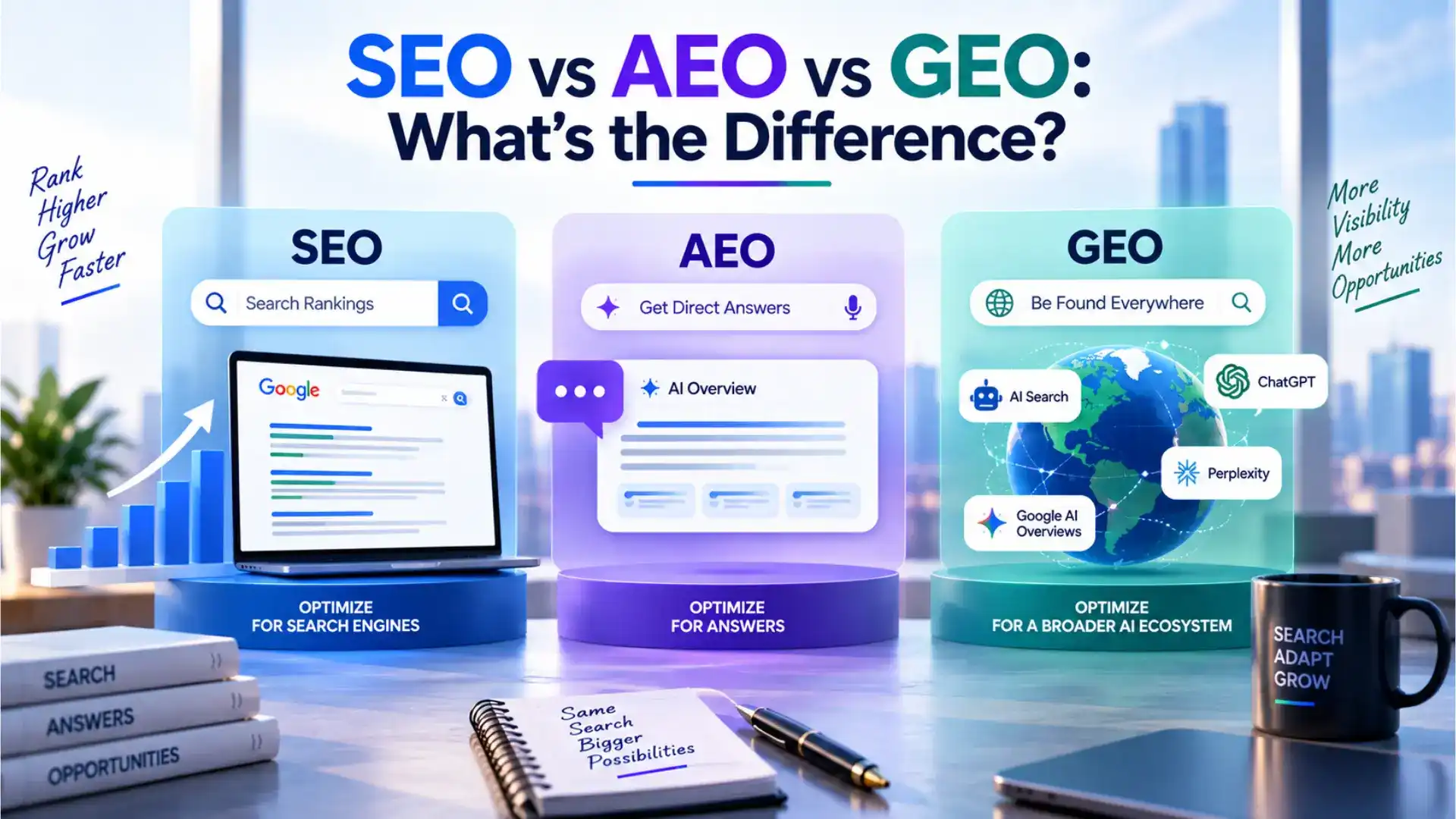
SEO helps your website become discoverable. AEO helps make your content answer-worthy. GEO helps strengthen your visibility within generative search experiences.
The businesses that adapt successfully will not simply create more content.
They will create better answers.
And they will connect those answers to measurable business outcomes.
At MetaSense Marketing, that’s the approach we believe matters most:
Don’t optimize just to rank. Optimize to become the source worth finding, understanding, citing and trusting.
If your website is ranking well but competitors are appearing in AI Overviews while you aren’t, MetaSense Marketing can help identify the visibility gap and develop an integrated SEO, AEO and GEO strategy designed to turn search visibility into measurable business growth.
Yes. Ranking well in traditional organic search does not guarantee that a page will be selected as a source for an AI Overview.
Possible reasons include search-intent mismatch, incomplete answers, weak topical coverage, limited original information, insufficient first-hand expertise, stronger competing sources, weak supporting content, or technical accessibility issues.
No. A high organic ranking can be helpful, but it does not guarantee AI Overview inclusion.
No. Google says there are no special technical requirements or special schema specifically required for AI Overviews or AI Mode.
FAQ content can be useful when it answers genuine questions, but FAQ schema should not be treated as a guarantee of AI Overview inclusion.
You should not treat llms.txt as a prerequisite for AI Overview visibility. Focus first on technical SEO, useful content, topical authority, internal linking and expertise.
Not necessarily. More useful, relevant and authoritative content can strengthen topical coverage, but publishing large amounts of low-value content does not automatically improve AI visibility.
Not necessarily. The important consideration is the quality, usefulness, originality, accuracy and expertise of the final content. AI can be used as a productivity tool, but generic mass-produced content is unlikely to provide a sustainable competitive advantage.
Start by identifying the exact queries where competitors are being cited. Compare their content with yours, analyze search intent, identify content gaps, improve answer clarity, strengthen topical coverage, demonstrate expertise, improve internal linking, address technical issues and build broader authority.
Not automatically. If your existing page already ranks well and has authority, improving that page may be more effective than creating another URL targeting the same intent.
Topical authority can be an important part of the broader picture. A website with comprehensive, interconnected and authoritative coverage can provide stronger contextual signals than a website with isolated pages.
There is no simple “backlinks = AI Overview” formula. Relevant authority and external recognition remain useful components of a broader SEO and brand strategy, but no specific backlink quantity guarantees AI Overview visibility.
Monitor the specific questions and queries that matter to your business. Record which companies and pages are cited and compare their content, authority and topical coverage with your own.
Track AI citations and visibility where data is available, along with traditional organic metrics such as impressions, clicks and traffic. Most importantly, connect visibility to qualified leads, conversions and revenue. Google is also introducing generative-AI performance reporting through Search Console for AI features such as AI Overviews and AI Mode.