Search is changing faster than most businesses realize.
For years, the primary objective of search marketing was relatively straightforward: identify keywords, optimize pages, build authority, improve rankings, generate organic traffic, and convert that traffic into customers.
That model still matters.
But the way people discover information is expanding.
A person searching for an SEO agency may no longer type only:
“SEO agency”
They may ask:
“What should I look for when choosing an SEO agency for a B2B company?”
Or:
“Which SEO agencies are best for a healthcare organization in the U.S.?”
Or:
“What is the difference between an SEO agency and an AI search optimization agency?”
Instead of simply returning a list of webpages, modern search experiences can synthesize information, provide direct answers, link to supporting sources, and allow users to continue asking follow-up questions.
Google’s AI Overviews and AI Mode are central examples. Google says AI Mode is designed for longer, more complex and nuanced questions and uses a technique called query fan-out, which breaks a question into related searches and explores multiple subtopics before producing a response.
At the same time, platforms such as ChatGPT and Perplexity are changing how people research products, companies, services, and solutions.
This has led to three increasingly common terms in digital marketing:
But what do these terms actually mean?
Are SEO, AEO, and GEO three different strategies?
Does AEO replace SEO?
Is GEO only about ChatGPT?
Do businesses need three separate marketing campaigns?
And most importantly:
Which one should your business invest in?
The answer is more nuanced than simply choosing one.
At MetaSense Marketing, we view SEO, AEO, and GEO as interconnected components of a modern search strategy. SEO provides the foundation, AEO focuses on becoming a useful answer and source, while GEO expands the objective toward visibility within generative AI experiences.
This guide explains the differences, similarities, practical applications, metrics, examples, and the approach businesses can take to compete across the evolving search landscape.
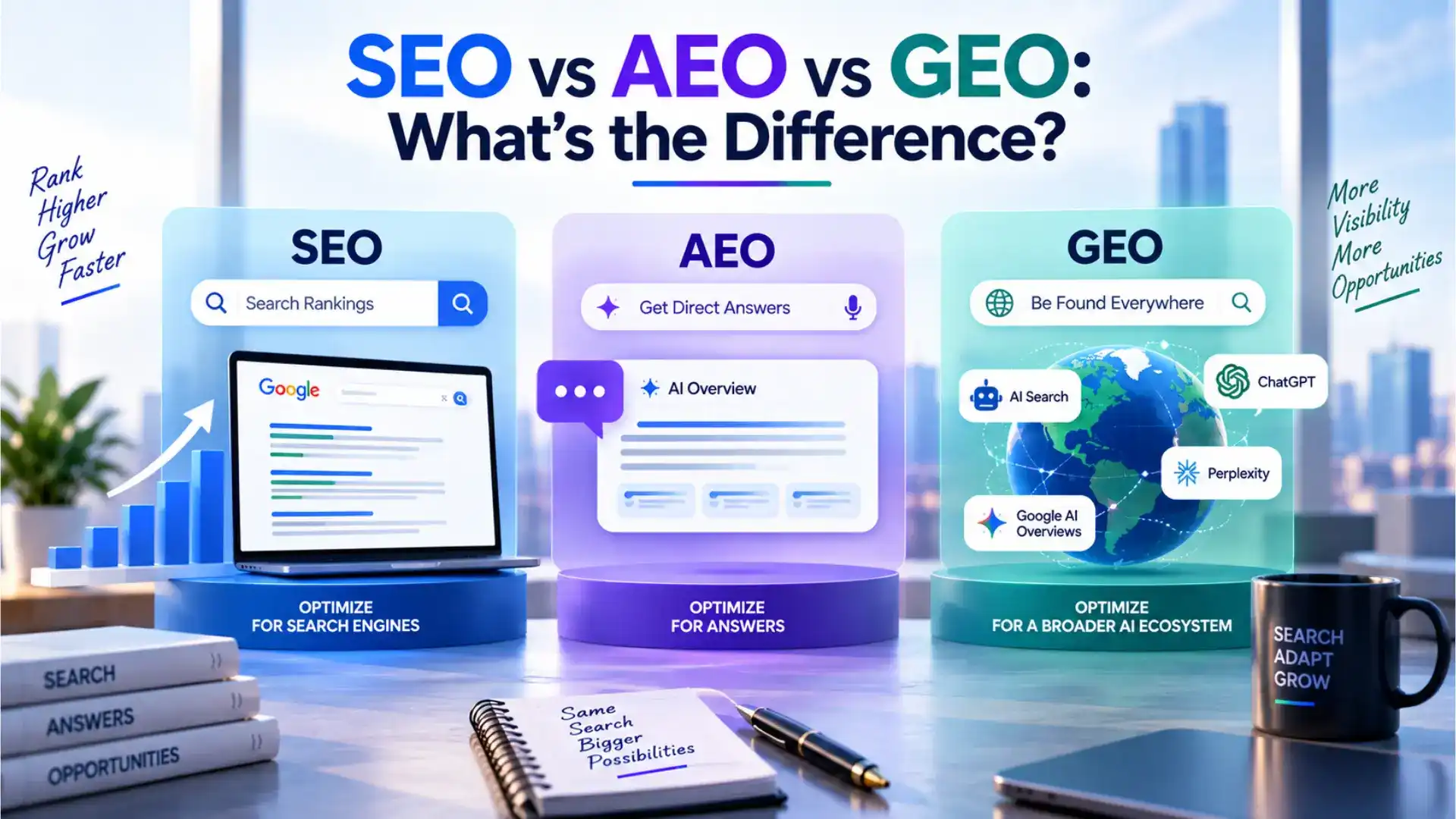
Before going deeper, here’s the simplest comparison:
| Strategy | Full Form | Primary Objective | Typical Visibility |
| SEO | Search Engine Optimization | Improve organic search visibility | Traditional search results |
| AEO | Answer Engine Optimization | Make content useful as an answer/source | Featured snippets, AI Overviews, answer experiences |
| GEO | Generative Engine Optimization | Increase brand/content visibility in generative AI experiences | AI-generated answers, citations, mentions, recommendations |
These aren’t isolated silos.
They overlap.
A strong SEO foundation can support AEO.
A strong AEO content strategy can contribute to broader generative-search visibility.
And a strong GEO strategy generally benefits from having authoritative, well-structured content that search systems can discover and understand.
The difference is primarily what you are optimizing for and how you measure success.
SEO stands for Search Engine Optimization.
SEO is the broader discipline of improving a website’s visibility in search engines and attracting relevant organic traffic.
Traditional SEO involves many areas, including:
The traditional SEO journey can be simplified as:
Search query → Search results → Website → Conversion
For example, someone searches:
“IT staffing agency in the U.S.”
An SEO strategy may identify the search intent, develop an optimized service page, improve the site’s technical foundation, build internal links, establish authority, and earn relevant external references.
The goal is to increase the probability that the page appears prominently when someone searches for the relevant topic.
One of the biggest misconceptions about SEO is that it is simply inserting keywords into webpages.
Modern SEO is much broader.
Search engines need to understand:
That is why technical SEO, content quality, topical authority, internal linking, and brand authority remain important even as AI search becomes more prominent.
Google’s current documentation for generative AI features specifically says that established SEO practices continue to be relevant and that there are no special technical requirements or special schema required specifically for AI Overviews or AI Mode.
AEO stands for Answer Engine Optimization.
AEO focuses on optimizing content so that it can serve as a useful answer or source when people ask questions through answer-oriented search experiences.
The core question changes from:
“What keyword do I want to rank for?”
to:
“What question is my audience asking, and can my website provide the best answer?”
For example, an IT staffing company shouldn’t optimize only for:
“IT staffing agency”
It should also understand questions such as:
This creates an answer ecosystem around the subject.
AEO therefore places considerable emphasis on:
The fundamental idea behind AEO
AEO can be summarized as:
Question → Useful answer → Source/citation → Website
The objective isn’t to manipulate an answer engine.
It is to make your content useful enough that an answer engine has a reason to retrieve, reference, or surface it.
GEO stands for Generative Engine Optimization.
GEO focuses on improving a brand’s visibility within generative AI experiences.
This can include situations where an AI system:
For example, imagine someone asks an AI platform:
“What are the best IT staffing agencies for healthcare companies?”
A GEO-focused strategy asks:
Is my brand understood as a relevant and credible healthcare IT staffing provider?
That requires more than one optimized webpage.
It can involve:
GEO therefore moves beyond individual keyword rankings and considers the broader digital identity and authority of a brand.
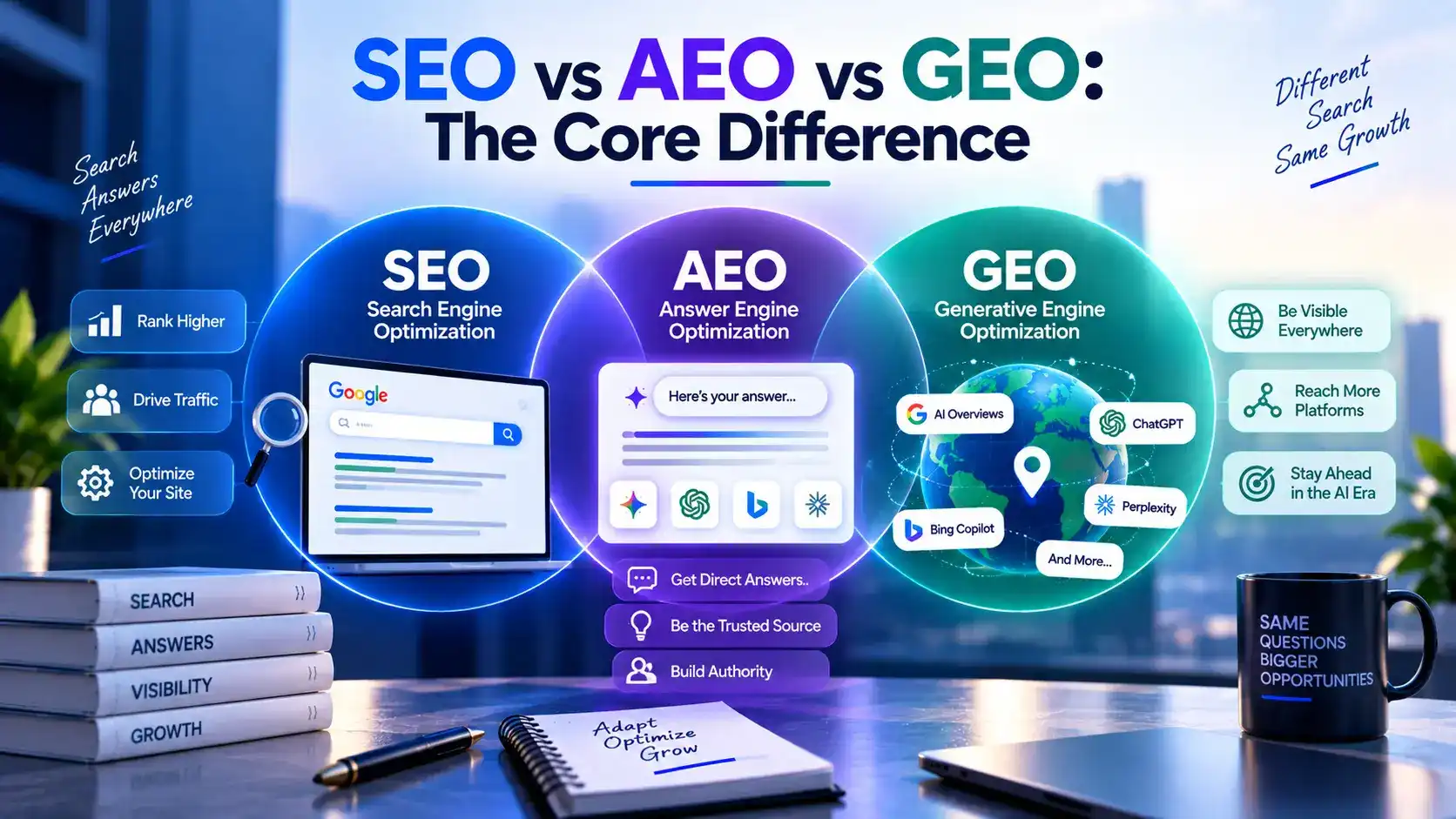
The easiest way to understand the distinction is to look at the question each strategy asks.
SEO asks:
“How can we improve our visibility in search results?”
AEO asks:
“How can we become a useful answer or source for the questions our audience asks?”
GEO asks:
“How can we make our brand and expertise visible and recognizable within generative AI experiences?”
That leads to three different but interconnected objectives.
SEO = Search visibility
AEO = Answer visibility
GEO = Generative visibility
Let’s take the query:
“What is the best IT staffing agency for healthcare organizations?”
Now let’s see how each strategy approaches it.
The SEO team may target:
IT staffing agency for healthcare
The page would be optimized for:
The objective is to rank organically.
The content strategy expands the question.
The page might answer:
The objective is to provide clear answers to the user’s information needs.
The strategy expands beyond the page.
It asks:
The objective is to strengthen the brand’s overall presence within generative discovery.
This is an important point.
You don’t necessarily need three separate pages for SEO, AEO, and GEO.
One excellent page can contribute to all three.
For example, a healthcare staffing guide could:
The difference is in how the content is researched, structured, promoted, connected, and measured.
This is why I would not recommend businesses create completely separate SEO, AEO, and GEO departments simply because the terminology is different.
Instead, build an integrated strategy.
One of the biggest misconceptions about AEO and GEO is:
“Traditional SEO is dead.”
I don’t agree.
Google’s own guidance makes this particularly clear.
Google’s current generative-AI documentation emphasizes that the same foundational SEO practices remain relevant to AI search experiences. Its guidance also highlights the importance of valuable, unique content and warns against treating AEO/GEO as a collection of special technical tricks.
The fundamentals still matter:
Crawlability
Search systems need to be able to access your important content.
Indexability
Important pages need to be eligible for indexing.
Content quality
Your information needs to provide value.
Search intent
The page needs to address what the user actually wants.
Internal linking
Related information needs to be connected logically.
Authority
Your website and brand need credibility.
User experience
People need to be able to consume and navigate the information.
AEO and GEO don’t eliminate these requirements.
They build upon them.
The growth of conversational search makes question-focused content increasingly valuable.
Google says AI Mode users ask longer and more complex queries than traditional searches, and its query fan-out system can break complex questions into multiple related searches.
That has an important implication for content strategy.
If your website only targets:
“healthcare staffing”
you may miss dozens of questions around the topic.
But if your website covers:
you create a much stronger topical ecosystem.
This is where AEO and traditional topical SEO overlap.
A business can have excellent rankings and still have limited visibility in generative AI conversations.
Imagine someone asks:
“Which companies provide the best healthcare IT staffing services?”
An AI system may generate a response based on information it retrieves from multiple sources.
The question becomes:
Is your brand part of the information ecosystem surrounding that topic?
This is why GEO requires thinking about the entire digital footprint.
Consider:
The objective is to establish a consistent, credible association between:
Brand + Expertise + Industry + Services + Evidence
Traditional keyword research often begins with:
These are still useful.
But AEO research adds:
GEO research goes broader again.
You want to understand:
The result is a much broader understanding of search demand.
Traditional SEO content might prioritize:
AEO content adds:
GEO content expands further:
The best content often incorporates all three.
FAQs can be useful.
But they are not an AEO shortcut.
Adding 100 questions to a page doesn’t automatically make it answer-engine optimized.
The questions should represent real user needs.
For example, a plumbing business could answer:
Why is my water heater leaking?
How much does water heater repair cost?
When should I replace my water heater?
Those are useful.
Adding dozens of variations such as:
What is plumbing?
What does a plumber do?
What is a plumbing company?
may not provide meaningful value if they don’t match the audience or page intent.
AEO should focus on information usefulness, not question quantity.
Structured data can help search engines understand eligible content, but it shouldn’t be treated as a guaranteed method for getting into AI Overviews.
Google’s current guidance explicitly says there are no special technical requirements or special schema needed for AI Overviews or AI Mode.
The correct approach is:
Use structured data accurately where appropriate.
Don’t use it because someone promised:
“Add this schema and you’ll appear in AI Overviews.”
That’s an important distinction between sustainable SEO and search-engine folklore.
llms.txt is another frequently discussed topic in AI-search marketing.
But I wouldn’t make it the centerpiece of an AEO or GEO strategy.
If a website has:
an AI-specific file won’t solve the underlying problems.
Businesses should prioritize the fundamentals first.
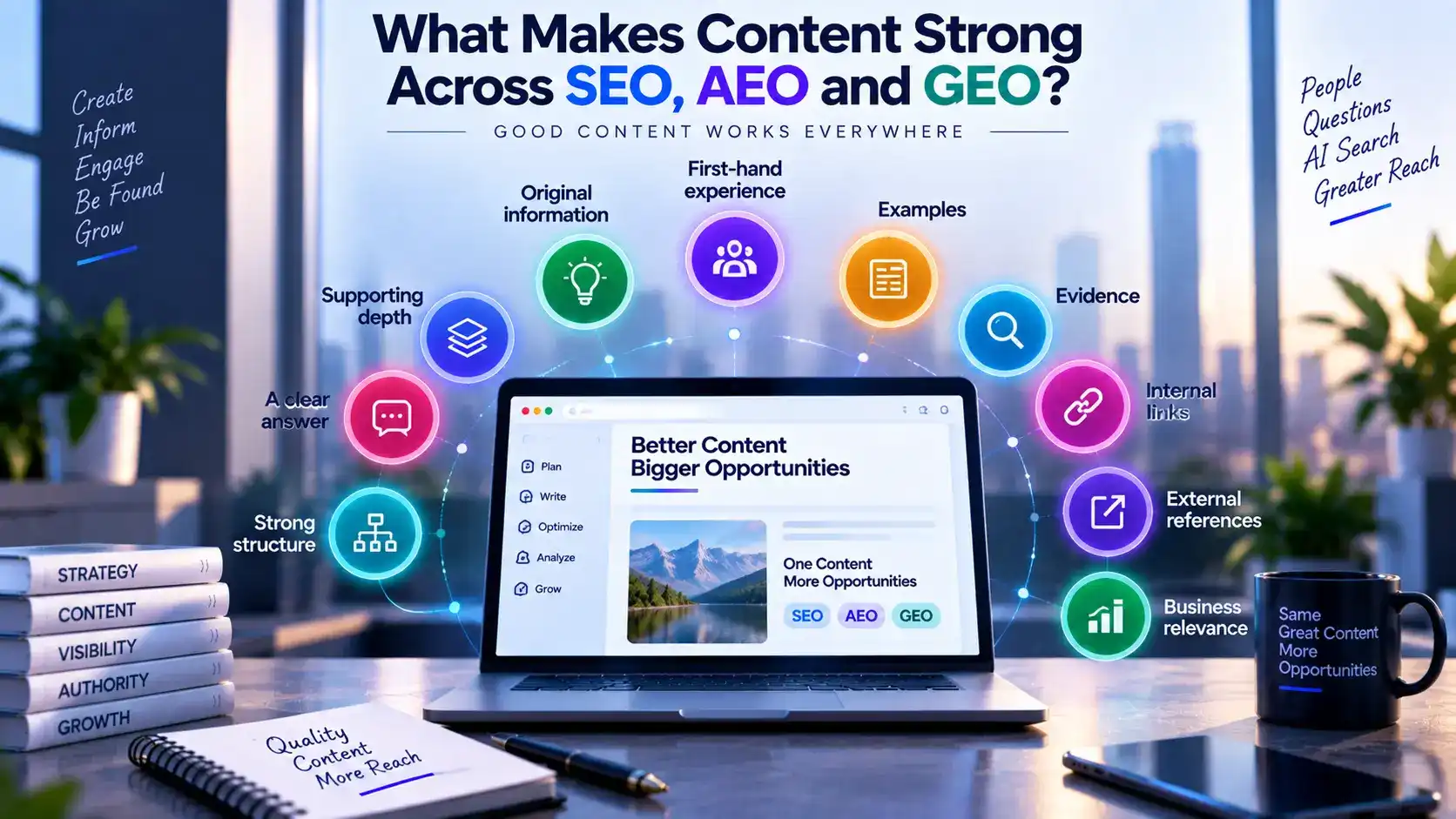
The strongest content usually contains several elements.
Tell the user what they need to know.
Explain the reasoning and context.
Provide something beyond generic summaries.
Show that someone with real expertise understands the subject.
Make abstract concepts practical.
Support important claims with credible sources or data.
Connect related information.
Support authority and context.
Make information easy to navigate.
Connect information to the user’s actual problem.
This is the type of content that can support multiple search experiences simultaneously.
Topical authority is particularly important because modern search is increasingly contextual.
Consider a company with one article about:
“What Is Healthcare Staffing?”
Compare that with a company that has 30 high-quality resources covering:
The second site provides much stronger evidence of subject-matter depth.
Topical authority isn’t about publishing as many pages as possible.
It is about building meaningful coverage around the subjects that matter to your audience and business.
Internal linking helps connect your content ecosystem.
Suppose you have:
Healthcare Staffing Services
linked to:
Healthcare Staffing Costs
which links to:
Temporary vs. Permanent Healthcare Staffing
which links to:
How to Choose a Healthcare Staffing Agency
This creates a logical information journey.
A visitor can move from:
Problem → Information → Comparison → Evaluation → Solution
That is valuable for SEO.
It is also useful for answer-focused content because related information is organized rather than isolated across disconnected URLs.
This may become one of the biggest differentiators between high-value content and commodity content.
Anyone can write:
“SEO is important for business growth.”
A senior SEO professional can explain:
That experience is difficult to reproduce through generic AI-generated content.
For MetaSense Marketing, client work itself can become a content asset.
Case studies, campaign insights, results, methodology, and expert opinions make the content more distinctive.
A practical example makes the difference between SEO and AEO much easier to understand.
MetaSense Marketing worked with Berks Plumbing & HVAC Specialist, focusing on improving visibility around plumbing and HVAC-related customer searches.
The strategy went beyond simply targeting service keywords.
We focused on understanding the questions potential customers were asking and developing content that addressed those questions.
The work involved areas such as:
The campaign produced several notable outcomes.
The website gained increased visibility around searches framed as customer questions.
The optimized content also achieved visibility in featured snippets.
The client’s content began appearing in Google AI Overview answers.
This is important because the strategy wasn’t based on trying to create an “AI Overview page.”
The focus was on producing useful information around the questions customers were actually asking.
The campaign contributed to an approximately 10× increase in traffic.
More importantly, lead generation increased by more than 2×.
This is the metric I would emphasize most strongly.
The objective of SEO, AEO, and GEO isn’t simply:
“Did we get an AI citation?”
The objective is:
“Did increased visibility create meaningful business growth?”
That’s the difference between optimizing for a search feature and optimizing for a business.
There are several lessons.
A person searching:
“Why is my water heater leaking?”
may appear to be performing informational research.
But they may need a plumber immediately.
Informational intent can become commercial intent very quickly.
The same content can potentially earn:
A page shouldn’t simply answer a question.
It should help the user determine the next appropriate step.
Visibility is useful.
Qualified leads are more useful.
Revenue is the ultimate outcome.
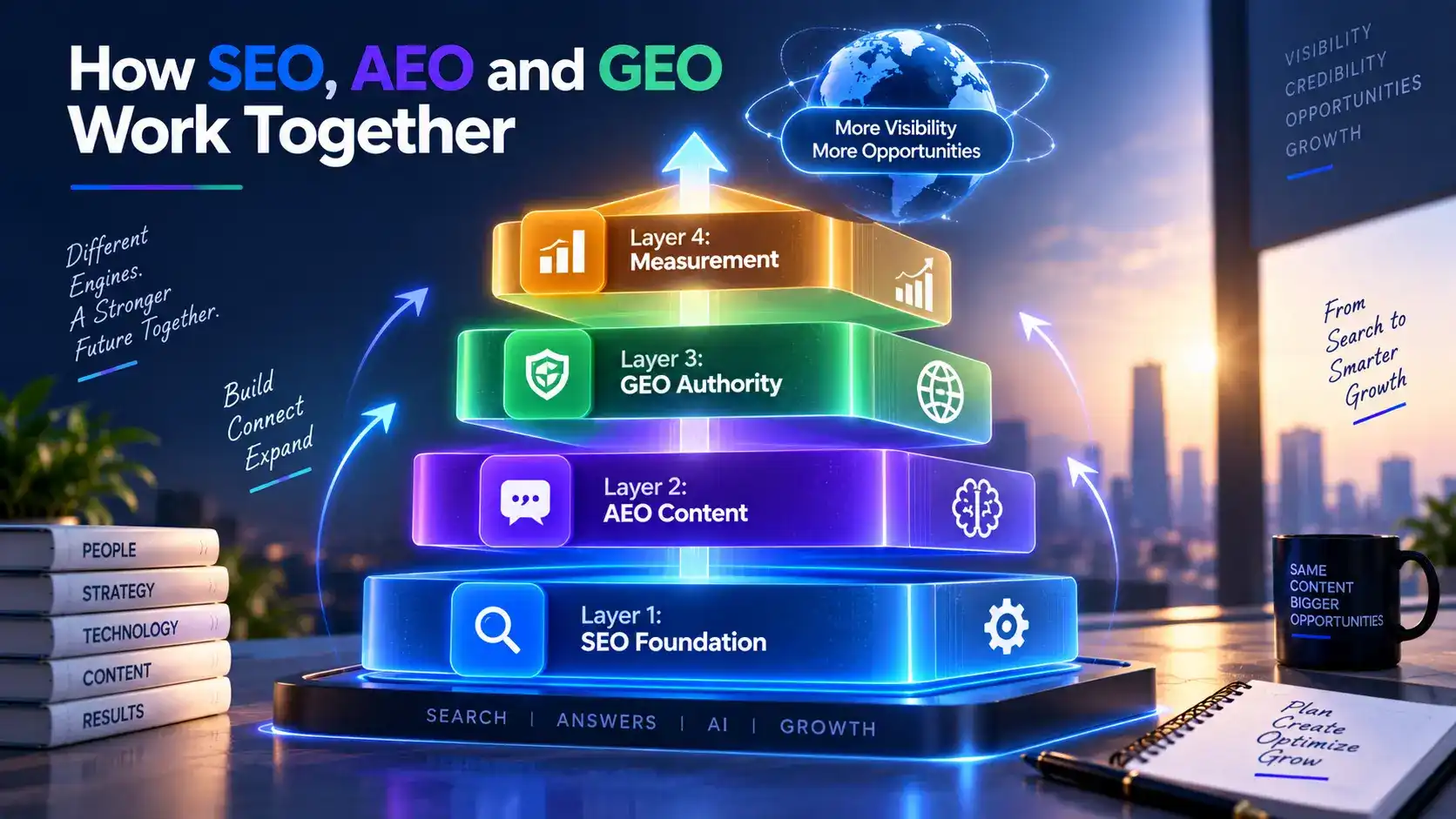
Think of the three strategies as layers.
Make the website technically sound.
Ensure:
Build answers around real customer questions.
Create:
Build the brand’s broader digital presence.
Develop:
Track:
This is an integrated search strategy.
The answer is:
Don’t choose only one.
The appropriate balance depends on the business.
Prioritize:
Prioritize:
Prioritize:
Prioritize:
The strategy should be customized to how your customers research and make decisions.
Traditional SEO measurement remains important.
Track:
These metrics tell you whether your website is gaining visibility and generating business from traditional search.
AEO requires additional metrics.
Consider:
Google has taken a major step toward this kind of measurement by introducing dedicated generative-AI performance reports in Search Console. Google says these reports can show impressions, pages, countries, devices, and performance over time for generative AI features such as AI Overviews and AI Mode. The rollout began with a subset of sites.
That development is significant because marketers can increasingly treat generative-search visibility as a measurable component of search performance.
GEO measurement is broader.
Track:
Is your website being used as a source?
Is your business being mentioned?
Does an AI system recommend your company when users ask for providers?
Does your brand appear when users ask:
“What are the best companies for X?”
Are competitors consistently being mentioned while your company isn’t?
Does AI-generated content correctly understand your:
This can be thought of as AI share of voice.
One important point businesses need to understand:
No legitimate SEO professional can guarantee:
“Your website will appear in every AI Overview.”
or:
“Your company will always be recommended by ChatGPT.”
AI systems change.
Search results change.
Queries change.
Sources change.
Competition changes.
Even Google’s own AI search experiences are continuously evolving. Google says it continues testing and improving how it ranks and displays links and supporting sources within generative AI experiences.
The correct objective is to increase the probability of visibility by building strong, useful, authoritative digital assets.
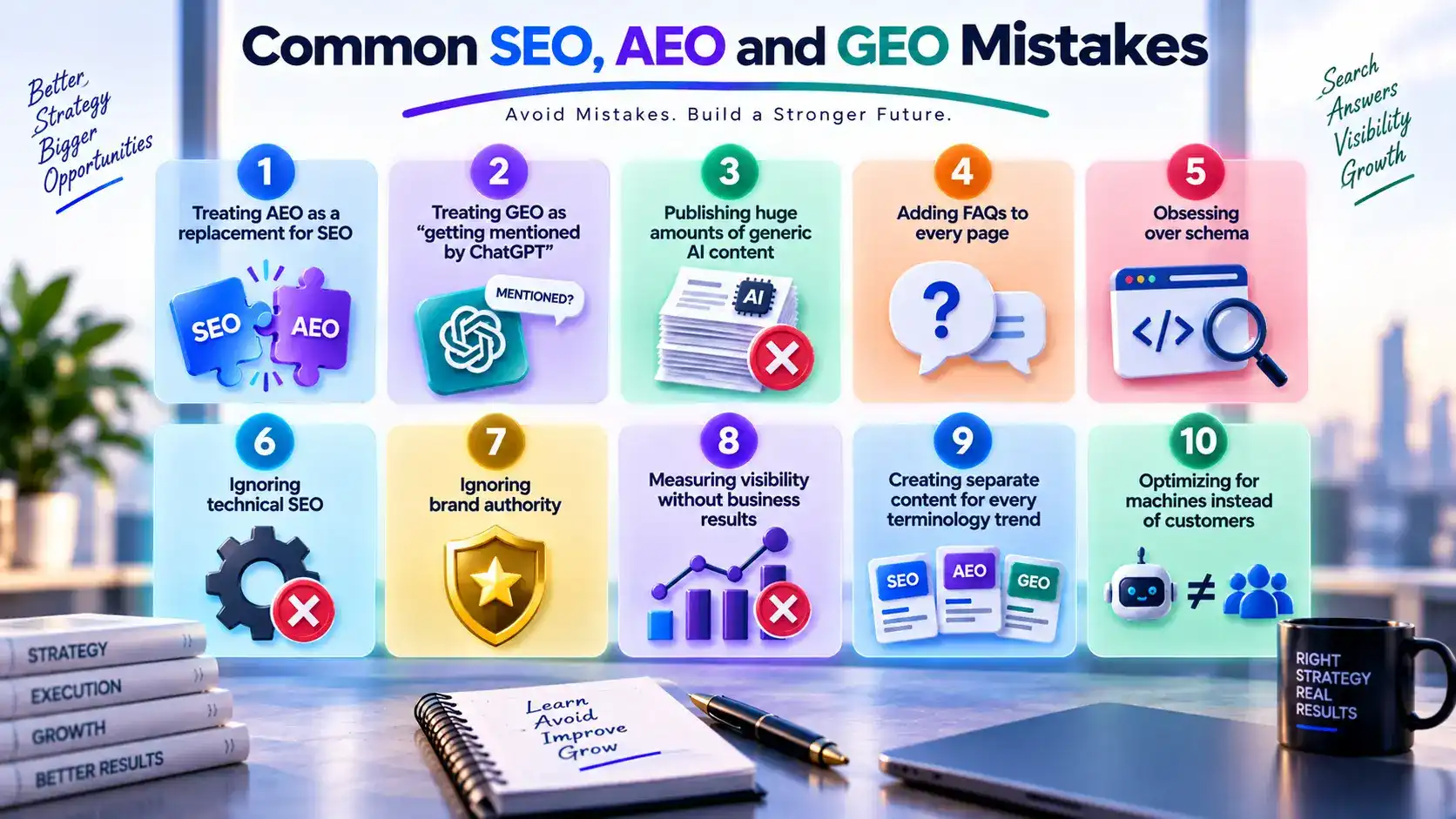
AEO needs strong foundations.
GEO is broader than one platform.
Volume doesn’t automatically create authority.
FAQs should solve real user problems.
Use structured data appropriately, but don’t treat it as an AI-search shortcut.
AI doesn’t eliminate crawlability or indexability.
Your website is only one part of your digital footprint.
Citations and rankings matter, but leads and revenue matter more.
Don’t create:
as completely disconnected silos.
Build a coherent topic strategy.
The customer should remain the center of the strategy.
This is an important area where businesses should separate marketing claims from search-engine guidance.
Google’s 2026 documentation specifically added guidance around generative AI features and includes a section addressing common AEO/GEO misconceptions. Google emphasizes that SEO best practices remain relevant and recommends providing unique, valuable content rather than focusing on special AI-only optimization techniques.
Google has also continued emphasizing original content and first-hand perspectives within AI Search. In May 2026, Google announced new ways for users to find original content and firsthand perspectives in AI Overviews and AI Mode, including a “Highly Cited” badge for some search results.
For SEO professionals, the takeaway is clear:
Don’t chase gimmicks. Build information worth discovering.
Google isn’t the only search environment marketers need to consider.
ChatGPT Search can search the web and provide links to relevant sources. OpenAI says ChatGPT can automatically search the web when a question would benefit from current information and that search responses can include links to relevant web sources.
This means brands also need to consider whether their websites and broader online presence can be discovered in AI-powered research environments.
The fundamental principles remain familiar:
Again, there isn’t one “ChatGPT SEO trick.”
There is a broader requirement to build a credible digital presence.
One major difference between traditional SEO and GEO is the importance of thinking beyond your own domain.
Suppose a company claims:
“We are one of the leading healthcare staffing agencies.”
That’s a self-description.
Now imagine multiple credible industry sources discuss the company as an established healthcare staffing provider.
That creates a stronger external signal.
Relevant brand mentions can come from:
Not every mention has equal value.
Relevance and credibility matter.
The goal isn’t to generate thousands of random mentions.
It is to build meaningful associations between your brand and the subjects you want to be known for.
A practical strategy can follow these stages.
Review:
Determine:
Understand traditional search demand.
Identify what customers ask before making decisions.
Classify:
Connect related questions into comprehensive topic ecosystems.
Give clear answers and supporting depth.
Include:
Develop relevant external references and mentions.
Track traditional search and AI visibility.
Measure:
Traffic → Leads → Customers → Revenue
Search is not static.
Neither should your strategy be.
If you need to remember only one framework, use this:
Be discoverable.
Make sure search engines can find, understand and rank your content.
Be answer-worthy.
Make sure your content directly solves the questions your audience asks.
Be recognizable.
Make sure your brand, expertise and information are strong enough to be understood, cited, mentioned or recommended within generative AI experiences.
Together:
Be discoverable. Be answer-worthy. Be recognizable.
The title of this article asks:
SEO vs AEO vs GEO: What’s the Difference?
But from a practical business perspective, I don’t think the future is about choosing one.
The future is about integrating them.
SEO provides the foundation.
AEO helps businesses adapt to question-based and answer-driven discovery.
GEO expands that visibility into generative AI environments.
The boundaries between the three will continue to overlap.
Google itself is moving toward a more conversational search experience. In 2026, Google said AI Mode had surpassed one billion monthly active users and that AI Mode queries had more than doubled every quarter since launch. Google also described a unified experience connecting AI Overviews and AI Mode with links to web content.
The implication for businesses is significant.
People are not necessarily abandoning search.
They are searching differently.
They are asking longer questions.
They are asking follow-ups.
They are comparing options.
They are looking for recommendations.
They are asking AI systems to synthesize information.
And they still need trustworthy sources.
Businesses should stop thinking only in terms of:
“Which keywords do we rank for?”
Instead, ask:
What questions do our customers ask?
What answers do they need?
Does our website provide those answers?
Is our expertise obvious?
Is our content original?
Are our topics connected?
Does our brand have authority outside our website?
Are we appearing in AI-generated answers?
Are we being cited?
Are we being mentioned?
Are we being recommended?
Is that visibility producing customers?
These questions create a much more complete view of search visibility.
At MetaSense Marketing, we don’t view SEO, AEO and GEO as three disconnected buzzwords.
We see them as part of the evolution of search.
Our approach can be summarized as:
SEO Foundation → Search Intent → Question Research → Content Strategy → Content Restructuring → Internal Linking → Topical Authority → Brand Mentions → AI Search Visibility → Measurement
The process starts with understanding the business and its customers.
We identify what people search for.
Then we identify what they ask.
Then we build content that answers those questions while supporting the business’s commercial objectives.
The strategy doesn’t stop at content.
We look at the broader digital ecosystem:
MetaSense also has its proprietary iMetaDex™ technology, which the company describes as patented AI-driven SEO technology designed to help businesses improve their Google visibility. MetaSense Marketing
The technology is part of a broader philosophy:
Use technology and data to make SEO more effective, but keep the strategy centered on business objectives and user needs.
SEO, AEO and GEO are different, but they are not competitors.
They represent different dimensions of modern search visibility.
SEO helps your website become discoverable in traditional search.
AEO helps your content become a useful answer to customer questions.
GEO helps your brand become visible within generative AI experiences through citations, mentions, recommendations and broader digital authority.
The strongest strategy combines all three.
If you only focus on rankings, you may miss emerging answer-driven search experiences.
If you only focus on AEO, you may overlook the technical and authority foundations that support search visibility.
If you only focus on GEO, you may end up chasing AI platforms instead of building a durable digital presence.
The better approach is:
Build a technically strong website. Create genuinely useful content. Answer real customer questions. Establish topical authority. Demonstrate first-hand expertise. Build credible brand mentions. Measure both search and AI visibility. Then connect that visibility to leads and revenue.
That’s the modern search strategy.
And ultimately, the question isn’t:
“Should my business do SEO, AEO, or GEO?”
The better question is:
“How can my business become easier to discover, easier to understand, and more trusted across every search experience my customers use?”
That’s where SEO, AEO, and GEO come together.
Neither is inherently better. SEO and AEO solve related but somewhat different visibility problems. SEO remains the foundation for organic search, while AEO focuses more heavily on answering user questions and gaining visibility in answer-driven experiences.
No. AEO should generally be viewed as an extension of modern SEO rather than a replacement. Google’s own guidance continues to emphasize traditional SEO fundamentals for its generative AI search experiences.
AEO focuses primarily on becoming a useful answer or source for questions. GEO focuses more broadly on visibility within generative AI experiences, including brand mentions, citations, recommendations and associations.
Yes. Strong technical SEO, crawlability, indexability, content quality, internal linking, topical authority and search intent can all support AEO.
Yes. SEO can help establish the content, authority and digital footprint that contribute to broader AI-search visibility.
Not necessarily. Most businesses should develop an integrated strategy rather than three disconnected campaigns.
No. FAQs can be useful when they address genuine user questions, but AEO is much broader than FAQs.
No. Google states that there are no special technical requirements or special schema required specifically for AI Overviews or AI Mode.
There is no reason to treat llms.txt as the foundation of a GEO strategy. Businesses should prioritize strong technical SEO, useful content, topical authority, expertise and credible digital presence.
Track question-based visibility, featured snippets, AI Overview visibility, AI Mode visibility, citations, cited pages and relevant organic traffic and conversions.
Track AI citations, brand mentions, recommendations, category visibility, competitive visibility and ultimately the traffic, leads and conversions associated with AI-driven discovery.
Yes. When question-focused content addresses problems that are connected to a customer’s buying journey, it can attract qualified prospects. MetaSense Marketing’s work with Berks Plumbing & HVAC Specialist is one example, where the campaign contributed to approximately 10× traffic growth and more than 2× lead generation.
There is no universal timeframe. Results depend on the site’s technical condition, existing authority, competition, content quality, industry, search demand and scope of work. Some improvements can occur quickly, while building meaningful authority can take much longer.
Useful content that answers real questions clearly and comprehensively is a strong starting point. Guides, service pages, comparisons, FAQs, how-to content, research, case studies and expert resources can all contribute.
GEO benefits from authoritative content, original insights, first-hand experience, case studies, research, expert commentary, strong topical coverage and credible third-party references.
Yes. Keywords remain useful for understanding demand and search language. However, modern research should expand beyond individual keywords to include questions, topics, entities, intent and the broader customer journey.
There is no single AI-search trick. A durable strategy combines technical SEO, useful content, topical authority, direct answers, first-hand expertise, internal linking, strong brand authority and continuous measurement.
MetaSense Marketing can develop an integrated strategy covering technical SEO, search-intent research, question research, content strategy, content restructuring, internal linking, topical authority, brand visibility and AI-search optimization. The objective is to improve discoverability, answer visibility, brand authority and measurable business outcomes.
Want to understand where your website stands across SEO, AEO and GEO? Connect with MetaSense Marketing to develop a search strategy designed around your audience, industry, competitive landscape and business goals.