Google Search is changing. Instead of always returning a list of blue links, Google can now use artificial intelligence to understand a complex query, gather information from multiple sources, and provide an AI-generated response with links to relevant websites.
For businesses competing for visibility in the U.S. market, this creates an important question:
The answer is not to abandon traditional SEO or create a separate set of “AI-only” tricks.
Google’s current guidance is clear: the SEO fundamentals that help pages perform in traditional Search remain important for AI Overviews and AI Mode. Google’s generative AI experiences use information from its Search index, meaning your website still needs to be crawlable, indexable, useful, authoritative, and relevant to the searcher’s needs.
But the way users search is evolving.
People are asking longer questions, combining multiple needs into a single query, asking follow-up questions, comparing options, and expecting more complete answers.
That means businesses need to think beyond simply ranking for individual keywords.
At MetaSense Marketing, our approach is to look at SEO as a broader visibility and business-growth system. Our experience developing and applying the patented iMetaDex™ technology for MetaSense demonstrates why search visibility requires more than publishing content and hoping Google finds it. MetaSense has used SEO to generate visibility for its own staffing business, including achieving first-page visibility for multiple keywords and driving meaningful organic traffic.
In 2026, that same principle applies to AI-powered search: build a website that gives Google strong information to understand, retrieve, and recommend, and give users a compelling reason to visit.
Google AI Overviews are AI-generated summaries that appear within Google Search for certain queries.
Rather than requiring users to open multiple pages to understand a topic, Google can synthesize information and provide a summary alongside links to supporting sources.
Google also offers AI Mode, which provides a more conversational search experience for complex questions and follow-up exploration.
Under the hood, Google’s generative AI search experiences can use techniques such as retrieval-augmented generation and query fan-out. Query fan-out allows Google’s systems to explore related searches to gather additional information that may help answer a complex question.
For example, someone searching:
“What is the best digital marketing strategy for a healthcare staffing company in the U.S.?”
may effectively require Google to consider several related topics:
This is why optimizing one page around one keyword is becoming an increasingly limited SEO strategy.
Yes. Absolutely.
This is one of the most important points marketers need to understand in 2026.
Google states that its generative AI features are rooted in its existing Search ranking and quality systems. Pages still need to meet Google’s technical requirements and be eligible for normal Search visibility before they can be considered for generative AI features.
So, AI Overviews have not replaced SEO.
They have expanded the search experience that SEO needs to serve.
Your website still needs:
The difference is that your content now needs to work well for more complex information retrieval and answer-generation experiences.
Understanding this process helps explain why certain SEO practices matter.
Google’s generative AI systems can retrieve relevant information from its Search index and use that information to construct responses. Google describes this as retrieval-augmented generation, where Search systems retrieve relevant pages and the AI uses information from those sources to provide grounded responses with supporting links.
For more complicated searches, Google can also use query fan-out.
Imagine someone asks:
“How should a small U.S. business choose an SEO agency in 2026?”
Google may need information about:
This creates an opportunity for websites that comprehensively cover a subject.
Instead of trying to predict one exact AI Overview query, businesses should build deep, useful topical coverage.
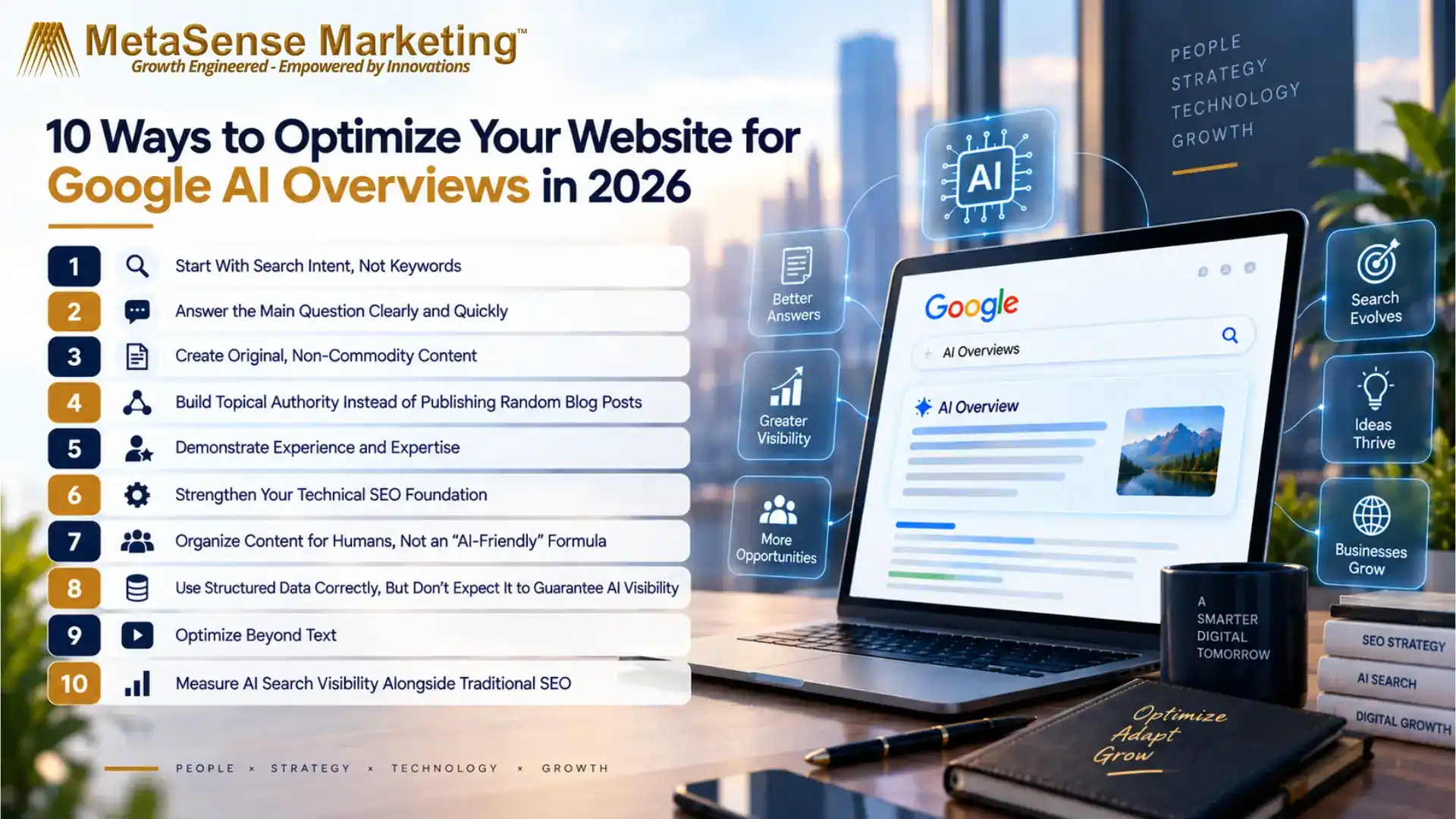
Keywords still matter, but they should not be the starting point for your entire content strategy.
Start with the question:
What is the user actually trying to accomplish?
A person searching “SEO agency” could be researching agencies.
Another person searching “best SEO agency for healthcare companies” has a much more specific commercial intent.
Someone searching “how much does SEO cost for a small business?” is asking for pricing information.
Someone searching “why is my website traffic declining?” has a diagnostic intent.
These searches may overlap in keywords but represent completely different needs.
Your content should answer the underlying intent, not simply repeat the keyword.
A useful framework is:
Keyword → Intent → Question → Supporting questions → Action
For every important topic, identify:
This creates content that is useful beyond a single search query.
AI search does not mean every article should become a collection of short answers.
However, important questions should be answered clearly.
If your H1 is:
How to Optimize Your Website for Google AI Overviews in 2026
don’t make the reader navigate through 800 words of background information before discovering the answer.
Give the reader a concise explanation early.
Then provide the depth, evidence, examples, and context needed to understand the subject.
A strong structure is:
Direct answer → Explanation → Evidence → Example → Practical action
This benefits both users and search engines.
It also makes your content easier to navigate when users arrive from an AI-generated search result looking for a specific piece of information.
This may be the biggest content opportunity in AI search.
If hundreds of websites say essentially the same thing, creating the 501st version does not give Google, or the reader, a compelling reason to choose you.
Google’s 2026 guidance emphasizes unique, valuable, non-commodity content rather than content created simply to manipulate generative AI visibility.
Ask:
What can my company say that another website cannot easily copy?
That could include:
For MetaSense Marketing, this is particularly important.
Our SEO perspective is not based only on theoretical marketing concepts. MetaSense developed iMetaDex™ from the practical experience of using SEO to grow its own staffing business and help smaller businesses compete digitally.
That type of experience creates content that is harder to commoditize.
A website that publishes 50 unrelated articles is not necessarily more authoritative than one that comprehensively covers a few important subjects.
Suppose a U.S. healthcare staffing company wants to build organic visibility.
Instead of publishing:
It could build a healthcare staffing marketing topic cluster around:
Healthcare Staffing Marketing
Supporting content could cover:
The pages should be connected through internal links and organized around clear topics.
This creates a stronger information architecture and helps establish comprehensive topical coverage.
AI can summarize information.
Your advantage is providing information that demonstrates why your organization is qualified to provide it.
Instead of saying:
“SEO is important for businesses.”
show the reader:
For example, a generic SEO article might say:
“Internal linking improves SEO.”
An expert-led article could explain:
“When we restructure a site with hundreds of service and location pages, we don’t treat internal links as a final optimization step. We map links according to topical relationships and user journeys so important pages receive contextual support from relevant content.”
The second statement communicates methodology and experience.
That’s much harder to manufacture with generic AI-generated content.
There is no special “AI Overview optimization switch.”
Your website still needs to be accessible to Google.
Google’s current guidance recommends maintaining fundamental technical SEO practices, including making pages crawlable and indexable, following JavaScript SEO best practices where applicable, providing a good page experience, and reducing unnecessary duplicate content.
Review:
Crawlability
Can Googlebot access the important content?
Indexability
Are your important pages eligible for indexing?
Robots.txt
Are you accidentally blocking valuable resources or pages?
Canonicalization
Are duplicate or similar URLs handled correctly?
Internal linking
Can Google discover important pages through logical links?
JavaScript
Does important content remain accessible when JavaScript is involved?
Page experience
Does the website work properly on mobile and desktop?
Technical SEO is not glamorous.
But it is foundational.
A brilliant article that Google cannot properly access is still a visibility problem.
There is a growing market of advice claiming that websites need to format content in a specific way to become “AI-readable.”
Be careful.
Google’s current guidance specifically warns against chasing supposed AEO/GEO hacks. It says website owners can ignore tactics such as artificial content “chunking,” unnecessary AI text files such as llms.txt, and attempts to manufacture inauthentic mentions.
Instead, use normal good information architecture.
Use:
The goal is not to make content look like it was written for a machine.
The goal is to make information easy for people to understand and easy for search systems to interpret.
Structured data can help search engines understand certain types of content and entities.
But marketers should not treat schema markup as a secret mechanism for getting into AI Overviews.
Google’s guidance does not require special schema for AI Overviews or AI Mode.
Use structured data when it accurately represents your content and is supported by Google’s documentation.
Do not add schema simply because someone claims:
“This schema will make ChatGPT or Google AI cite your website.”
There is no legitimate guarantee of that.
Structured data should support a sound SEO strategy, not replace one.
Search is increasingly multimodal.
Users can search with images, videos, products, local information, and other formats.
Google’s guidance recommends supporting textual content with high-quality images and videos where appropriate and keeping business information such as Merchant Center and Business Profile data accurate when relevant.
For a U.S. local or service business, this can mean maintaining:
For e-commerce, product information becomes especially important.
For professional services, original diagrams, screenshots, videos, research, and examples can make a page substantially more useful.
The principle is simple:
Don’t build a website consisting entirely of undifferentiated blocks of text.
One of the biggest mistakes marketers can make in 2026 is defining SEO success as:
“Did we get an AI Overview citation?”
That is too narrow.
You should measure the complete business impact of organic search.
Look at:
Google introduced dedicated generative AI performance reporting in Search Console in June 2026, providing visibility into impressions, pages, countries, devices, and dates associated with generative AI features such as AI Overviews and AI Mode. Google initially began rolling these reports out to a subset of websites.
This gives SEO teams another useful layer of measurement.
But the ultimate KPI should remain business value.
A page generating 500 highly qualified visits can be more valuable than a page generating 50,000 low-intent visits.
The AI-search industry has produced plenty of theories about how websites should optimize for generative search.
Some are useful.
Others are unnecessary.
There is no magic tag that tells Google:
“Please put my page in the AI Overview.”
Google’s own guidance says not to chase artificial “chunking” strategies as an AEO/GEO hack.
Google specifically identifies unnecessary AI text files such as llms.txt among tactics that site owners can ignore for Google Search generative AI optimization.
More content does not automatically mean more authority.
If AI is used to create content, the standard should remain the same:
Is this genuinely useful, accurate, original, and created for people?
This is perhaps the biggest misconception.
Google explicitly says its SEO best practices remain relevant because generative AI features are grounded in Google’s core Search systems.
No.
Traditional ranking position and inclusion in an AI-generated response are related to overall search visibility, but they should not be treated as identical outcomes.
Google can retrieve and cite different sources depending on the query, the information required, and the systems involved.
This is another reason why businesses should not obsess over a single ranking position.
Instead, build a website that is consistently useful across the entire topic.
If Google needs information about:
“How does healthcare staffing work?”
your website should have strong content around the subject.
If the next query becomes:
“What are the benefits of contract healthcare staffing?”
your site should be able to answer that too.
And if the user follows up with:
“How much does it cost?”
your content should provide useful, credible information there as well.
That is a much more durable search strategy.
At MetaSense Marketing, a useful way to think about modern SEO is through six stages:
Identify the topics, questions, entities, audiences, and search intents relevant to the business.
Evaluate technical SEO, existing rankings, content gaps, internal linking, competitors, and search visibility.
Create or improve content that provides genuinely useful information and demonstrates expertise.
Build relationships between pages through internal links and logical information architecture.
Monitor organic performance, conversions, visibility, and generative AI search signals where available.
Use performance data and changing search behavior to continuously refine the strategy.
This is fundamentally different from:
“Write an article, add keywords, publish it, and wait.”
Modern SEO requires an ongoing feedback loop.
Imagine a company has an article titled:
“Benefits of Digital Marketing”
The article contains 1,500 words of generic information.
It discusses:
There is nothing technically wrong with it.
But there is little reason for Google, or users, to consider it particularly valuable.
Now imagine transforming it into:
“Digital Marketing for U.S. Healthcare Staffing Companies: Strategies, Costs, and Lead Generation”
The new article could include:
The second article has a much clearer audience, intent, and purpose.
It also provides information that is more difficult for competitors to replicate.
That is the type of content businesses should be aiming to create.
AI can be extremely useful for SEO.
But there is a difference between using AI to improve your work and using AI to replace expertise.
AI can help with:
But human expertise remains essential for:
The strongest SEO teams will not necessarily be the teams producing the most AI-generated content.
They will be the teams that use AI to increase the quality and scale of human expertise.
MetaSense Marketing’s perspective on SEO comes from an unusual starting point: using search marketing to help grow a real operating business.
MetaSense developed its patented iMetaDex™ technology after seeing how SEO and digital marketing could help its staffing business compete for visibility against much larger organizations.
According to MetaSense, iMetaDex™ played an important role in generating organic visibility for MetaSense Staffing, including first-page rankings for multiple keywords and significant website traffic.
That experience matters because SEO should ultimately be connected to business outcomes.
The objective isn’t simply:
“Get more rankings.”
It is:
Get discovered → earn attention → attract qualified visitors → build trust → generate business.
Google AI Overviews change how the first part of that journey happens.
They do not eliminate the rest.
For businesses investing in digital marketing, that distinction is critical.
The conversation around AI Overviews sometimes makes it sound as though traditional search is disappearing.
A better way to understand the transition is that Search itself is becoming more intelligent and more conversational.
People can ask complicated questions.
Google can explore related searches.
AI can synthesize information.
Users can then click through to supporting sources and continue researching.
Google itself describes AI Overviews as a way to help users get the gist of complicated topics while providing links that allow them to explore further.
That means websites still have an important role.
But earning that click increasingly requires more than simply appearing in a ranking.
Your content has to provide something worth exploring.
The biggest mistake businesses can make in 2026 is treating Google AI Overviews as another algorithm to manipulate.
They are better understood as another interface through which Google connects users with information.
The winning strategy is therefore not:
“How do I trick AI into citing my website?”
It is:
“How can I make my website the most useful, credible, accessible, and authoritative source for the questions my customers are asking?”
That requires strong technical SEO.
It requires genuinely useful content.
It requires topical depth.
It requires first-hand expertise.
It requires original information.
It requires a logical website structure.
And increasingly, it requires measuring visibility beyond traditional blue-link rankings.
For businesses competing in the U.S. market, this is where an experienced SEO partner can make a meaningful difference.
MetaSense Marketing combines SEO expertise with its proprietary iMetaDex™ technology to help businesses strengthen their digital visibility and compete more effectively in search.
The future of SEO isn’t about optimizing instead of Google.
It’s about building a website that deserves to be found, whether the user encounters it through a traditional result, an AI Overview, AI Mode, or the next evolution of search.
Optimize for people. Build for search. Measure business impact.
That is the foundation for sustainable SEO in 2026.
Schedule a Call for Website Optimization
What is the best way to optimize for Google AI Overviews?
Start with foundational SEO: make your site crawlable and indexable, create useful and original content, satisfy search intent, demonstrate expertise, maintain strong internal linking and site architecture, and provide a good user experience. Google says there are no special technical requirements or special optimizations required specifically for AI Overviews.
Does Google AI Overview optimization replace SEO?
No. Google’s current documentation explicitly says SEO best practices remain relevant because generative AI features are grounded in Google’s core Search systems.
Does schema markup help websites appear in AI Overviews?
Use valid structured data where it accurately describes your content, but do not expect schema to guarantee AI Overview visibility. Google does not require special schema for AI Overviews or AI Mode.
Is llms.txt necessary for Google AI Overviews?
No. Google’s current generative AI SEO guidance specifically says site owners can ignore unnecessary AI text files such as llms.txt when optimizing for Google Search’s generative AI features.
Does AI-generated content hurt AI Overview visibility?
The issue is not simply whether AI was involved in producing content. The important question is whether the resulting content is helpful, reliable, original, and created for people. Mass-produced, low-value content designed primarily to manipulate search visibility is a fundamentally different proposition from using AI as part of a quality-controlled content workflow.
How do I know whether my website appears in Google’s AI features?
Google has introduced dedicated generative AI performance reporting in Search Console that can show visibility associated with AI Overviews and AI Mode for eligible sites as the reporting rolls out.
How long does it take to optimize a website for AI Overviews?
There is no guaranteed timeframe. AI Overview visibility depends on factors including technical accessibility, content quality, relevance, authority, competition, query behavior, and Google’s systems. SEO should therefore be treated as an ongoing optimization process rather than a one-time AI Overview campaign.