Search has changed.
People no longer use search engines only by typing short keywords such as “SEO agency,” “plumber near me,” or “IT staffing company.” They increasingly ask complete questions and expect an immediate, useful answer.
For example:
“How do I choose the right IT staffing agency for my business?”
“How much does an emergency plumber cost?”
“What is the best digital marketing strategy for a small business?”
“What are the benefits of hiring a healthcare staffing agency?”
Instead of simply returning a list of webpages, modern search experiences can provide synthesized answers, supporting sources, recommendations, and follow-up information.
Google AI Overviews and AI Mode are major examples of this change. Other answer-driven platforms include ChatGPT, Perplexity, Gemini, Claude, and Microsoft Copilot.
This shift has created a growing area of search marketing called AEO, or Answer Engine Optimization.
At its core, AEO is about making your website a strong source for the questions your customers are asking.
For businesses, the objective isn’t simply to rank for a keyword anymore.
It is to become a source that an answer engine can find, understand, trust, cite, and recommend.
This guide explains what AEO means, how it differs from traditional SEO, why it matters in 2026, how answer engines use content, how to optimize a website for AEO, what mistakes to avoid, how to measure results, and how MetaSense Marketing approaches SEO and AI-driven search visibility.
AEO stands for Answer Engine Optimization.
Answer Engine Optimization is the process of optimizing your website’s content and digital presence so that answer engines can understand your expertise and potentially use your information when generating answers to users’ questions.
A simple way to understand AEO is:
AEO is the practice of creating content that directly answers the questions your audience is asking so that your website has an opportunity to be surfaced, cited, or referenced when an answer engine responds.
Traditional SEO often focuses on:
Keyword → Ranking → Click → Website
AEO expands that journey:
Question → Answer → Citation/Reference → Website → Trust → Conversion
For example, a traditional SEO page might target:
“IT staffing agency”
An AEO strategy asks additional questions:
The objective isn’t to create content simply because these questions contain keywords.
The objective is to solve the user’s information need.
That distinction is critical.
The growth of AI-powered search has changed the search journey.
Google has continued expanding AI Overviews and AI Mode, while other platforms such as ChatGPT and Perplexity have made conversational research a normal part of how people discover information.
Google’s own 2026 documentation now includes specific guidance for optimizing websites for generative AI features in Search. Importantly, Google says that established SEO fundamentals remain relevant and that there are no special technical requirements or special schema needed specifically to appear in AI Overviews or AI Mode.
Google has also introduced dedicated Search Console reporting for generative AI visibility. The new reporting provides information such as impressions, pages, countries, devices, and performance over time for generative AI features such as AI Overviews and AI Mode. The rollout is initially being tested with a subset of websites.
That matters because marketers can increasingly think about AI visibility as something that needs to be measured, not simply discussed.
Consider the difference.
A traditional search might produce:
Best IT Staffing Agencies in the U.S.
followed by a list of websites.
An answer-driven search may instead provide a synthesized response explaining:
If your business is one of the sources being referenced, your visibility is occurring inside the answer experience.
That creates a new layer of search visibility.
No, but they are closely connected.
AEO does not replace SEO.
In fact, many of the fundamentals required for strong AEO visibility are the same fundamentals that support traditional organic search.
These include:
The difference is primarily in the search experience and optimization objective.
| SEO | AEO |
| Optimizes for organic search visibility | Optimizes for answer visibility |
| Often begins with keywords | Often begins with questions and information needs |
| Focuses heavily on rankings and organic traffic | Adds citations, mentions and answer inclusion |
| Optimizes webpages for search engines and users | Makes information easier to understand and use as an answer |
| Measures rankings, clicks, traffic and conversions | Adds AI visibility, citations, mentions and recommendations |
The best strategy in 2026 isn’t:
SEO vs. AEO
It is:
SEO + AEO
A website with weak technical SEO, poor content, limited authority, and indexing problems cannot solve those problems simply by adding a few FAQs.
AEO works best when it is built on a strong SEO foundation.
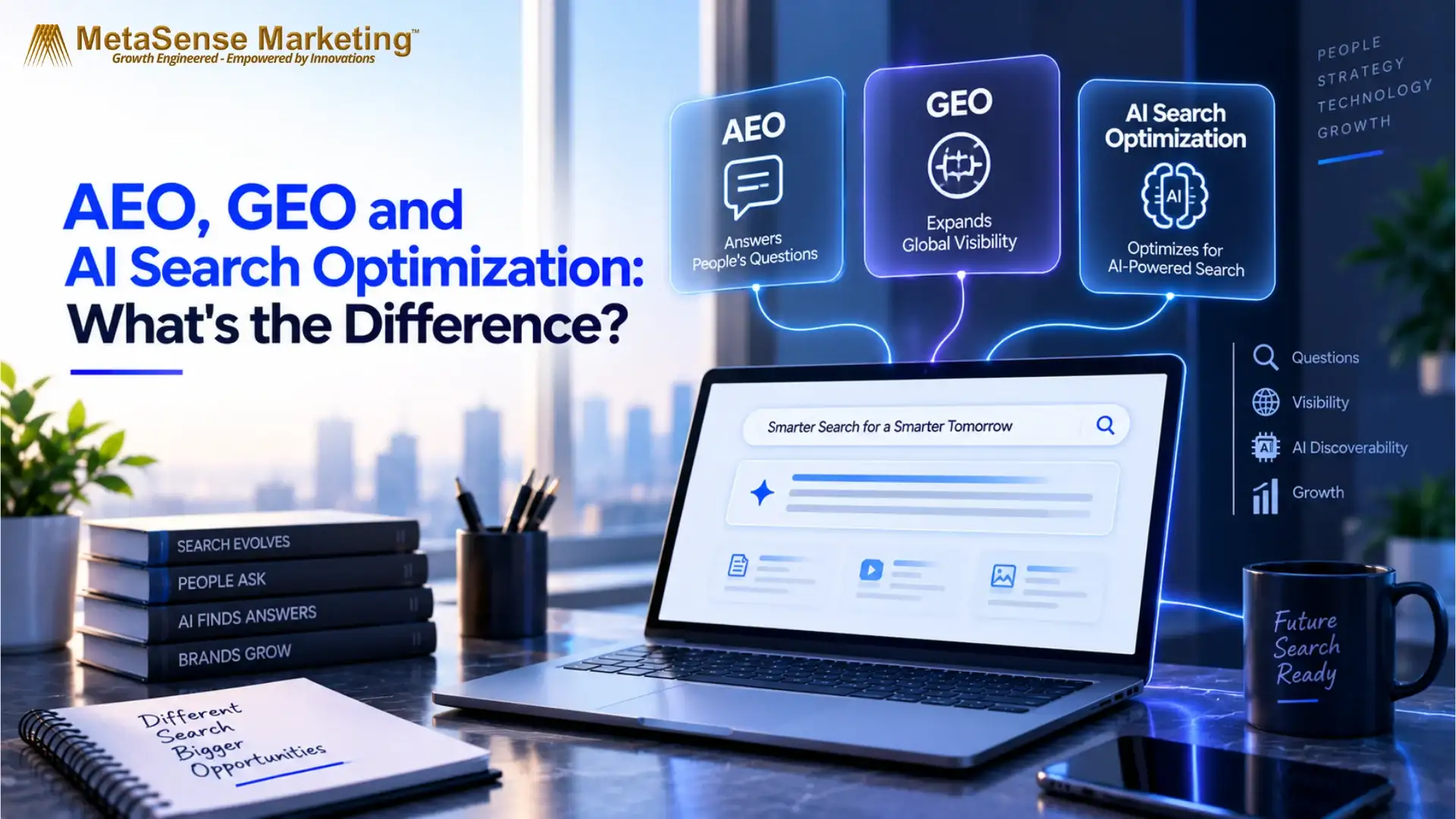
The terminology surrounding AI search can be confusing.
You may encounter:
Different marketers use these terms differently.
Some define AEO specifically around direct answers and citations. Others use AEO and GEO interchangeably.
At MetaSense Marketing, we view them as closely connected components of the modern search strategy.
The underlying objective is similar:
Make your business, content, expertise, and information discoverable and understandable across search experiences powered by increasingly sophisticated AI systems.
Whether a prospective customer searches through Google AI Overviews, Google AI Mode, ChatGPT, Perplexity, Gemini, Claude, or Copilot, the business challenge is fundamentally similar:
Can the system understand what your company does, recognize your expertise, find useful information from your website, and determine that your information is relevant enough to surface?
An answer engine is a search or AI system that attempts to provide a direct or synthesized answer to a user’s question rather than simply presenting a list of webpages.
Examples include:
The exact technology and retrieval process differs between platforms.
That’s why AEO should not be reduced to one technical trick.
The goal is to build high-quality, understandable, authoritative information that can perform across different search environments.
There isn’t one universal algorithm shared by every answer engine.
Google, ChatGPT, Perplexity, Gemini, Claude and Copilot can use different systems, indexes, retrieval methods, models and ranking signals.
However, the practical challenge for marketers is remarkably consistent.
An answer engine needs to:
Google has described query fan-out as part of AI Mode, where complex queries can be broken into multiple related searches to explore different aspects of a topic before generating an answer.
This is one reason comprehensive topical coverage matters.
Example
A user asks:
“What is the best staffing strategy for a growing U.S. hospital?”
That question potentially involves:
A page that only says:
“We provide healthcare staffing services.”
doesn’t provide much information for the system to work with.
A well-developed website with authoritative content across these related subjects gives search systems a much stronger understanding of the organization’s expertise.
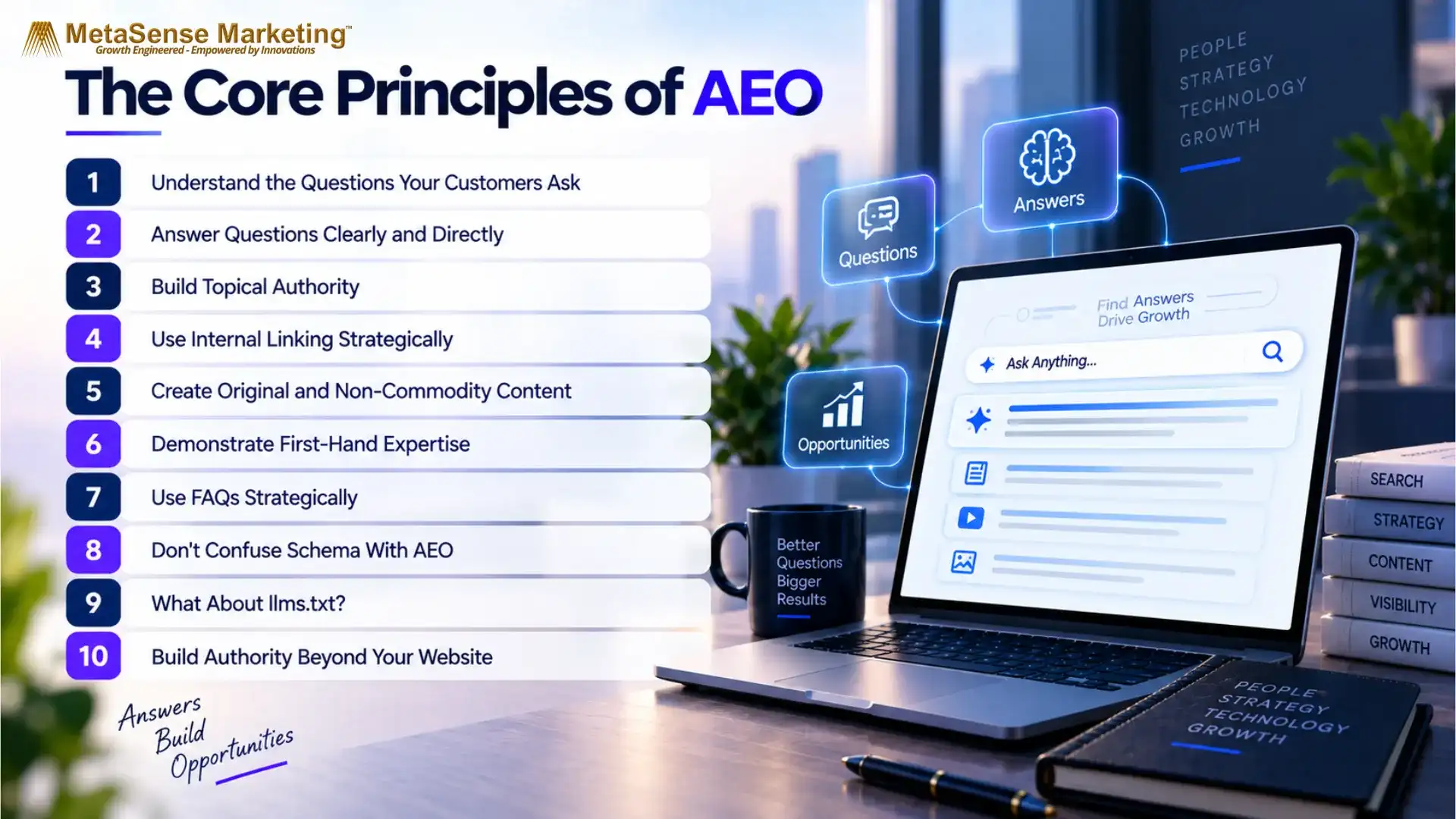
AEO isn’t one tactic.
It is a framework consisting of multiple connected activities.
AEO begins with question research.
Instead of starting only with:
“What keyword should we target?”
Ask:
“What does our customer want to know?”
For a digital marketing agency, the questions could include:
For a plumbing business:
For an IT staffing company:
Every question can represent a potential entry point into your business.
One of the simplest AEO principles is also one of the most overlooked:
Answer the question.
If your heading says:
Don’t spend the first five paragraphs talking about the history of SEO.
Start with a clear definition.
Then expand.
For example:
AEO, or Answer Engine Optimization, is the practice of optimizing website content so that answer engines can understand, retrieve, and potentially cite or surface that information when responding to users’ questions.
Then explain:
This structure helps users and makes the page’s primary purpose immediately clear.
One article isn’t always enough to demonstrate expertise.
Suppose a company wants to become known for:
Healthcare staffing
Instead of publishing one page, develop a topic cluster.
Healthcare Staffing Services
Then connect these pages through internal links.
This gives users a path through the subject.
It also gives search systems a much clearer picture of the website’s topical expertise.
Internal linking is often discussed as a traditional SEO technique.
But it also plays an important role in building an organized information ecosystem.
Imagine this structure:
Healthcare Staffing
↓
Healthcare Staffing Costs
↓
Temporary Healthcare Staffing
↓
Healthcare Workforce Planning
↓
Healthcare Staffing Agency Selection
Each page answers a different question.
The links connect the answers.
A strong internal linking strategy should help users move naturally from:
Question → Deeper information → Comparison → Solution → Conversion
Don’t add links merely because a keyword appears.
Add them because the reader may genuinely want to explore the connected topic.
This is one of the most important AEO principles.
AI systems can already generate generic explanations of almost any subject.
If your article says exactly what 50 competitors say, you have limited differentiation.
Instead, provide something that cannot easily be copied from generic sources.
Examples include:
Google’s current guidance for generative AI features specifically emphasizes creating unique, non-commodity content and continuing to follow established SEO best practices.
This is where experienced marketers have an advantage.
Your experience becomes content.
Consider these two statements:
“Internal linking is important for SEO.”
versus:
“When restructuring a client’s website, we use internal links to connect related informational questions with commercial service pages, allowing users to move naturally from learning about a problem to evaluating a solution.”
The second statement demonstrates practical knowledge.
Even better:
“For one client, restructuring content around question-based searches helped increase visibility and contributed to measurable traffic and lead growth.”
That is the type of experience that makes content more valuable.
Your campaigns can become:
AEO isn’t only about technical optimization.
It’s also about giving answer engines something worth citing.
FAQ content can be extremely useful.
But there is an important distinction between:
Useful FAQs
and
FAQ stuffing
Useful FAQs answer genuine questions.
For an SEO agency:
For a plumbing company:
These questions support the user’s journey.
The objective should not be:
“Let’s add 100 questions because AI likes FAQs.”
The objective should be:
“Let’s answer the questions preventing our customers from making an informed decision.”
Structured data is useful when it accurately describes page content and follows search-engine guidelines.
But structured data should not be treated as a secret way to force AI systems to cite your website.
Google’s current documentation specifically states that there are no special technical requirements or special schema needed for AI Overviews or AI Mode.
That doesn’t mean schema is useless.
It means marketers should use it appropriately.
Implement structured data because it helps search engines understand eligible content—not because someone promises that a particular schema type will automatically generate an AI citation.
llms.txt has become a popular discussion point in AI-search marketing.
But it should not become a distraction from fundamentals.
If your website has:
adding an AI-specific file isn’t going to solve the underlying problem.
Focus first on the fundamentals.
Your website is not your entire digital identity.
A business may also be represented through:
This matters because answer engines increasingly operate across large information ecosystems.
Your brand should be consistently represented across relevant sources.
For example, if a company describes itself as a:
“Healthcare IT staffing agency”
on its website, but third-party sources consistently describe it differently, there may be less clarity around the organization’s identity and expertise.
A strong digital presence creates consistency.
A common mistake is assuming AEO means:
“Publish more blogs.”
It doesn’t.
AEO can apply to:
Google’s current guidance for generative AI search also discusses opportunities across local, shopping, image and video content—not just conventional articles.
This means your entire website should be considered part of your AEO strategy.
A useful structure might look like this:
What Is AEO?
Define the topic immediately.
Explain the business context.
Explain the process.
Address the user’s next questions.
Show how the strategy works in practice.
Give actionable steps.
Explain what to avoid.
Show how success is evaluated.
Answer remaining high-value questions.
This structure is useful because it follows the way users naturally learn.
Let’s take a hypothetical HVAC company.
Traditional SEO approach
Target keyword:
HVAC repair
Create:
“Best HVAC Repair Services”
Optimize:
That’s useful, but incomplete.
AEO approach
Start with the customer’s questions:
Then create content around the questions.
Now the company has opportunities to address users at multiple stages of the customer journey.
Awareness
“Why is my AC blowing warm air?”
Consideration
“Should I repair or replace my AC?”
Commercial research
“How much does AC repair cost?”
Decision
“How do I choose an HVAC repair company?”
This is AEO thinking.
One of the strongest ways to understand AEO is to look at what happens when question-focused content is connected to a broader SEO strategy.
MetaSense Marketing worked with Berks Plumbing & HVAC Specialist, a local plumbing and HVAC business.
The objective wasn’t simply to create pages containing service keywords.
The strategy included addressing questions customers were searching for, restructuring content, strengthening topical relevance, improving internal connections, and creating content designed to answer user concerns.
The campaign produced several meaningful outcomes.
The website gained greater visibility around questions related to its services.
This is important because informational searches can represent customers at the beginning of the purchasing journey.
Someone asking:
“Why is my water heater leaking?”
may not initially search for a plumbing company.
But the question can quickly lead to:
“How much does water heater repair cost?”
and eventually:
“Who can repair my water heater near me?”
A strong AEO strategy connects those stages.
The client’s content also achieved visibility in featured snippets.
This illustrates an important relationship between traditional search optimization and answer-focused content.
Creating clear answers can benefit multiple search experiences.
The client’s content also began appearing in Google AI Overview answers.
This is an important distinction.
The objective wasn’t to create a page solely for an AI Overview.
The content was developed to answer genuine customer questions comprehensively.
That created opportunities for the content to be surfaced in multiple search environments.
The campaign contributed to approximately 10× traffic growth for the client.
More importantly, the campaign generated more than twice the leads.
This is the metric businesses should ultimately care about.
AEO shouldn’t be treated as a vanity metric.
The real goal is:
Visibility → Qualified traffic → Leads → Revenue
The Berks Plumbing & HVAC Specialist campaign demonstrates why answer-focused SEO should be connected to the entire customer journey.
There are several lessons worth taking from this campaign.
Informational questions aren’t necessarily low-value traffic.
A customer often starts with a problem.
The company that provides the clearest answer can become the company the customer remembers.
One question is rarely enough.
The best strategy connects related questions into a broader topic.
Featured snippets, organic rankings, AI Overviews, traffic and leads can all be part of the same broader strategy.
The ultimate objective is business growth.
Local businesses have a particularly interesting opportunity.
Consider a search such as:
“Who is the best emergency plumber near me?”
An answer engine may need to understand:
This means local AEO needs more than blog content.
A local business should strengthen:
For a local company, the goal is not simply to answer:
“What is plumbing?”
It is to answer questions that connect local need with business capability.
B2B buyers often conduct extensive research before contacting a provider.
They may ask:
This creates significant AEO opportunities.
B2B businesses should create:
The more complex the buying journey, the more questions a prospective customer is likely to ask.
AEO isn’t limited to service businesses.
E-commerce brands can optimize around questions such as:
“Which running shoes are best for flat feet?”
“What laptop is best for video editing?”
“Which air purifier is best for a large bedroom?”
Product discovery increasingly involves comparison and recommendation questions.
Useful content can include:
Google’s generative-search guidance also recognizes shopping-related content as an important area within AI-powered Search.
For industries where users need trustworthy information, content quality becomes even more important.
Consider:
“What should I look for when choosing a healthcare staffing agency?”
A useful answer may need to cover:
A generic 500-word article won’t necessarily establish meaningful authority.
A comprehensive resource backed by real experience can.
For professional services, expertise itself becomes a content asset.
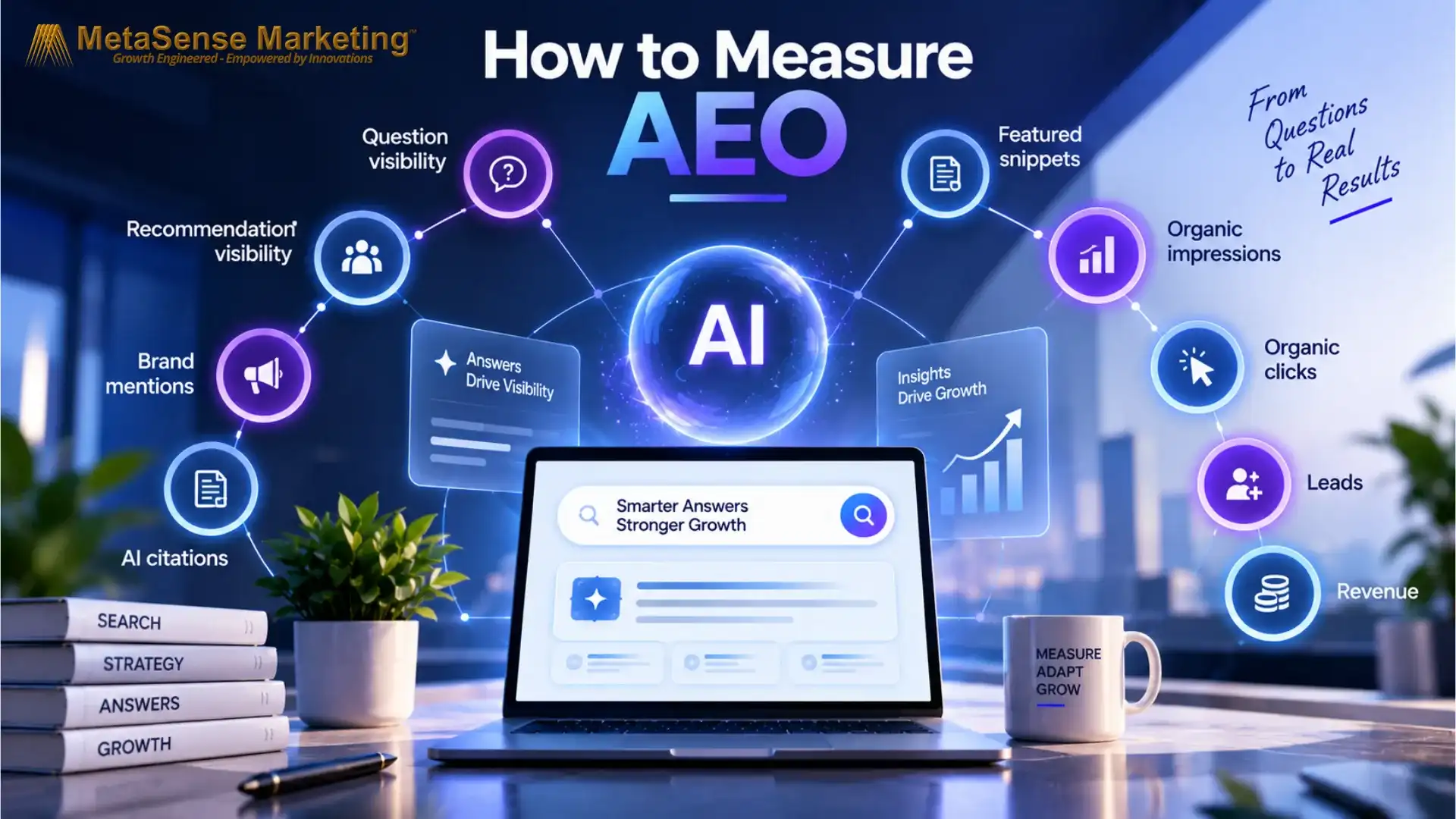
AEO measurement is still developing, but businesses should establish a framework rather than relying on one metric.
AI citations
Track whether your website appears as a cited or linked source in relevant AI answers.
Brand mentions
Monitor whether your company is mentioned when people ask relevant category or service questions.
Recommendation visibility
Track queries such as:
“Best SEO agencies for small businesses”
or:
“Best IT staffing companies in the U.S.”
and see whether your business appears.
Question visibility
Track the number and quality of question-based queries for which your website gains visibility.
Featured snippets
Monitor answer-oriented SERP features.
Organic impressions
Measure whether visibility is expanding.
Organic clicks
Measure whether visibility translates into visits.
Leads
Track whether those visitors generate qualified leads.
Revenue
Where attribution allows, connect organic and AI-assisted discovery to revenue.
Measurement is becoming more sophisticated.
In June 2026, Google announced new generative AI performance reporting in Search Console for AI features in Search and Discover. Google says the reporting can show impressions, pages, countries, devices, and performance over time for generative AI features.
This is an important development for SEO teams.
It means AI visibility is moving from an abstract concept toward something that can increasingly be analyzed alongside traditional search performance.
However, marketers should still connect visibility data to business outcomes.
A page receiving AI impressions is useful.
A page generating qualified customers is better.
1. Thinking AEO Means Publishing More Content
More content isn’t automatically better.
Publishing 500 weak articles can be less valuable than publishing 20 genuinely useful resources.
2. Writing for AI Instead of Humans
Your content should remain readable and useful.
Don’t turn every paragraph into a robotic answer designed to satisfy an imagined AI formula.
3. Adding Questions Everywhere
Questions are useful when they represent genuine user needs.
Don’t manufacture questions merely to increase keyword density.
4. Treating FAQ Schema as a Shortcut
Schema can help search engines interpret eligible content, but it is not a guarantee of AI visibility.
5. Obsessing Over llms.txt
Don’t allow emerging AI files and terminology to distract from the fundamentals.
6. Ignoring Technical SEO
AI search does not make crawlability irrelevant.
If search engines can’t access important content, you have a foundational problem.
7. Ignoring Internal Linking
A collection of disconnected articles doesn’t create the same topical structure as a well-connected content ecosystem.
8. Copying Competitors
If ten competitors say the same thing, publishing an eleventh version doesn’t create differentiation.
Add experience.
Add data.
Add examples.
Add opinions.
Add original insights.
9. Measuring Only Citations
A citation is visibility.
A lead is business value.
10. Treating AEO as a One-Time Project
Search systems change.
User behavior changes.
Competitors publish new content.
AI platforms evolve.
AEO should therefore become part of an ongoing SEO and content strategy.
Before publishing an important page, ask:
A practical workflow can look like this.
Start with your services, products and expertise.
Use keyword research, Search Console, customer conversations, sales questions, forums, competitor research and search suggestions.
Create clusters around major topics.
Determine whether each question is:
Before creating a new article, determine whether you already have a page that could answer the question.
Sometimes the best AEO strategy isn’t creating another URL.
It’s improving the page you already have.
Make important information easy to understand.
Answer related questions naturally.
Connect the page to relevant content across your website.
Use your experience, data, examples and case studies.
Develop relevant external mentions and references.
Monitor organic visibility, AI visibility, citations, mentions, traffic, leads and conversions.
Update content as search behavior, customer questions and industry information change.
AEO is likely to become increasingly integrated into mainstream SEO.
The distinction between:
SEO
and
AI Search Optimization
will continue to become less important as search engines evolve.
The fundamentals remain surprisingly consistent:
The difference is that the interface through which people discover that information is changing.
Yesterday, the user clicked a blue link.
Today, the user may receive an AI-generated summary.
Tomorrow, an AI agent may research options, compare businesses, and recommend a solution.
That means brands need to think beyond rankings.
They need to think about discoverability, authority, citations, recommendations and trust.
The most important idea behind AEO is simple.
Search optimization is moving from:
“How do I rank for this keyword?”
toward:
“How do I become a trusted source for this question?”
That doesn’t make traditional SEO irrelevant.
It makes good SEO even more important.
Your website still needs to be crawlable.
Your pages still need to be relevant.
Your content still needs to be useful.
Your business still needs authority.
But now there is another opportunity:
When someone asks an answer engine a question related to your business, your content can become part of the answer.
That’s the real opportunity behind Answer Engine Optimization.
AEO requires more than adding FAQs to a website.
It requires understanding:
At MetaSense Marketing, our approach combines SEO fundamentals with answer-focused content strategies designed around real user questions and business objectives.
Our process can include:
Question Research → Search Intent → Content Strategy → Content Restructuring → Internal Linking → Topical Authority → Brand Mentions → Technical SEO → AI Search Visibility → Measurement
MetaSense also developed iMetaDex™, a patented AI-driven SEO technology that the company describes as helping businesses improve their Google visibility. MetaSense’s own history describes how SEO and iMetaDex™ played an important role in growing its staffing business and achieving first-page visibility for multiple keywords.
The goal isn’t simply to chase the latest AI-search terminology.
It’s to build a website and brand that are useful enough for people and understandable enough for search systems.
For businesses that want to compete in an increasingly AI-driven search environment, MetaSense Marketing can help develop an integrated SEO, AEO and GEO strategy focused on visibility, authority, traffic and measurable business growth.
AEO is not about trying to trick an AI system into mentioning your company.
It is about becoming the business that has the best answer to the questions your customers are asking.
The companies that succeed will not simply publish more content.
They will create better answers.
They will demonstrate expertise.
They will build topical authority.
They will connect related information.
They will establish their brands across the wider web.
And they will measure whether that visibility produces meaningful business results.
Search is evolving from a system that primarily helps users find webpages into an environment where systems increasingly help users understand information and make decisions.
Businesses need to evolve with it.
If you want your business to be discovered not only through traditional search results but also through AI-powered answer experiences, connect with MetaSense Marketing for professional SEO, AEO and GEO services. Our team can help you build an answer-focused search strategy designed around your audience, industry, business goals and long-term organic visibility.
The future of search isn’t only about ranking the answer. It’s about becoming the source behind the answer.
What does AEO stand for?
AEO stands for Answer Engine Optimization. It is the practice of optimizing content and a brand’s digital presence so that answer engines can understand and potentially surface, cite, or reference that information when responding to users.
What is the purpose of AEO?
The primary purpose of AEO is to increase the likelihood that your business and content are visible when users ask relevant questions through AI-powered search and answer experiences.
Is AEO the same as SEO?
No. AEO and SEO overlap significantly, but AEO places greater emphasis on direct answers, question-based content, citations, mentions and visibility within answer-driven search experiences. A strong AEO strategy should build upon solid SEO fundamentals.
Is AEO the same as GEO?
The terminology varies. Some marketers use AEO and GEO as distinct concepts, while others use them interchangeably. Both generally refer to optimizing a brand’s content and digital presence for AI-generated and answer-driven search experiences.
Does AEO replace traditional SEO?
No. Technical SEO, crawlability, indexability, search intent, content quality, internal linking, authority and user experience remain important.
How do I optimize my website for AEO?
Start by identifying real questions your customers ask. Create clear answers, build comprehensive topic coverage, strengthen internal linking, demonstrate first-hand expertise, establish authority, maintain strong technical SEO, and measure AI and organic search visibility.
Do FAQs improve AEO?
Useful FAQs can help because they directly address customer questions. However, simply adding large numbers of FAQs does not guarantee inclusion in AI Overviews or other AI-generated answers.
Does FAQ schema guarantee AI Overview visibility?
No. Google states that there are no special technical requirements or special schema required for AI Overviews or AI Mode. Structured data should be implemented accurately where applicable rather than used as an AI visibility shortcut.
Do I need llms.txt for AEO?
You should not treat llms.txt as a prerequisite for Google AI Overview visibility. Prioritize foundational SEO, useful content, crawlability, indexability, topical authority and genuine expertise.
Can AI-generated content rank or appear in AI answers?
AI-assisted content can be useful, but the critical question is whether it provides real value. Publishing generic, mass-produced content simply to manipulate search visibility is not a sustainable AEO strategy. Human expertise, originality, accuracy and usefulness remain important.
How long does AEO take?
There is no universal timeframe. Results depend on the website’s existing authority, technical health, content quality, competition, topic, search demand and the scope of optimization. Some improvements can occur relatively quickly, while establishing meaningful topical authority can take considerably longer.
How do you measure AEO?
Useful metrics include:
Google’s 2026 Search Console generative AI reporting is also beginning to provide dedicated visibility data for AI features such as AI Overviews and AI Mode.
Can AEO generate leads?
Yes. AEO can help attract users who are researching problems, services, products and solutions. When answer-focused content is connected to relevant service pages and conversion paths, that visibility can contribute to lead generation.
The Berks Plumbing & HVAC Specialist campaign is an example from MetaSense Marketing where answer-focused SEO work was associated with increased question-based visibility, approximately 10× traffic growth and more than 2× lead generation.
Is AEO only important for large companies?
No. Small and local businesses can benefit significantly from answering specific questions within their markets. In fact, niche expertise can provide an opportunity for smaller businesses to compete against larger brands for highly specific searches.
Should every page on my website be optimized for AEO?
Every important page should be useful and understandable, but not every page needs to be turned into a question-and-answer article. Product pages, service pages, location pages, case studies and other content types can all contribute to an AEO strategy in different ways.
What is the biggest AEO mistake businesses make?
One of the biggest mistakes is treating AEO as a collection of tricks, such as adding excessive FAQs, stuffing questions into headings, or relying on a single technical implementation.
AEO is fundamentally about being a useful, credible and discoverable source of information.