Search is changing rapidly.
People are no longer relying only on traditional Google search results to discover businesses, products, services, and answers. They are increasingly using AI-powered search experiences and conversational platforms to research companies, compare solutions, ask questions, and make purchasing decisions.
This shift has created a new layer of search visibility commonly discussed through AI SEO, Answer Engine Optimization (AEO), and Generative Engine Optimization (GEO).
For businesses in the United States, that raises an important question:
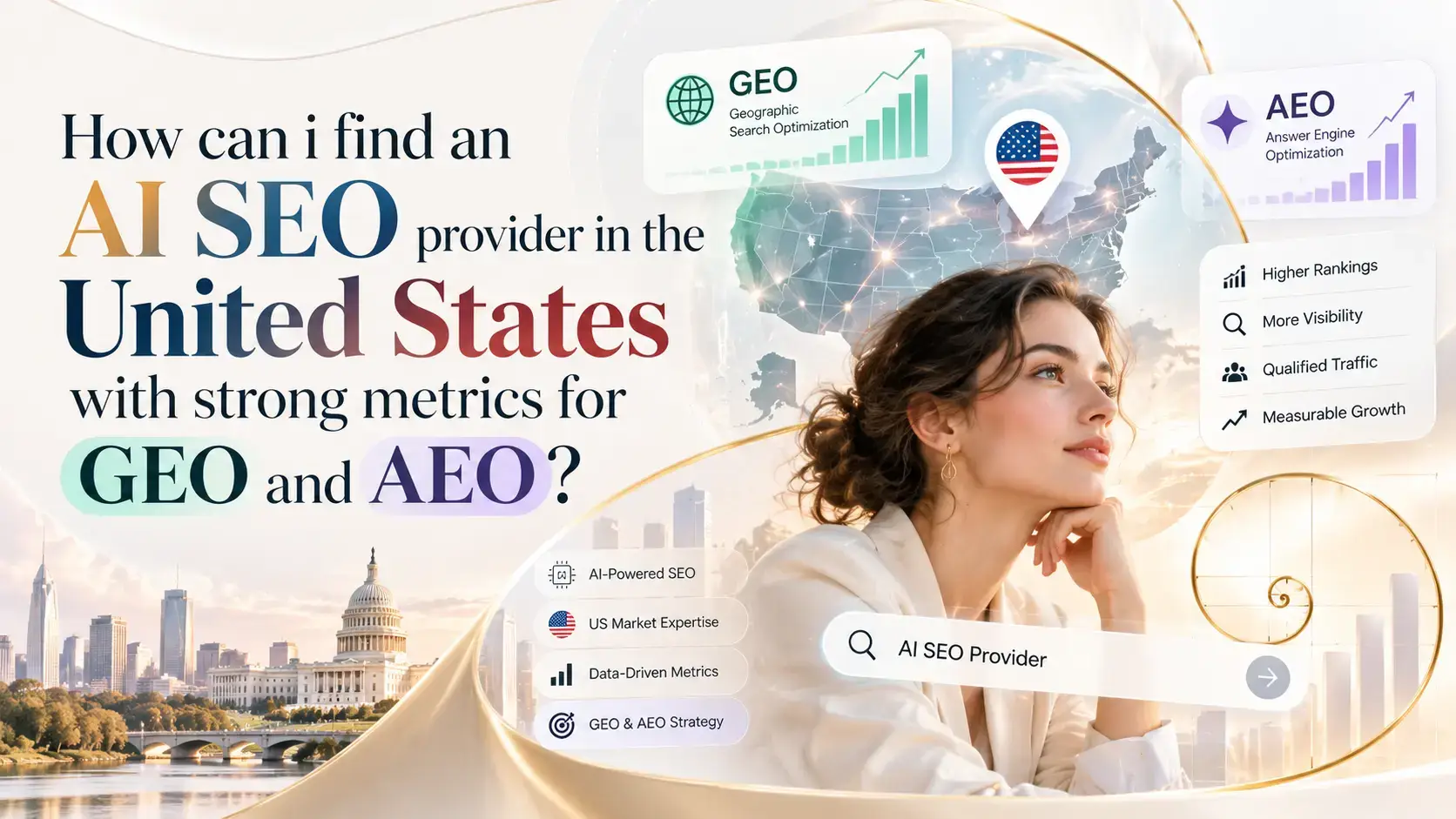
How can you find an AI SEO provider in the US that can actually demonstrate measurable results in AEO and GEO?
The answer is not to choose an agency simply because its website says “AI SEO,” “GEO,” or “AEO.”
You need to evaluate its methodology, evidence, measurement framework, SEO capabilities, content strategy, technical expertise, and ability to demonstrate how your brand can become more visible across AI-generated answers.
This guide explains what to look for when comparing AI SEO services in the US.
AI SEO is the practice of optimizing a website, brand, content ecosystem, and digital presence so that they can perform effectively across modern search experiences that increasingly include artificial intelligence.
It does not necessarily mean replacing traditional SEO with AI.
In fact, Google continues to emphasize fundamental SEO practices for its AI search experiences. Google Search Central’s documentation explains that AI features are part of Google Search and that established practices around crawlability, indexability, useful content, structured data, and overall search quality remain important.
A practical AI SEO strategy therefore combines:
The objective is broader than ranking a page for a keyword.
The objective is to make your business discoverable, understandable, trustworthy, and citable across modern search environments.
GEO stands for Generative Engine Optimization.
GEO generally refers to optimizing a brand’s digital presence for generative AI systems that produce synthesized answers from multiple sources.
The terminology is still evolving, and marketers do not always use AEO and GEO consistently. Some organizations use AEO as a broader umbrella term, while others distinguish AEO from GEO based on the type of AI experience being optimized.
For businesses, the practical objective is similar:
Increase the probability that your brand, website, products, services, or expertise are represented accurately and prominently in AI-generated answers.
This makes metrics particularly important.
An agency should not simply tell you:
“We optimize your website for ChatGPT.”
It should be able to explain:
Traditional SEO primarily focuses on improving visibility in search results.
AI SEO expands the visibility objective.
| Traditional SEO | AI SEO / AEO / GEO |
| Rankings | AI visibility |
| Organic impressions | AI mentions and citations |
| Keyword positions | Query-level AI presence |
| Organic traffic | AI referral traffic |
| SERP features | AI-generated answer inclusion |
| Backlinks | Broader authority and entity signals |
| Search snippets | Answer-ready content |
| Search intent | Search intent + conversational intent |
| Page optimization | Brand and content ecosystem optimization |
These areas overlap significantly.
A strong AI SEO provider should therefore not abandon traditional SEO.
Instead, it should build AI-search visibility on top of a technically strong SEO foundation.
AI SEO can provide several potential benefits when implemented correctly.
Your business may be discovered through an AI-generated response even when a customer does not interact with a traditional list of search results in the same way.
Detailed, authoritative content can help establish your brand as a useful source of information around your subject area.
AI search visibility can expose your business to users researching providers, products, services, and solutions.
Someone asking an AI system:
“What are the best digital marketing services for a small business in New Jersey?”
has a different intent from someone casually browsing marketing information.
Being represented in that research journey can create an additional opportunity for discovery.
Search behavior is becoming increasingly multimodal and AI-assisted. Google is also expanding reporting around AI and multimodal search experiences in Search Console.
Businesses should therefore consider AI visibility alongside traditional organic search visibility.
This is one of the most important questions to ask.
A provider should not measure AI SEO simply by saying:
“Your website is optimized for AI.”
That is not a meaningful performance metric.
Instead, ask for measurable KPIs.
How frequently is your website cited when target questions are asked?
For example:
The exact methodology matters, so ask the provider how it defines and calculates the metric.
How frequently does your brand appear in AI-generated responses for your tracked queries?
This helps measure brand visibility even when users do not click through to your website.
However, a mention alone should not be treated as a business outcome.
A provider should ideally distinguish between:
Ask:
How frequently does my brand appear compared with competitors?
For example, an agency could monitor a defined set of commercial and informational queries and compare brand visibility against selected competitors.
This gives you a competitive perspective rather than looking only at your own numbers.
For Google-focused campaigns, monitor the presence of your website or brand within relevant AI-generated search experiences.
Google has introduced documentation around AI Overviews and AI Mode, including mechanisms through which users can identify preferred sources.
The provider should explain exactly what it measures because AI search results can vary by query, location, language, device, and other contextual factors.
Look at traffic coming from AI platforms.
Depending on your analytics configuration and the platform, this can help identify visits originating from AI-powered discovery.
But traffic should not be the only KPI.
A business can receive relatively little AI referral traffic while still gaining meaningful brand visibility through zero-click AI answers.
This is where AI SEO becomes connected to business performance.
Track:
The important question is:
Is AI visibility contributing to qualified business outcomes?
A professional provider should be able to tell you which queries are being monitored.
For example:
Commercial queries
Informational queries
This is much more useful than reporting a vague “AI visibility score.”
When comparing an AI SEO provider in the US, evaluate the provider across several areas.
AI SEO does not eliminate the fundamentals of SEO.
The provider should understand:
Google’s own documentation continues to emphasize established SEO principles for its search experiences.
Ask the provider:
“How do you optimize our content for answer-driven searches?”
A credible answer should involve more than adding FAQs to every page.
Look for a process involving:
Ask:
“How do you measure our visibility across generative AI platforms?”
The provider should be able to explain:
Do not accept vague statements such as:
“We increased AI visibility by 500%.”
Ask for context.
You should want to know:
The more specific the case study, the easier it is to evaluate.
Before hiring an agency, ask for a sample reporting dashboard.
A strong report might include:
| Metric | Before | Current | Change |
| Organic traffic | X | X | % |
| Target keyword visibility | X | X | % |
| AI citation rate | X | X | % |
| Brand mention rate | X | X | % |
| AI share of voice | X | X | % |
| AI referral sessions | X | X | % |
| AI-assisted conversions | X | X | % |
| Organic conversions | X | X | % |
The exact metrics will depend on the business.
The key is transparency and reproducibility.
Ask the agency to explain how every metric is calculated.
One of the biggest mistakes businesses can make is accepting a proprietary AI score without understanding what it represents.
Suppose an agency tells you:
“Your AI visibility score increased from 42 to 78.”
That sounds impressive.
But what does 78 mean?
Does it represent:
You should know.
A useful AI SEO metric should have a clearly defined methodology.
Different businesses may need different platform coverage.
Depending on your target audience, your provider might monitor:
The provider should explain why particular platforms matter for your audience instead of simply claiming to optimize for every AI platform.
There is no single technical switch that turns on AI SEO.
Instead, optimize the website and broader digital presence around several principles.
Avoid generic AI-generated articles that provide little original value.
Create content that demonstrates:
Research questions customers actually ask.
Then create pages and sections that answer those questions directly.
For example:
Question: What is GEO?
Follow it with a concise definition before expanding into examples, benefits, methodology, and implementation.
This creates content that is easier for both users and search systems to understand.
Do not publish one article about AI SEO and expect it to establish authority.
Build a connected topic ecosystem.
For example:
AI SEO
→ What Is AI SEO?
→ AI SEO Benefits
→ How to Optimize a Website for AI Search
→ AEO vs SEO
→ AEO vs GEO
→ What Is GEO?
→ How to Optimize for GEO
→ How to Appear in AI Overviews
→ How AI Search Affects Local SEO
→ Measuring AI Search Visibility
→ AI SEO for Small Businesses
This creates stronger topical coverage.
Connect related content logically.
An article about GEO should link to:
Internal linking helps users navigate your website and helps search engines understand relationships between pages.
AI systems need to understand what your business is, what it offers, who it serves, and why it is relevant.
Maintain consistent information across:
Structured data can help search engines understand information on a page.
Google explains that structured data can help it understand page content and can support eligible search appearances.
However, schema should not be treated as an automatic way to obtain AI citations.
It is one part of a broader technical and content strategy.
There is no guaranteed method for obtaining an AI Overview citation.
That distinction is important.
A provider promising:
“We guarantee your business will appear in Google AI Overviews.”
should be treated cautiously.
Google’s AI search experiences use information from multiple sources, and visibility can vary depending on the query and search context.
A practical strategy is to:
The goal is not to “hack” AI Overviews.
The goal is to create a website that search systems can confidently understand and use as a useful source.
Before signing a contract, ask these questions.
These questions can quickly separate a provider with a genuine methodology from one primarily using AI SEO terminology as a sales pitch.
Be cautious if a provider:
No agency controls Google’s final search experience.
AI-generated results can change based on queries, sources, models, context, and platform behavior.
Ask for the underlying methodology.
AI search optimization still depends heavily on a technically sound, useful, discoverable website.
Traffic, impressions, mentions, and visibility can all be useful, but they should connect to meaningful business outcomes.
If you cannot understand how an agency measures GEO or AEO, you cannot properly evaluate the results.
AI search optimization should not be sold as a guaranteed shortcut.
This depends on your business.
An AI SEO specialist may make sense when:
A broader digital marketing agency in the US may be more appropriate when you need:
For many businesses, AI SEO works best as an extension of an existing search strategy rather than as a completely separate marketing activity.
A comprehensive AI SEO services in the US program may include:
Not every business needs the same AI SEO strategy.
Focus on:
Focus on:
Focus on:
Focus on:
There is no universal price for AI SEO services.
Pricing depends on:
Rather than selecting the cheapest provider, compare the scope of work, measurement methodology, expertise, reporting, and expected business objectives.
A $500/month package and a $5,000/month program may technically both be called “AI SEO,” while delivering completely different levels of strategy and execution.
AI SEO should not be treated as an instant-results channel.
The timeline depends on the starting point.
A new website may first need:
An established website with strong organic visibility may have a different starting position.
Track progress monthly, but evaluate meaningful trends over a longer period.
More importantly, do not judge the campaign using a single metric.
Look at the progression from:
Visibility → Citations → Qualified Traffic → Leads → Revenue
where measurable.
SEO, AEO, and GEO should not be treated as completely isolated marketing channels.
They increasingly overlap.
A technically strong website supports SEO.
Useful content supports SEO and answer-driven discovery.
Topical authority can support broader search visibility.
Strong brand recognition can improve how your business is understood across digital environments.
And measurable AI visibility can help you understand whether your brand is appearing in the conversations that matter.
The terminology will likely continue to evolve.
The underlying principle is more important:
Create a website and digital presence that search engines and AI systems can understand, trust, retrieve, cite, and recommend when relevant.
Before hiring an AI SEO provider, check whether they can demonstrate:
Most importantly, ask:
“Can you show me exactly how you measure AI search visibility and how those measurements connect to business results?”
That question can tell you more about an agency’s capabilities than its list of AI SEO services.
At MetaSense Marketing, AI SEO should be approached as an evolution of search strategy, not as a replacement for SEO.
Our approach can combine traditional SEO with AEO, GEO, content strategy, technical optimization, topical authority, internal linking, digital authority, and conversion-focused measurement.
The objective is to help businesses become more visible across both traditional search results and emerging AI-driven discovery experiences.
For businesses evaluating AI SEO services for business, the focus should be on measurable visibility, meaningful search intent, useful content, and business outcomes, not vanity metrics.
Whether your goal is to improve traditional organic rankings, increase visibility in AI-generated answers, strengthen your brand’s topical authority, or build a broader SEO, AEO, and GEO strategy in the US, the right approach begins with understanding where your customers search and what information they need before making a decision.
If you’re looking for an AI SEO provider in the US that understands the relationship between SEO, AEO, and GEO, start by evaluating methodology, evidence, reporting, and business impact.
MetaSense Marketing can help you build a search strategy designed for both today’s search results and tomorrow’s AI-driven discovery.
Build your SEO foundation.
Optimize for answers.
Strengthen your authority.
Measure your AI visibility.
Turn search visibility into business growth.