Artificial intelligence is moving beyond content generation.
For years, small businesses used AI primarily to write social media captions, brainstorm blog topics, create images, summarize reports, or answer basic questions.
That is changing.
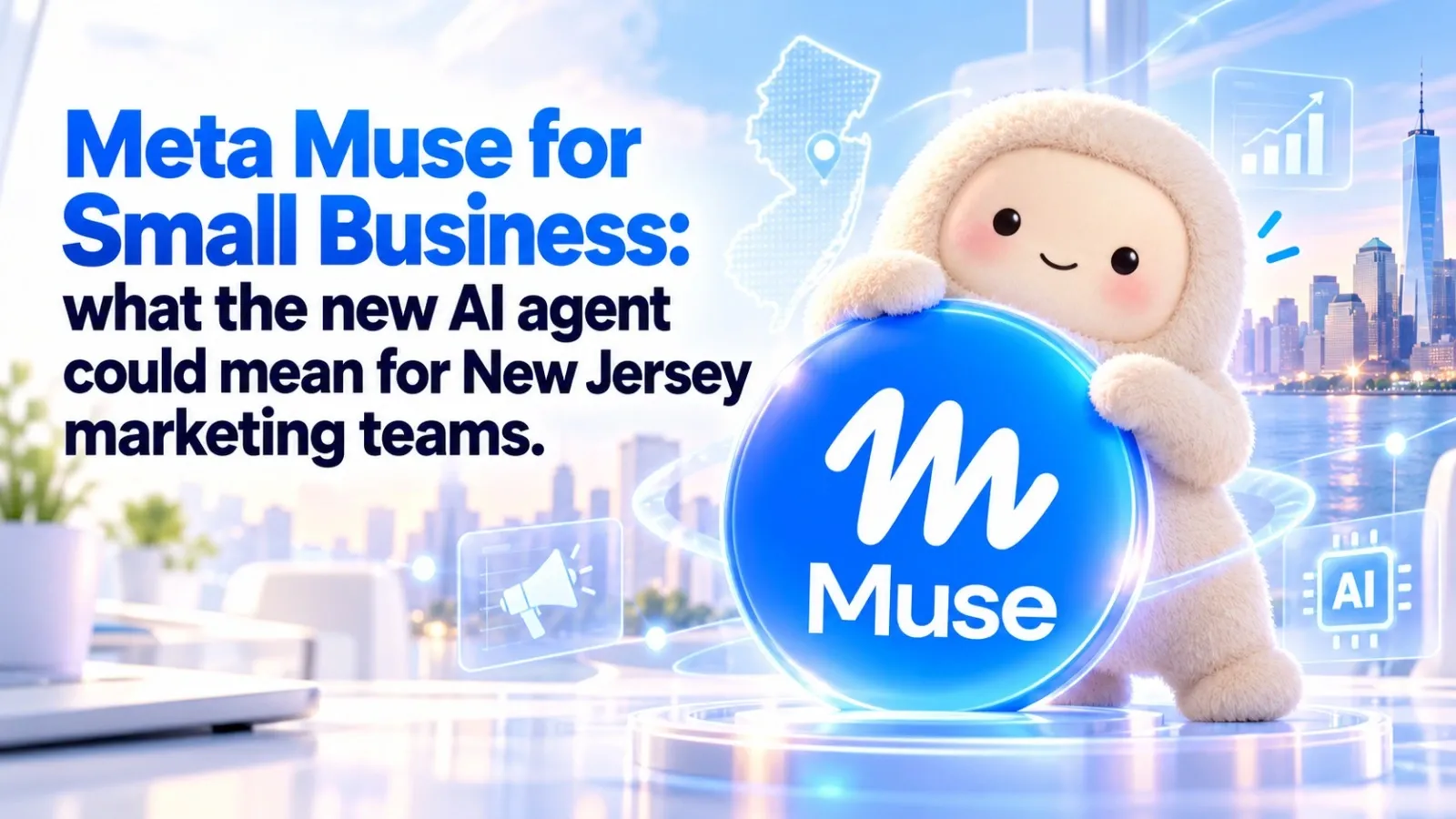
Meta is now positioning Muse as an AI agent that can do more than generate an answer. It can work toward business goals, connect with the tools a business already uses, analyze information, and help execute tasks.
On September 29, 2026, Meta announced Muse for Small Business, expanding Muse with business-focused skills and connectors. Meta says businesses can connect tools including Asana, Box, Canva, Dropbox, Figma, Granola, HighLevel, Intuit QuickBooks, Klaviyo, Lovable, Notion, Shopify, Slack, Stripe, Zoom, as well as Facebook and Instagram business accounts.
For New Jersey businesses, this could have significant implications for how small marketing teams approach content, advertising, customer engagement, reporting, and day-to-day operations.
But Muse should not be viewed simply as another AI content-writing tool.
The bigger opportunity is AI-assisted business execution.
Meta describes Muse as a personal AI agent designed to help people accomplish goals rather than simply answer questions.
The original Muse announcement described it as an agent that can take tasks and projects off a user’s plate, turn goals into action plans, and work across connected applications. Meta says Muse runs through a dedicated secure environment and can work on a person’s behalf across apps they use.
With Muse for Small Business, Meta is expanding those capabilities specifically toward running a business.
Instead of asking:
“Write me five Instagram captions.”
a business owner could give Muse a broader objective such as:
“Analyze my recent campaigns and social performance and create a growth plan for next quarter.”
Meta specifically provides this type of growth-planning workflow as one of its example Muse use cases.
That is a fundamentally different approach to using AI.
Meta Muse for Small Business is designed to help small-business owners use AI across the tools they already use to operate their companies.
Meta says Muse can connect to business software and understand information about the business, including what it sells, its brand voice, and recurring customer questions. It can also connect to Facebook Pages, Instagram professional accounts, and Meta ad accounts.
This matters because the value of an AI agent increases when it has useful context.
An AI tool that only sees a blank chat window has limited information.
An AI agent connected to:
Can potentially provide much more useful assistance.
A traditional chatbot generally works like this:
Prompt → Answer
An AI agent is closer to:
Goal → Research → Plan → Execute → Review
That difference matters.
For example, a traditional AI tool might help you write:
“Create a Facebook advertising campaign for my New Jersey business.”
An agentic system could potentially analyze existing business information, review campaign performance, identify opportunities, create recommendations, and prepare campaign assets.
Meta says Muse can analyze sales, campaigns, and social activity and create a growth plan. It also describes use cases involving ads and content, financial performance, and proactively identifying items that need attention.
This is why Meta Muse for Businesses deserves attention from marketing teams.
New Jersey has a large and diverse small-business ecosystem.
Businesses across industries such as:
often have a similar marketing problem:
There is more marketing work than available time.
A small team may need to manage:
Muse could potentially help reduce the amount of manual work involved in coordinating these activities.
The most interesting use cases are not necessarily individual content-generation tasks.
They are workflows.
Muse can potentially help marketers understand what is working across campaigns and social activity.
A marketing team could ask:
“Analyze this month’s campaigns and tell me where we are wasting budget.”
The value comes from connecting analysis to actual business data rather than asking AI to make assumptions.
Instead of asking AI to generate random social posts, a team could provide a broader goal:
“Create next month’s content plan based on our recent performance, customer questions, and business priorities.”
That can produce a more strategically connected content workflow.
Muse can connect to Instagram professional account analytics and Facebook Pages, according to Meta.
A marketing team could use this information to investigate:
The important point is that the AI is working from the business’s actual context.
Meta’s example use cases include analyzing ads and content and drafting a campaign for the following week.
For a New Jersey marketing team, this could potentially support:
But marketers should still review campaign recommendations before anything is launched.
AI agents could become particularly useful when marketing and sales workflows are connected.
For example:
New lead → qualification → follow-up → CRM update → sales notification
The more of this workflow an AI agent can safely coordinate, the more valuable it becomes.
Meta is also developing Meta Business Agent, which is designed to interact with customers, answer business-specific questions, recommend products, qualify leads, book appointments, and support sales.
This suggests that Meta’s broader strategy is not limited to marketing content.
It is moving toward AI-assisted business operations.
This could be particularly important for paid advertising teams.
Meta is already introducing additional AI capabilities for marketers.
At Advertising Week New York 2026, Meta announced broader rollout of Ads Creative Studio and described new AI capabilities that can help marketers plan, create, and optimize campaigns. Meta also said AI-powered audience discovery is coming to Detailed Targeting and that Customer Lifecycle Strategy is opening to all advertisers.
Muse adds another potential layer.
Instead of marketers manually moving between:
Analytics → Ads Manager → Creative Tool → Spreadsheet → Project Management → Reporting
AI agents could increasingly coordinate information across those systems.
That does not mean marketers disappear.
It means their role can move further toward:
Strategy → Decision-making → Oversight → Creative direction → Business analysis
No, not automatically.
This is one of the most important distinctions businesses should make.
An AI agent can help execute tasks.
It does not automatically understand the complete business strategy.
For example, an AI system may identify that a particular advertisement has a lower cost per click.
But a marketer still needs to determine:
Marketing is not simply a collection of tasks.
It involves judgment.
AI agents are likely to change what businesses expect from agencies.
A business may eventually ask:
“Why am I paying an agency to manually produce a weekly report when an AI agent can analyze the data?”
That is a fair question.
Agencies therefore need to provide value beyond repetitive execution.
The future value of a strong digital marketing agency in the US will increasingly come from:
AI can accelerate execution.
The agency still needs to determine what should be done and why.
The biggest opportunity may be connecting marketing activities that are currently fragmented.
Imagine a New Jersey business using:
Meta says Muse can connect to many of these tools.
Instead of analyzing each system independently, an AI agent could potentially help connect the information.
For example:
Sales are declining
↓
Muse identifies lower-performing products
↓
Checks recent campaigns
↓
Reviews social performance
↓
Reviews customer questions
↓
Identifies potential marketing issues
↓
Creates recommendations
↓
Marketing team reviews them
↓
Team approves next steps
This is where agentic AI becomes much more interesting than basic AI content generation.
Muse is not a replacement for Google Search or a dedicated SEO platform.
But it could potentially help businesses manage parts of their broader marketing workflow.
For a New Jersey local business, an AI-assisted workflow could help identify:
However, businesses should not assume that connecting Muse to their social accounts automatically improves their Google rankings.
Local SEO still requires a deliberate strategy involving:
Muse can potentially support the workflow.
It does not eliminate the underlying marketing strategy.
Yes.
The biggest change may be moving from content production to content operations.
Today, a business might ask:
“Can AI write a blog?”
That question is becoming less interesting.
A better question is:
“Can AI help us determine what content we should create, why we should create it, how it performed, and what we should create next?”
That is a much more strategic application.
For example:
AI can potentially support multiple stages of that process.
Meta says users remain in control with Muse for Small Business and that nothing publishes, sends, or spends without approval.
That is particularly important for marketing.
Imagine an AI agent has access to:
A mistake could have real business consequences.
Human approval should remain important for activities such as:
Automation should reduce operational workload without eliminating appropriate controls.
Businesses do not need to adopt every new AI product immediately.
Instead, start by identifying repetitive processes.
Ask your marketing team:
What takes the most time every week?
It could be:
Then determine which tasks are:
These are good candidates for automation.
These may benefit from AI-assisted analysis.
These should remain strongly human-led.
This simple framework can help determine where Muse or another AI agent could provide value.
A small marketing team could potentially structure its workflow like this:
Ask Muse to review:
and identify the most important changes.
Use those findings to identify:
Use AI tools to help prepare:
Marketing professionals review:
Review the week’s results and determine what should change next week.
This is an example of how AI can become part of an operating system rather than simply a writing assistant.
Only connect the systems it genuinely needs.
Human approval should remain part of important workflows.
Customer behavior still requires research and interpretation.
Automating the wrong process simply makes the wrong process faster.
Businesses should understand what information is being connected, what permissions are being granted, and how the relevant service handles that information.
The goal is not:
“AI completed 100 tasks.”
The better question is:
“Did AI help the business achieve a meaningful outcome?”
| Traditional Approach | AI-Agent Approach |
| Manually collect data | AI-assisted data gathering |
| Manually prepare reports | AI-assisted analysis |
| Manually brainstorm content | AI-assisted ideation |
| Manually move information between tools | Connected workflows |
| Separate tools for separate tasks | Agent coordinating multiple tools |
| Human executes every step | Human sets goals and reviews important actions |
| Reactive reporting | Potentially proactive recommendations |
The important word is potentially.
Businesses should evaluate the actual capabilities available to their account and region rather than assuming every Muse feature is immediately available everywhere.
Meta announced Muse as available in the US and Canada, while its September 29 announcement introduced the expanded Muse for Small Business experience.
However, individual features, connectors, subscriptions, and availability can vary.
Businesses should check the capabilities available to their specific Muse account before building critical workflows around them.
The bigger story is not simply Meta Muse.
The bigger story is the transition from:
AI that creates content
to:
AI that helps operate workflows.
Meta is building a broader ecosystem around AI agents. Its September 2026 announcement of Meta Enterprise Platform also describes a business-focused technology stack involving Muse, Meta Business Agent, Muse API, and other tools.
That points toward a future in which businesses increasingly use AI agents to coordinate parts of:
For small businesses, that could be particularly significant because they often have limited staff but many operational responsibilities.
Don’t start by asking:
“How can we replace our marketing team with AI?”
Start with:
“Where is our team spending time on work that could be automated or accelerated?”
Then divide those activities into three categories.
Repetitive, low-risk tasks.
Tasks requiring analysis, creativity, or research but still benefiting from human review.
Strategic decisions that require business judgment, expertise, and accountability.
That framework creates a much more sustainable AI strategy.
Meta Muse for Small Business is important because it represents a shift in how small businesses can use AI.
It is not simply another tool for writing captions or generating blog posts.
Meta is positioning Muse as an AI agent that can work with business context, connect to the software businesses already use, analyze information, and help accomplish broader goals.
For New Jersey marketing teams, the opportunity is potentially significant.
A small team could use AI to reduce repetitive work, analyze performance faster, coordinate information across tools, and spend more time on strategy and creative decision-making.
But the best results will likely come from a human + AI model.
AI can help with speed, scale, analysis, and execution.
Marketing professionals remain responsible for:
Strategy. Judgment. Creativity. Positioning. Brand. Customer understanding.
The businesses that benefit most from Meta Muse may not be the ones that automate everything.
They will be the ones that understand what should be automated, what should be assisted, and what should remain human-led.
How MetaSense Marketing Can Help
At MetaSense Marketing, we believe AI should strengthen a marketing strategy rather than replace the strategic thinking behind it.
For New Jersey businesses, that means combining AI capabilities with:
The next stage of digital marketing is not simply about producing more content.
It is about building smarter systems that connect data, technology, customer behavior, and strategy.
Meta Muse may be one step toward that future. The businesses that prepare for it now can be better positioned to use AI as a competitive advantage rather than simply another marketing tool.