If you’re a business owner in the United States, you’ve probably faced this question:
Should I invest in SEO or Google Ads?
It’s a reasonable question.
Both can generate website traffic. Both can produce leads. Both can increase visibility in Google. And both can become significant parts of a digital marketing strategy.
But they work very differently.
Google Ads can put your business in front of high-intent searchers almost immediately.
SEO takes longer to build, but successful organic visibility can continue generating traffic and leads without paying for every individual click.
So which delivers better ROI?
The honest answer is:
There is no universal winner. It depends on your business, competition, customer journey, budget, and how you measure return.
From my perspective as a Senior SEO Specialist, I generally recommend that businesses build their SEO foundation first and then use Google Ads strategically alongside it.
Why?
Because SEO can establish a sustainable organic acquisition channel, while Google Ads can provide the immediate visibility needed to generate demand while that organic presence develops.
For many businesses, the strongest strategy isn’t SEO vs. Google Ads.
It’s:
SEO + Google Ads.
This guide explains the difference between the two, how to measure their ROI, when each makes sense, what each costs, where businesses waste money, and how we approach the combination at MetaSense Marketing.
Before comparing ROI, understand how the two channels work.
Search engine optimization improves your website’s ability to appear in organic search results.
You don’t pay Google every time someone clicks your organic listing.
However, SEO requires investment in:
SEO is an investment in an organic asset.
Google Ads is a paid advertising platform that allows businesses to bid for visibility on relevant searches and other Google properties.
You typically pay when users interact with your advertisements according to the campaign’s bidding and billing model.
Google Ads can generate visibility much faster than SEO.
But there is an important trade-off:
When you stop funding your campaigns, your paid visibility generally stops.
That’s fundamentally different from organic search.
| Factor | SEO | Google Ads |
| Initial results | Usually slower | Usually faster |
| Traffic cost per click | No direct CPC for organic clicks | Paid |
| Long-term value | Potentially high | Requires ongoing spend |
| Initial investment | Moderate to high | Variable |
| Time to build | Months are common | Can start quickly |
| Control over messaging | Moderate | High |
| Targeting | Primarily search/content intent | Extensive campaign targeting |
| Best for | Sustainable organic growth | Immediate demand |
| Main SEO metrics | Traffic, conversions, leads | ROAS, revenue, CAC, qualified leads |
| When budget stops | Organic visibility can remain | Paid visibility generally stops |
| Compounding potential | Yes | Limited without continued spend |
Neither column automatically wins.
The right choice depends on your business model.
SEO ROI isn’t simply:
“How much traffic did we generate?”
Traffic is an important metric, but traffic alone doesn’t pay the bills.
For SEO, I focus on:
For example, imagine SEO generates:
20,000 organic visits
That sounds impressive.
But if those visitors generate only five relevant leads, the strategy may not be commercially successful.
Now imagine another campaign generates:
5,000 organic visits
but produces:
150 qualified leads
The second campaign may be significantly more valuable.
That’s why I prefer to evaluate SEO through the progression:
Organic Visibility → Traffic → Conversions → Leads → Customers → Revenue
Paid search gives us a different set of metrics.
I typically look at:
Return on ad spend measures the revenue generated relative to advertising spend.
For example:
If a business spends $5,000 on Google Ads and generates $20,000 in attributable revenue:
ROAS = 4×
That means the business generated $4 in revenue for every $1 spent on advertising.
But even ROAS isn’t enough by itself.
You also need to understand:
A campaign can have an attractive ROAS and still be unattractive to a business if margins are poor.
Suppose a new plumbing company launches today.
It has:
The company can’t simply publish one page and expect to rank immediately for:
“plumber near me.”
SEO takes time.
But the business may be able to create a Google Ads campaign targeting relevant high-intent searches and start generating visibility much faster.
That’s one of the biggest strengths of paid search.
For example:
“Emergency plumber near me”
can represent extremely high commercial intent.
A customer with a burst pipe doesn’t necessarily want to spend three months reading plumbing articles.
They want someone who can help now.
Google Ads can put a business in front of that searcher quickly.
Now consider the opposite situation.
A business invests in SEO for a year and develops strong organic visibility for hundreds of relevant searches.
The company has built:
That content can continue attracting organic visitors after the initial investment.
This doesn’t mean SEO becomes “free.”
You still need:
But you’re building an asset rather than simply purchasing each visit.
That’s why I view SEO as a long-term acquisition channel.
One of the biggest differences between SEO and Google Ads is the potential for compounding.
Imagine you publish one useful page.
It ranks.
You then publish another.
It ranks.
You build internal links.
You earn relevant links.
Your website develops topical authority.
You create more useful resources.
More pages start attracting organic visibility.
The value of the work can accumulate.
Paid advertising generally doesn’t work the same way.
If you stop spending:
Ad spend stops → paid visibility declines/stops.
With SEO:
Investment → content/authority → organic visibility → continued opportunity
Again, SEO isn’t passive.
But it can create cumulative value.
This is where many businesses misunderstand ROI.
They compare:
SEO monthly fee
against:
Google Ads monthly budget
and assume the cheaper option is better.
That’s not an accurate comparison.
SEO costs can include:
Google Ads costs include:
The difference is what you’re buying.
With Google Ads, a significant portion of your investment is purchasing immediate visibility.
With SEO, a significant portion of the investment is building organic search assets and authority.
Imagine a local healthcare practice has a $3,000 monthly marketing budget.
Option A: All Google Ads
$3,000/month goes toward paid search.
The business can potentially generate immediate visibility and leads.
But the advertising spend continues every month.
Option B: SEO
$3,000/month goes toward:
The business may see slower results initially.
But over time, it can build organic visibility that continues generating opportunities without paying Google for each organic click.
Option C: Combined Strategy
The business might invest in:
SEO foundation + targeted Google Ads
This can create immediate visibility while building the longer-term organic channel.
For many businesses, Option C is the strategy I prefer.
If a business comes to me and says:
“We want more leads from Google.”
I don’t immediately say:
“Let’s launch Ads.”
I first want to know whether the website can support sustainable acquisition.
I’d evaluate:
If the foundation is weak, I want to fix it.
Why?
Because paid traffic sent to a poor website can simply accelerate wasted spend.
Imagine paying $10 per click to send users to a page that:
The problem isn’t necessarily the advertising.
The problem is the destination.
For many businesses, we would recommend:
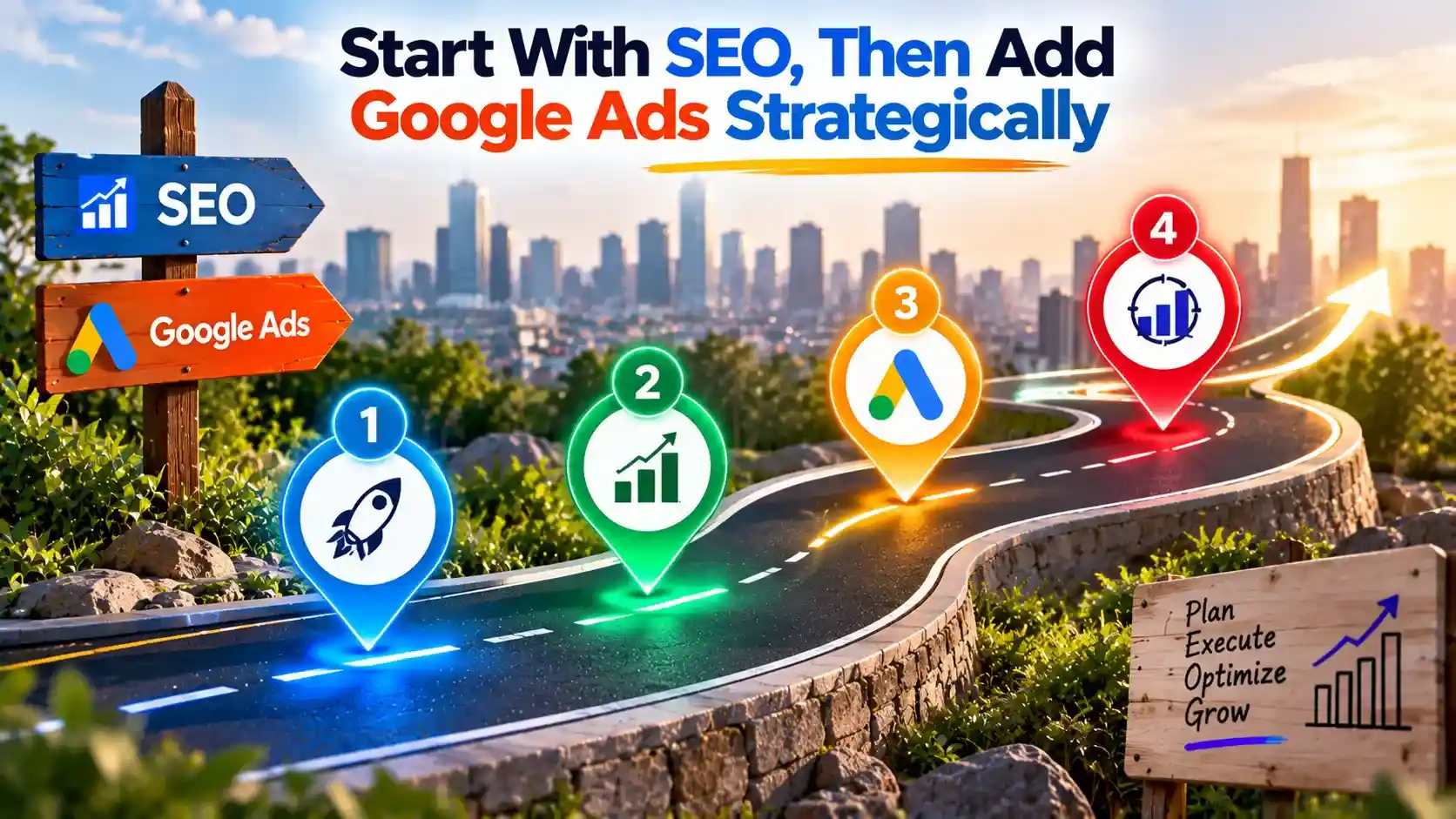
Focus on:
Develop:
Use Google Ads for:
Analyze which:
Then optimize both SEO and Ads accordingly.
I would prioritize SEO when a business:
If you want an acquisition channel that can continue producing organic opportunities over time, SEO is valuable.
Industries where customers research before buying can benefit significantly from content-driven SEO.
Businesses with healthy customer lifetime value can justify the longer investment horizon.
Local SEO can be particularly valuable for businesses that depend on customers within a defined geographic area.
Building organic visibility can diversify acquisition.
Businesses with genuine knowledge can turn that expertise into content and authority.
Google Ads can make more sense when:
A new business may not have enough organic visibility to wait for SEO.
Paid search can test demand quickly.
Searchers actively looking for a provider can be valuable.
You may need additional visibility during specific periods.
Emergency plumbing, emergency HVAC, roadside services, and similar businesses can benefit from immediate search visibility.
Ads can help determine whether a keyword or offer converts before committing heavily to long-term SEO.
Paid search can provide another route to visibility while SEO develops.
For a local business, I generally wouldn’t start by trying to dominate national search.
I’d start with:
Local SEO + Google Business Profile + Service Pages + Reviews
Then build outward.
For example, an HVAC company might prioritize:
Google says local search results are primarily influenced by relevance, distance, and prominence, and that complete business information and reviews can contribute to local visibility.
Google Ads can then supplement those organic efforts for high-value searches.
Healthcare is another industry where the two channels can work together.
A healthcare provider may need visibility for:
SEO can help build long-term educational visibility.
Google Ads can help capture high-intent searches where immediate patient acquisition is important.
However, healthcare marketing requires additional attention to:
The content strategy should never sacrifice accuracy for search visibility.
Professional services often have longer decision cycles.
Think:
A potential client may research a provider for weeks before contacting them.
SEO can help capture those research searches.
Content can answer:
Google Ads can capture high-intent commercial searches at the moment the prospect is ready to take action.
Again, combining the channels can be powerful.
Startups have a unique problem:
They often need customers before they have established organic authority.
That’s where Google Ads can be useful.
A startup can use paid campaigns to test:
At the same time, SEO can build long-term visibility.
I wouldn’t recommend waiting to start SEO until the startup is “big enough.”
Start building the foundation early.
But I also wouldn’t tell a startup with no traffic and urgent revenue needs to rely exclusively on SEO.
They aren’t.
They’re two different acquisition mechanisms.
SEO can answer:
“How do we build sustainable organic visibility?”
Google Ads can answer:
“How do we buy targeted visibility right now?”
The best marketers understand how they interact.
Suppose you run Google Ads and discover:
Keyword A → 8% conversion rate
Keyword B → 1.5% conversion rate
Keyword C → 6% conversion rate
That data can inform your SEO strategy.
Why spend months pursuing a keyword with weak commercial performance when another search is consistently producing customers?
Paid search can provide valuable real-world conversion data.
The reverse is also true.
Suppose organic search reveals:
Those insights can inform paid campaigns.
That’s why I prefer integrated search strategies.
Our work with Berks Plumbing & HVAC Specialist demonstrates the value of building organic search visibility around customer needs.
The campaign wasn’t simply about increasing keyword usage.
We focused on:
The website gained visibility for question-based searches and featured snippets and began appearing in Google AI Overview answers.
The campaign also contributed to:
Approximately 10× traffic growth
and
More than 2× lead generation.
This is important because it demonstrates why SEO shouldn’t be evaluated only by rankings.
The ultimate value is what happens after visibility.
Traffic → Leads → Customers
That’s the business case for SEO.
Let’s imagine a new HVAC company launches in a competitive U.S. market.
It has no meaningful organic visibility.
The company could spend months building SEO before gaining significant traction.
Instead, it could use Google Ads to target searches such as:
This can generate immediate exposure.
At the same time, the business should build:
The short-term and long-term strategies support each other.
This is an underused strategy.
Suppose you aren’t sure whether a particular service has enough commercial demand.
Instead of spending six months trying to rank organically, you could run a controlled paid campaign.
If the search produces:
you have evidence that the topic deserves deeper SEO investment.
Paid search can therefore become a market intelligence tool.
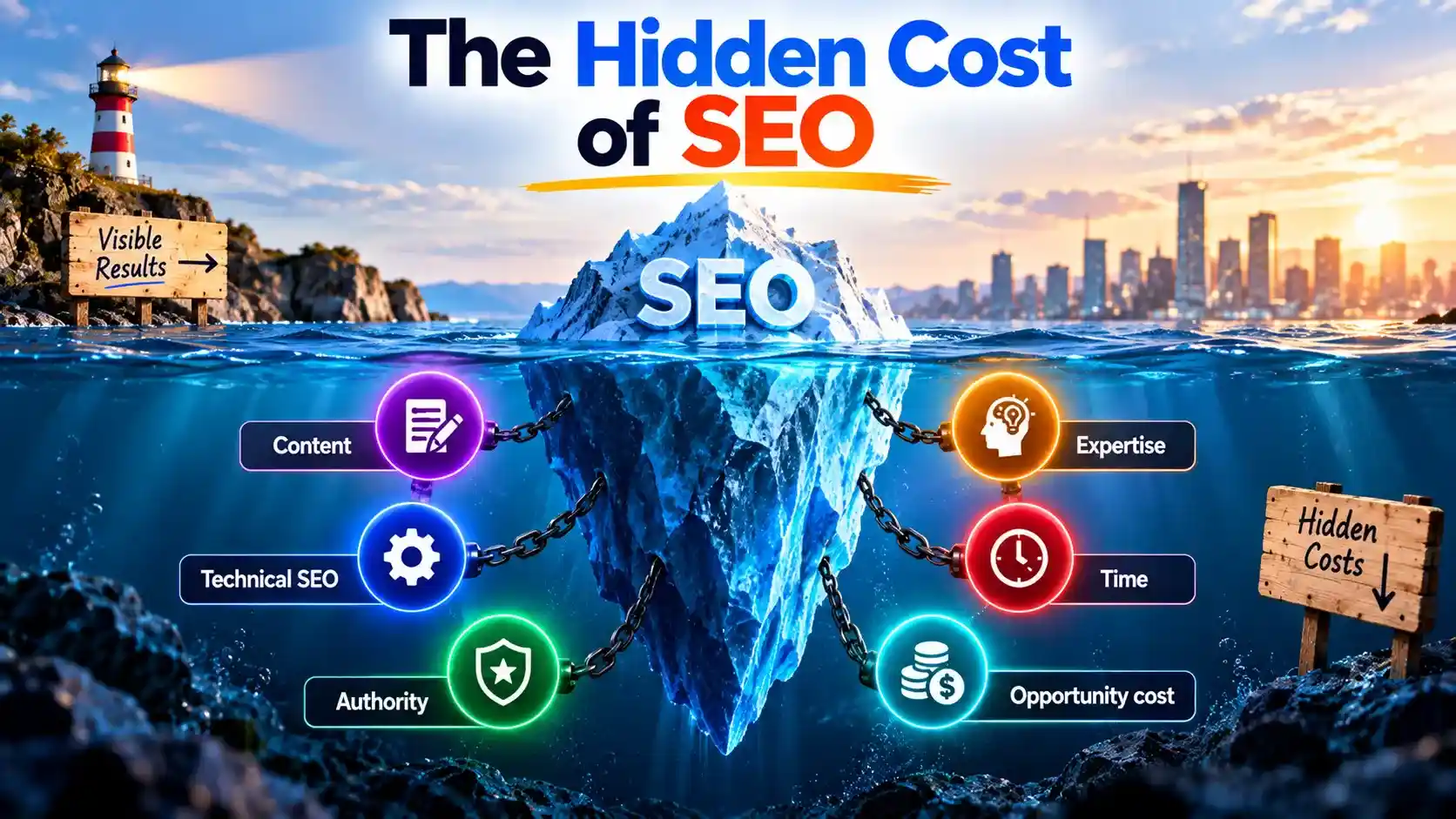
SEO has a reputation for being “free traffic.”
It isn’t.
Organic clicks don’t have a direct CPC, but SEO requires investment.
Costs can include:
Good content requires research, writing, editing, expertise, and updating.
Websites need ongoing technical maintenance.
Competitive industries may require legitimate digital PR and link acquisition.
High-value topics require subject-matter knowledge.
SEO is rarely instantaneous.
Money invested in SEO can’t simultaneously be invested elsewhere.
So don’t compare:
$3,000 SEO
with:
$3,000 Ads
as if they purchase exactly the same thing.
They don’t.
Google Ads also has costs beyond the advertised budget.
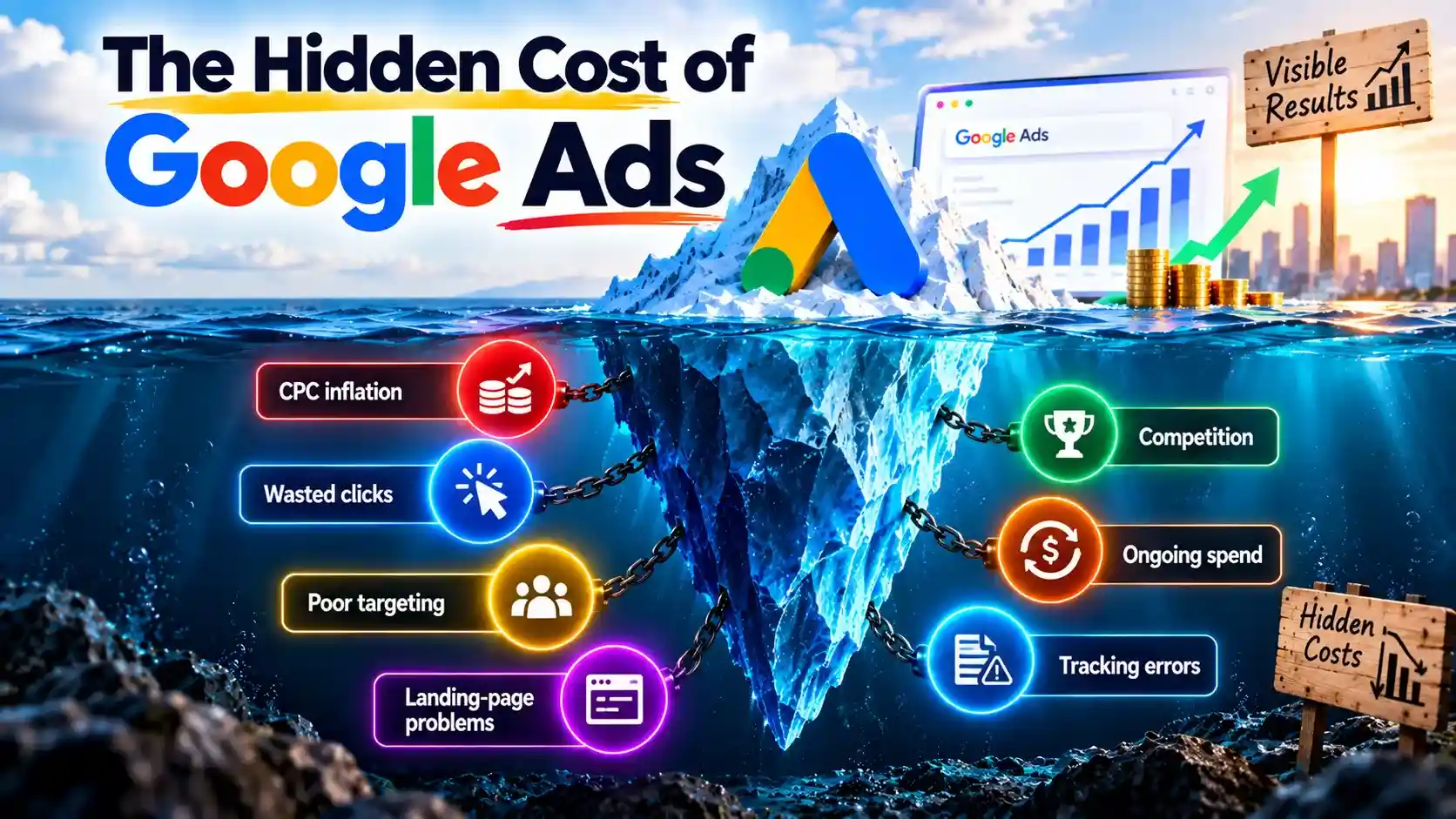
Competitive keywords can become expensive.
Not every click becomes a customer.
Broad targeting can attract irrelevant traffic.
A strong ad can’t rescue a poor conversion experience.
Your competitors can bid on the same high-value searches.
When the budget stops, paid visibility generally stops.
If conversion tracking isn’t configured correctly, you may make decisions based on misleading data.
This is why Google Ads should be managed as a profitability channel, not simply a traffic channel.
A simplified formula is:
SEO ROI = (Revenue Attributed to SEO − SEO Investment) ÷ SEO Investment × 100
For example:
SEO investment:
$36,000
Attributed revenue:
$90,000
SEO ROI:
($90,000 − $36,000) ÷ $36,000 × 100 = 150%
Real-world attribution can be considerably more complicated, particularly for businesses with long customer journeys and multiple marketing touchpoints.
So treat attribution as a model rather than absolute truth.
For paid advertising, you can calculate:
ROAS = Attributable Revenue ÷ Ad Spend
If you spend:
$10,000
and generate:
$40,000
in attributable revenue:
ROAS = 4×
But don’t stop there.
Calculate customer acquisition cost:
CAC = Total Acquisition Cost ÷ Number of New Customers
If the cost of acquiring a customer is greater than the profit or lifetime value that customer generates, a high click-through rate doesn’t save the campaign.
Here’s my answer:
Google Ads often wins for speed.
SEO can win on efficiency and cumulative value.
Google Ads can provide immediate visibility while SEO is being built.
SEO can become a powerful sustainable acquisition channel.
Local SEO + Google Ads can work extremely well together.
Both can be highly profitable when properly managed.
There is no universal ROI winner.
The better question is:
“Which channel should receive what portion of our acquisition budget at this stage of the business?”
That changes the conversation.
A startup may need more paid acquisition initially.
An established local business may benefit from heavier SEO investment.
A seasonal business may increase Google Ads during peak demand while maintaining SEO throughout the year.
A professional-services firm may invest heavily in content and organic authority while using paid search selectively.
Strategy should follow economics.
For many U.S. small and mid-sized businesses, I’d recommend a model like this.
Website
Fix:
SEO
Build:
Tracking
Implement:
Develop:
Launch Google Ads around:
Use data to determine:
Then reinvest accordingly.
The search environment is expanding beyond traditional blue links.
Google’s current guidance says established SEO fundamentals remain relevant for AI features such as AI Overviews and AI Mode, while encouraging unique, valuable content that isn’t simply commodity information. (developers.google.com)
That makes the relationship between SEO and AI search important.
The content you create for SEO can also support:
This is another reason I don’t recommend treating SEO as outdated.
Instead, modern SEO should expand to include AEO and GEO considerations.
For businesses competing in 2026, I increasingly think about search visibility as a three-layer system.
Build organic rankings and sustainable visibility.
Make content useful for answer-driven searches and questions.
Improve the brand’s visibility across generative AI search experiences.
Capture immediate high-intent demand.
Together:
SEO → Sustainable visibility
AEO → Answer visibility
GEO → Generative search visibility
Google Ads → Immediate paid visibility
That’s a much more complete search strategy.
There isn’t a universal number.
But for the types of U.S. businesses we commonly discuss – local businesses, healthcare, home services, professional services, and startups – I would generally consider $1,000–$1,500 per month a reasonable minimum starting point for a serious ongoing digital marketing program, depending on competition and scope.
A business with a highly competitive market may need substantially more.
The critical point is not simply how much you spend.
It’s whether the investment is allocated toward the channels most likely to generate profitable customers.
Example Allocation
A business with a $2,500 monthly marketing budget might prioritize:
SEO + Local SEO: Core investment
Content: Supporting investment
Google Ads: Focused high-intent campaigns
Social: Targeted presence
Analytics: Essential
A different business might allocate more toward paid acquisition.
The strategy should be based on customer acquisition economics.
Before investing, ask:
1. How quickly do we need leads?
If the answer is “immediately,” Google Ads becomes more attractive.
2. How competitive is our organic market?
Extremely competitive keywords may require a longer SEO investment.
3. What’s our customer lifetime value?
Higher LTV can justify higher acquisition costs.
4. What’s our conversion rate?
Traffic doesn’t matter if the website can’t convert.
5. What is our target CAC?
Know what you can afford to spend acquiring a customer.
6. Do we have existing organic authority?
If yes, SEO may have a head start.
7. Are we a local business?
If yes, local SEO should usually be evaluated early.
8. Do customers research before purchasing?
If yes, SEO and content can capture that research journey.
9. Is demand seasonal?
If yes, paid search can help capture demand during peak periods.
10. Can we track leads and revenue?
If not, fix measurement before aggressively increasing spend.
Traffic isn’t the same as sustainable acquisition.
SEO requires significant investment.
A longer time horizon doesn’t make an investment bad.
Building organic authority earlier can provide a competitive advantage later.
This makes optimization extremely difficult.
Focus on commercially meaningful searches.
Not if the traffic doesn’t convert.
In many cases, integrated search marketing produces the strongest strategy.
Use this simplified framework.
| Your Situation | Recommended Priority |
| Brand-new business | SEO foundation + Google Ads |
| Need leads immediately | Google Ads |
| Established website | SEO + selective Google Ads |
| Local business | Local SEO + Google Ads |
| Seasonal business | SEO year-round + Ads during peaks |
| Strong organic visibility | SEO + strategic Ads |
| Highly competitive organic market | SEO + Paid Search |
| Long customer journey | SEO + Content |
| New service launch | Google Ads + SEO |
| Limited budget | Focused SEO/local SEO first |
| Strong customer lifetime value | Invest in both |
| Poor website | Fix website before scaling Ads |
If a U.S. business asks us:
“Should we invest in SEO or Google Ads?”
our answer generally isn’t one or the other.
We recommend building the SEO foundation first and then using Google Ads strategically based on business needs.
Why?
Because we want the business to build an asset that can generate sustainable organic visibility while using paid search where immediate demand capture makes sense.
The strategy can include:
Website & Technical SEO
↓
Local SEO
↓
Search & Question Research
↓
Content Optimization
↓
Topical Authority
↓
AEO/GEO
↓
Google Ads
↓
Conversion Optimization
↓
ROI Measurement
This allows us to connect search visibility with actual business outcomes.
MetaSense Marketing provides digital marketing services that include SEO and broader digital marketing solutions for businesses looking to improve online visibility and growth. MetaSense Marketing
Its iMetaDex™ platform is also positioned by the company as an AI-driven SEO technology designed to help improve Google visibility. Learn more about MetaSense.
If you’re looking for a simple answer:
Google Ads is usually better for immediate visibility.
SEO can be better for sustainable, long-term organic growth.
But the smartest strategy for many businesses isn’t choosing one.
It’s combining them intelligently.
Start by building a strong SEO foundation.
Build local visibility where relevant.
Create useful content around customer questions.
Develop topical authority.
Improve your website’s ability to convert visitors.
Then use Google Ads to capture high-intent demand, test opportunities, support new services, and generate leads while your organic presence grows.
Over time, use data from both channels to determine where the next dollar should go.
Because the real question isn’t:
“Which channel gets more clicks?”
It’s:
“Which channel generates the most profitable customers at a sustainable acquisition cost?”
That’s how I would evaluate SEO and Google Ads.
And that’s the approach we take at MetaSense Marketing: search visibility is valuable, but business outcomes are the real measure of ROI.
If your business needs help deciding how much to invest in SEO, Local SEO, Google Ads, AEO, or GEO, MetaSense Marketing can help build a search strategy around your market, competition, customer intent, budget, and measurable growth objectives.
Neither is universally better. Google Ads generally provides faster visibility, while SEO can provide longer-term organic value. The right choice depends on the business and its acquisition goals.
Not necessarily. SEO requires investment in strategy, technical work, content, expertise, and authority. However, organic traffic doesn’t require a direct payment for each click.
Google Ads does not directly improve organic rankings. However, paid campaigns can provide useful data about keywords, messaging, audiences, and conversions that can inform SEO strategy.
It varies significantly by industry, competition, website authority, technical condition, content quality, and investment. SEO typically requires a longer time horizon than Google Ads.
A properly configured campaign can begin generating impressions and clicks shortly after launch, but meaningful lead generation depends on search demand, targeting, competition, ad quality, landing pages, and conversion tracking.
For many small businesses, I recommend starting with SEO and local SEO while using Google Ads strategically for high-intent searches and immediate lead-generation needs.
Yes. In fact, combining them can provide both immediate paid visibility and longer-term organic growth.
Local SEO should generally be a core priority for businesses dependent on customers in a defined geographic area. Google Ads can supplement it, especially for high-intent and urgent searches.
It can be, particularly when a new business needs immediate visibility and has a strong offer and conversion-ready website. But building the SEO foundation at the same time is important for long-term growth.
ROAS means Return on Ad Spend. It measures attributable revenue relative to advertising expenditure.
At minimum, track organic traffic, conversions, leads, qualified leads, and ultimately customers and revenue where attribution allows.
Track ROAS, revenue, customer acquisition cost, qualified leads, conversion rate, traffic, cost per conversion, and ultimately customer profitability.
Prioritize the channels closest to your customers and strongest commercial intent. For many local businesses, that means establishing the website, technical SEO, Google Business Profile, and local SEO foundation before expanding into multiple paid and social channels.