For a small business in the United States, digital marketing can feel unnecessarily complicated.
You hear that you need SEO.
Then someone tells you to run Google Ads.
Another person says social media is essential.
Someone else recommends email marketing, video, influencer marketing, content marketing, AI search optimization, and a dozen other channels.
The result?
Many small businesses try to do everything at once and end up doing nothing particularly well.
That’s the wrong approach.
A small business doesn’t need to dominate every digital channel. It needs to identify where its customers are looking, what those customers need, and which marketing activities are most likely to generate qualified leads and revenue.
For many U.S. small businesses, particularly local businesses, healthcare providers, home-service companies, professional services firms, and startups – the best starting point is usually a strong website, technical SEO, Google Business Profile and local SEO, followed by content optimization and carefully selected social and paid channels.
Google itself says local search visibility is primarily influenced by relevance, distance, and prominence, while complete Business Profile information, reviews, and other business signals can contribute to local visibility.
And search itself is evolving.
Google is increasingly incorporating AI-generated experiences into Search, while AI platforms are creating new ways for people to discover businesses and information. Google’s 2026 documentation now includes dedicated guidance for optimizing for generative AI features and emphasizes that traditional SEO fundamentals remain relevant.
That means a small-business marketing strategy in 2026 needs to accomplish two things at once:
Build a strong foundation for traditional search and local discovery while preparing the business for newer AI-driven search experiences.
At MetaSense Marketing, that’s how we approach digital marketing.
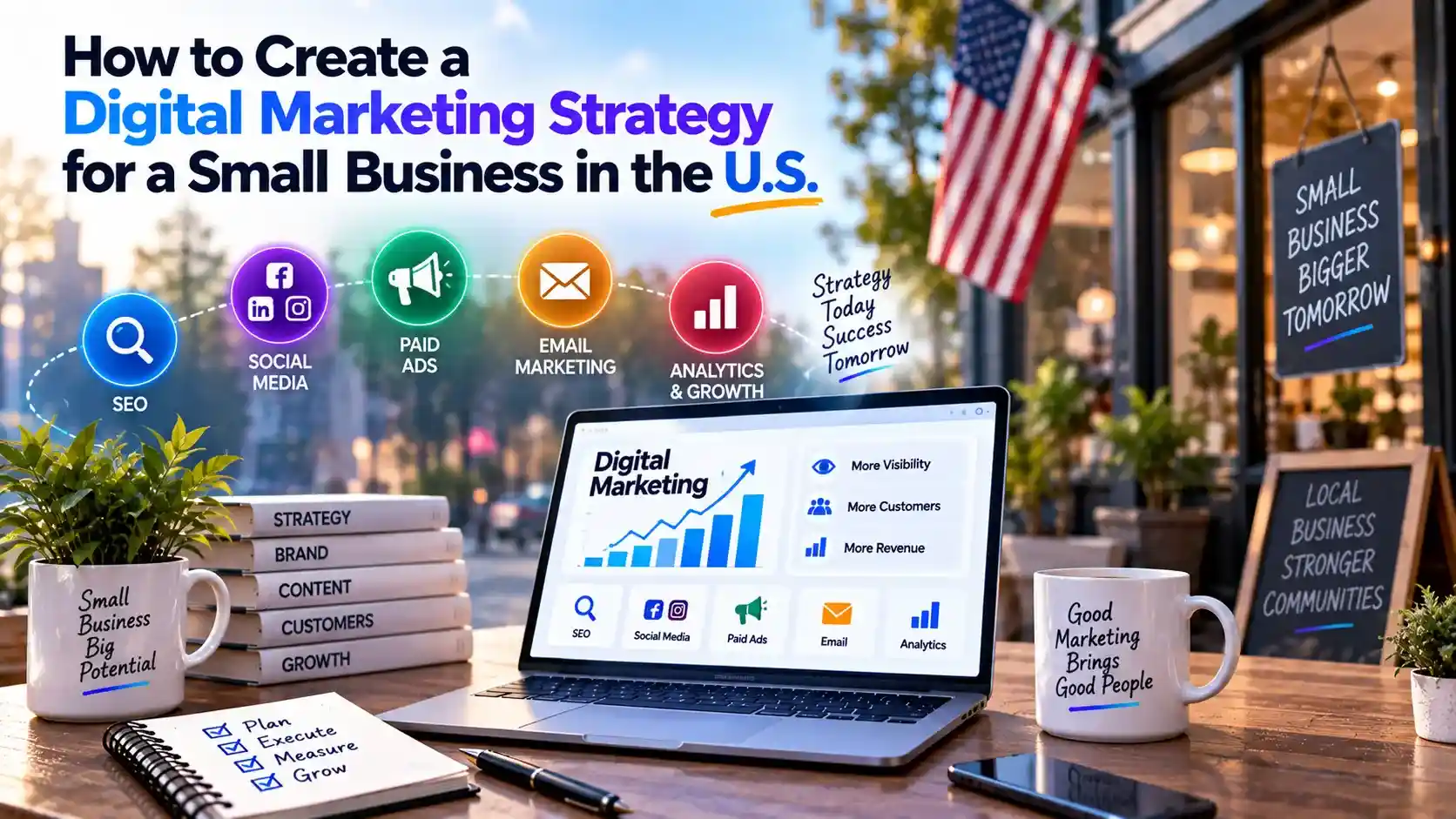
This guide walks through how to create a practical digital marketing strategy for a small business in the U.S., what to prioritize, how much to budget, what to measure, and what mistakes to avoid.
A digital marketing strategy is a structured plan for using online channels to:
It is not simply a list of platforms.
A strategy answers:
Who are we trying to reach?
What problem do we solve?
Where do our customers search for solutions?
What information do they need before buying?
Which channels can reach them efficiently?
How much can we invest?
How will we measure the return?
That distinction is important.
A business can have Facebook, Instagram, LinkedIn, a website, Google Ads, and a blog and still have no digital marketing strategy.
Having channels is not a strategy.
Having a reason for using each channel is.
A large corporation may have:
A small business usually doesn’t.
It may have one owner managing marketing between sales calls and operations.
That changes the strategy.
For a small business, marketing should prioritize:
Focus over volume.
Local relevance over broad visibility.
High-intent customers over vanity traffic.
Conversion over follower counts.
Sustainable growth over short-term tactics.
This is particularly important for businesses that serve a specific geographic market.
A local plumber in Phoenix doesn’t need 100,000 website visitors from around the world.
They need the right people in Phoenix searching for plumbing services.
A local dental practice doesn’t need thousands of followers in other states.
It needs qualified patients within its service area.
A local law firm doesn’t need to rank nationally for every legal term.
It needs visibility for the services and locations that drive cases.
Before choosing a marketing channel, define what the business actually wants to accomplish.
Common goals include:
Be specific.
Instead of:
“We want more traffic.”
use:
“We want 30 additional qualified service inquiries per month.”
Instead of:
“We want better social media.”
use:
“We want to generate 10 qualified consultations per month from social media.”
Instead of:
“We want better SEO.”
use:
“We want to increase non-branded organic traffic by 40% and generate more qualified leads from local searches.”
The more specific the goal, the easier it becomes to decide which marketing activities deserve investment.
Before optimizing your website or launching ads, understand who you’re trying to reach.
For a U.S. small business, I would examine:
Location
Where are your customers?
Demographics
Depending on the business:
Buying intent
Are they:
Customer questions
What do customers ask before contacting you?
Existing customers
Your current customers can tell you:
Search behavior
What do potential customers type into Google?
What questions do they ask?
What services do they search for?
What locations do they include?
What comparisons do they make?
This research becomes the foundation of your content and SEO strategy.
Not every customer starts with:
“Buy this product.”
The journey may look like:
Problem → Research → Questions → Comparison → Provider search → Contact → Purchase
For a home-service business:
“Why is my AC not cooling?”
may become:
“How much does AC repair cost?”
which becomes:
“AC repair company near me”
which becomes:
“Best AC repair company in Dallas”
which finally becomes:
Phone call or appointment.
Your digital marketing strategy should address this entire journey.
That’s why a small business shouldn’t only create service pages.
It should also create helpful content that addresses the questions customers ask before they become ready to buy.
Your website is the foundation of your digital marketing system.
If the website is slow, confusing, difficult to navigate, poorly structured, or unclear about what the business offers, increasing traffic won’t solve the fundamental problem.
A strong small-business website should clearly communicate:
Essential website elements
Your website should generally include:
Don’t make customers hunt for your phone number
If generating phone calls is a major objective, the phone number should be easy to find.
If appointments are important, the appointment CTA should be obvious.
If quote requests are the primary conversion, make the quote process straightforward.
Your website shouldn’t force visitors to solve a puzzle before contacting you.
Before investing heavily in content or paid advertising, make sure search engines can access and understand your website.
Review:
Technical SEO doesn’t necessarily generate customers by itself.
Its role is to remove obstacles that can prevent your content and website from performing properly in search.
For many U.S. small businesses, Google Business Profile and local SEO should be among the first marketing priorities.
If you operate locally, customers may find you through:
Google says complete and accurate Business Profile information can help businesses appear for relevant local searches. It also explains that local results are primarily based on relevance, distance, and prominence.
Your Business Profile should accurately represent:
And don’t treat your profile as something you create once and forget.
Monitor it.
Keep information accurate.
Respond to reviews.
Add useful visual content.
For most local small businesses, I would prioritize local SEO before trying to compete nationally for broad keywords.
Why?
Because local searches often have strong commercial intent.
Someone searching:
“HVAC company near me”
is probably closer to making a decision than someone searching:
“What is HVAC?”
That doesn’t mean informational content is unimportant.
It means you should build both.
Local SEO should include:
Google states that prominence can include information from across the web, including links and articles, and that review count and ratings can contribute to local ranking.
This is an important warning.
Suppose a company serves:
Creating six genuinely useful location pages can make sense if each location has meaningful information.
But creating:
Best Plumber in Dallas
Best Plumber in Plano
Best Plumber in Frisco
with essentially the same content and only changing the city name isn’t a strong local SEO strategy.
Each page should provide genuine local value.
For example:
Don’t create pages simply to capture city-name variations.
Small businesses often make a costly mistake:
They target keywords that are too broad.
A new local business might try to rank for:
“SEO”
or:
“Plumbing”
or:
“Healthcare”
Those searches can be extremely competitive and may not even reflect the business’s immediate commercial opportunity.
Instead, look for more specific searches.
For example:
“SEO agency for small businesses in New Jersey”
“Emergency plumber in Dallas”
“Family dentist in Austin”
“Healthcare staffing agency in Philadelphia”
“HVAC repair company near me”
These searches communicate more information.
They include:
Long-tail keywords often give small businesses more realistic opportunities to compete.
Content marketing should not mean:
“Publish two blogs every week.”
It should mean:
“Create useful information that helps potential customers solve problems and make decisions.”
Research questions such as:
These questions can become:
One piece of research can produce content across multiple channels.
Search is changing.
Google’s 2026 documentation now provides specific guidance for generative AI features and emphasizes that traditional SEO best practices remain relevant. It also recommends creating unique, non-commodity content and provides guidance around local, shopping, image, and video content for AI search.
For a small business, this means content should be:
Don’t write for an imaginary “AI algorithm.”
Write for the customer.
Make the information clear enough that search systems can understand it.
This is where small businesses have an opportunity to outperform generic competitors.
A local HVAC company has technicians who have actually diagnosed HVAC problems.
A healthcare organization has professionals who understand its industry.
A law firm has attorneys with real case experience.
A restaurant has people who understand its customers and food.
Use that expertise.
Include:
Generic content is easy to reproduce.
First-hand expertise is harder to replicate.
Don’t publish random blog posts.
Build connected coverage around the subjects that matter to your business.
For an HVAC company, a topic cluster might include:
Core service
HVAC Repair Services
Supporting topics
Then connect those pages internally.
This creates a stronger information ecosystem than publishing unrelated articles every week.
Reviews are important for local businesses.
But don’t think of reviews simply as:
“We need more five-star ratings.”
The review process should be authentic.
Ask satisfied customers to leave honest feedback.
Make the process easy.
Respond professionally.
Learn from negative feedback.
Google specifically recommends responding to reviews and says that reviews and positive ratings can contribute to local prominence.
Don’t manufacture reviews.
Don’t buy reviews.
Don’t write fake reviews.
Don’t pressure customers into saying specific things.
Build a reputation customers genuinely want to talk about.
Small businesses don’t need to be everywhere.
Choose platforms based on customer behavior.
Can be useful for:
Useful for visually driven businesses such as:
Often valuable for:
YouTube
Useful for businesses that can demonstrate expertise visually.
Examples:
The objective isn’t to accumulate followers.
The objective is to reach the right audience and influence business outcomes.
Paid advertising can provide faster visibility than organic SEO.
But small businesses need discipline.
Don’t start with:
“Let’s spend money everywhere.”
Start with:
What action do we want the customer to take?
For example:
Then choose the appropriate campaign.
For high-intent local services, paid search can be particularly useful because customers may already be searching for the exact service they need.
But paid advertising should be evaluated based on:
Cost → Leads → Qualified Leads → Customers → Revenue
not simply:
Clicks → Impressions
SEO and paid search shouldn’t operate in completely separate worlds.
Paid campaigns can reveal:
SEO can reveal:
Use the data from one channel to improve another.
Content doesn’t have to exist in isolation.
Suppose you publish:
“How Much Does an HVAC Replacement Cost?”
You can turn that into:
One strong piece of research can become multiple marketing assets.
This is much more efficient for a small business than trying to create completely different ideas for every platform.
Email isn’t always the first priority for a new local business.
But once you have customers and leads, it can become highly valuable.
Use email for:
The advantage is that you’re building an audience you can communicate with without paying for every interaction.
There isn’t one universal budget.
But for the type of U.S. small businesses we’re discussing, I would consider $1,000–$1,500 per month a practical minimum starting point for serious ongoing digital marketing, depending on the market, industry, competition, and scope.
That doesn’t mean every business needs to spend $1,500 immediately.
It means businesses should be realistic about what professional marketing requires.
Focus on:
You can potentially expand into:
A larger budget can support:
The key isn’t the absolute number.
It’s how the budget is allocated.
A $1,500/month strategy with clear priorities can outperform a $5,000/month strategy scattered across ten unrelated channels.
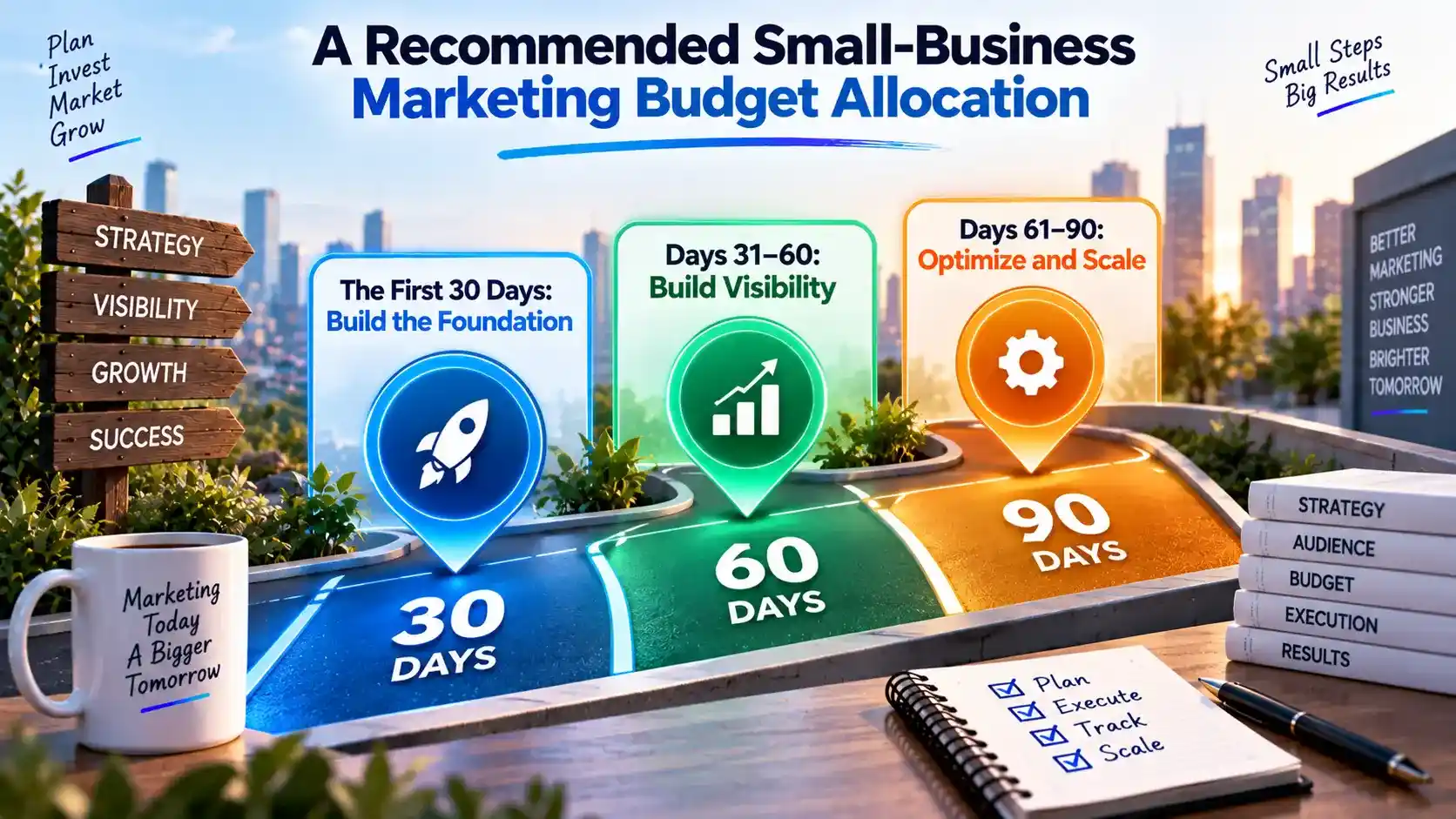
For a local small business starting from scratch, I might begin with something like:
Website + Technical SEO: Foundation
Google Business Profile + Local SEO: High priority
Content: Consistent investment
Social Media: Focused, not everywhere
Paid Ads: Controlled testing
Analytics/Tracking: Mandatory
The exact percentages should depend on the business.
A local emergency plumber and a B2B SaaS startup shouldn’t receive the same allocation.
During the first month, focus on understanding and fixing the basics.
Website
Local
Research
Measurement
Set up:
Don’t start spending heavily on ads before you can measure what happens after the click.
Now begin creating consistent visibility.
Focus on:
The goal is to build the beginning of a search and customer acquisition engine.
Now you have enough information to determine what’s working.
Review:
Then allocate more resources toward what is working.
Stop or reduce activities that aren’t producing meaningful outcomes.
This is where strategy becomes data-driven rather than assumption-driven.
Traffic is useful.
But traffic alone isn’t enough.
I recommend tracking several layers.
The most important progression is:
Traffic → Leads → Customers → Revenue
A business owner may tell me:
“Our Instagram gained 5,000 followers!”
My next question is:
“How many qualified customers did those followers generate?”
Similarly:
“Our website traffic increased 200%.”
Good.
But:
Did leads increase?
And:
Did revenue increase?
Marketing metrics need business context.
A smaller audience that generates customers can be more valuable than a massive audience that generates nothing.
AI search shouldn’t replace the foundational strategy.
It should become another layer.
For a small business, AI-search optimization can include:
Google’s 2026 guidance says established SEO practices remain relevant for generative AI features and specifically emphasizes creating unique, valuable content rather than relying on special AI-search tricks.
So a small business shouldn’t think:
“We need a completely separate AI marketing strategy.”
Instead:
“We need our existing digital presence to be useful across traditional and AI-driven search.”
This is one of the biggest advantages of a focused strategy.
A small company doesn’t need to beat a national corporation for every broad keyword.
It can win through:
Local relevance
Own the markets you actually serve.
Specific services
Target highly relevant service searches.
Long-tail content
Answer questions larger competitors ignore.
First-hand expertise
Demonstrate real experience.
Reviews
Build genuine local reputation.
Local authority
Develop relevant local mentions and relationships.
Topical authority
Become a trusted resource in a specific niche.
Customer experience
Turn satisfied customers into repeat business and referrals.
This is especially important for local businesses.
Google’s own description of local ranking emphasizes relevance, distance, and prominence, not simply who has the largest website.
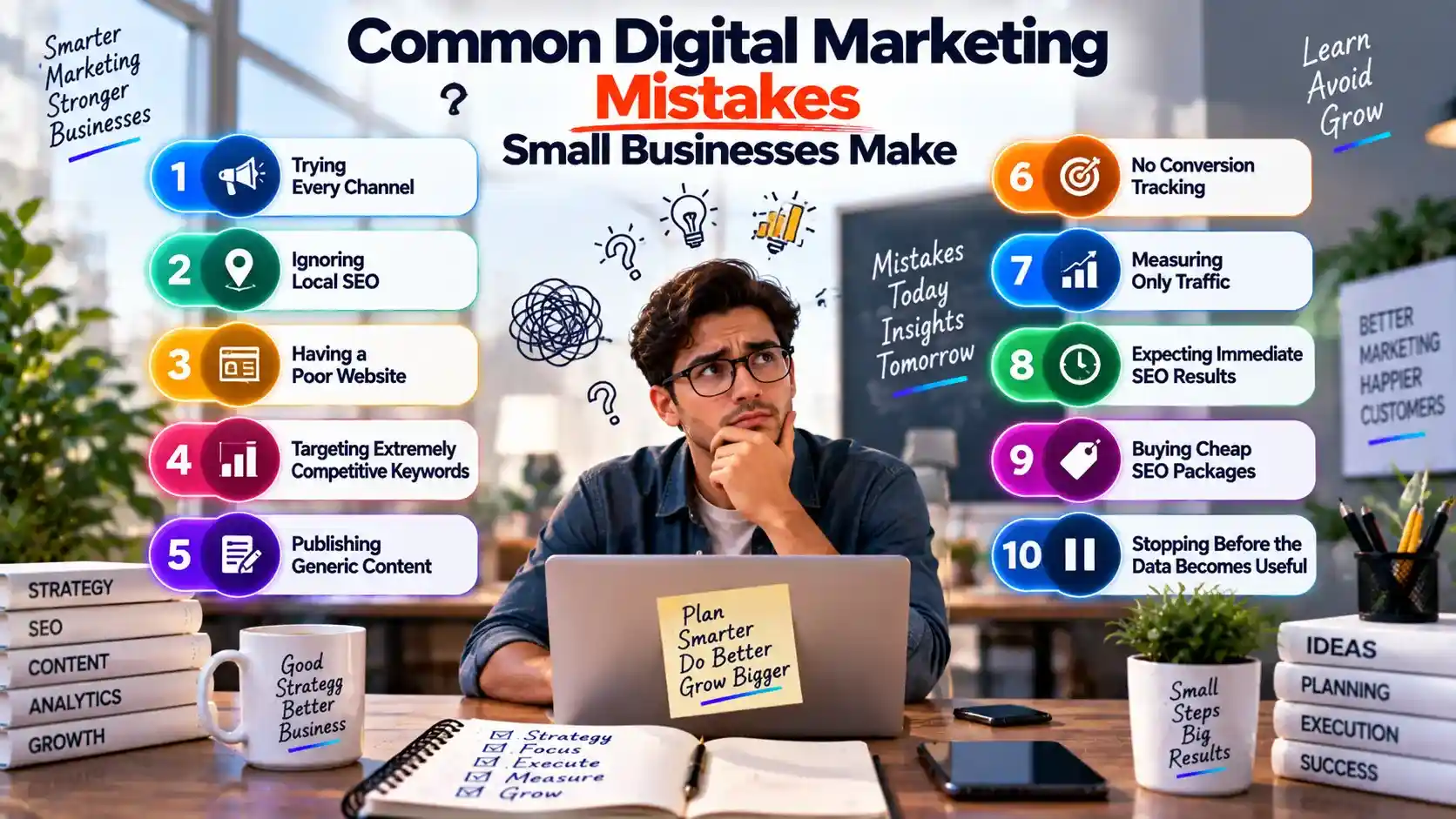
Facebook.
Instagram.
TikTok.
LinkedIn.
YouTube.
Google Ads.
SEO.
Email.
Influencers.
And suddenly the business has no budget or time left to execute any of them properly.
Better approach: choose the channels most closely connected to your customers and goals.
A local business without a strong Google Business Profile and local search strategy is often leaving high-intent visibility on the table.
Driving traffic to a confusing website doesn’t solve the conversion problem.
A new local business trying to rank nationally for a broad term can spend months without meaningful results.
Content should solve customer problems, not simply fill a blog calendar.
If you don’t know which channels generate leads, you don’t know where your marketing budget is working.
Traffic isn’t the same as revenue.
SEO requires time to build visibility and authority.
A low-cost package that produces hundreds of low-quality links or generic articles may create more problems than opportunities.
Marketing requires iteration.
You need enough time and data to understand what’s working.
Not every business should use the same playbook.
Local Home-Service Business
Examples:
Prioritize:
Healthcare Practice
Prioritize:
Healthcare content should also be handled with particular care around accuracy, expertise, privacy, and applicable regulations.
Professional Services
Examples:
Prioritize:
Startup
Prioritize:
The strategy should evolve as the startup discovers which audience segments and acquisition channels produce the strongest economics.
A good digital marketing strategy should ultimately be judged by business outcomes.
One example from our work is Berks Plumbing & HVAC Specialist.
The campaign focused on understanding the questions and problems potential customers were searching for rather than simply trying to increase keyword frequency.
The strategy included:
The campaign contributed to:
Approximately 10× growth in traffic
and
More than 2× lead generation.
The client also gained increased visibility for question-based searches, featured snippets, and Google AI Overview answers.
The lesson is particularly relevant to small businesses:
You don’t necessarily need to publish more content. You need to publish the right content for the right audience and connect it to a clear business objective.
For a local business, the path can look like:
Customer Question → Useful Content → Search Visibility → Service Page → Lead → Customer
That’s digital marketing working as a system.
At MetaSense Marketing, we believe small businesses need a strategy built around focus and measurable outcomes, not an endless list of marketing activities.
Our approach can begin with:
Business Goals
↓
Audience Research
↓
Competitor Research
↓
Website & Technical SEO
↓
Google Business Profile & Local SEO
↓
Keyword + Question Research
↓
Content Optimization
↓
Social & Paid Media
↓
AEO/GEO & AI Search Visibility
↓
Conversion Tracking
↓
Performance Optimization
The exact mix changes based on the business.
A local home-service company may need to emphasize local SEO and Google Ads.
A professional-services company may need more emphasis on authority-driven content and LinkedIn.
A healthcare organization may need a stronger combination of local search, educational content, reputation, and carefully managed paid acquisition.
The strategy should fit the business, not the other way around.
MetaSense has an established presence in healthcare, technology staffing, and digital marketing, and its website describes its digital marketing capabilities as helping clients improve web traffic, online presence, and sales.
MetaSense also describes its iMetaDex™ technology as patented AI-driven software designed to help businesses improve their Google visibility.
That combination of marketing expertise and technology can be particularly useful as businesses navigate the transition from traditional search toward AI-assisted discovery.
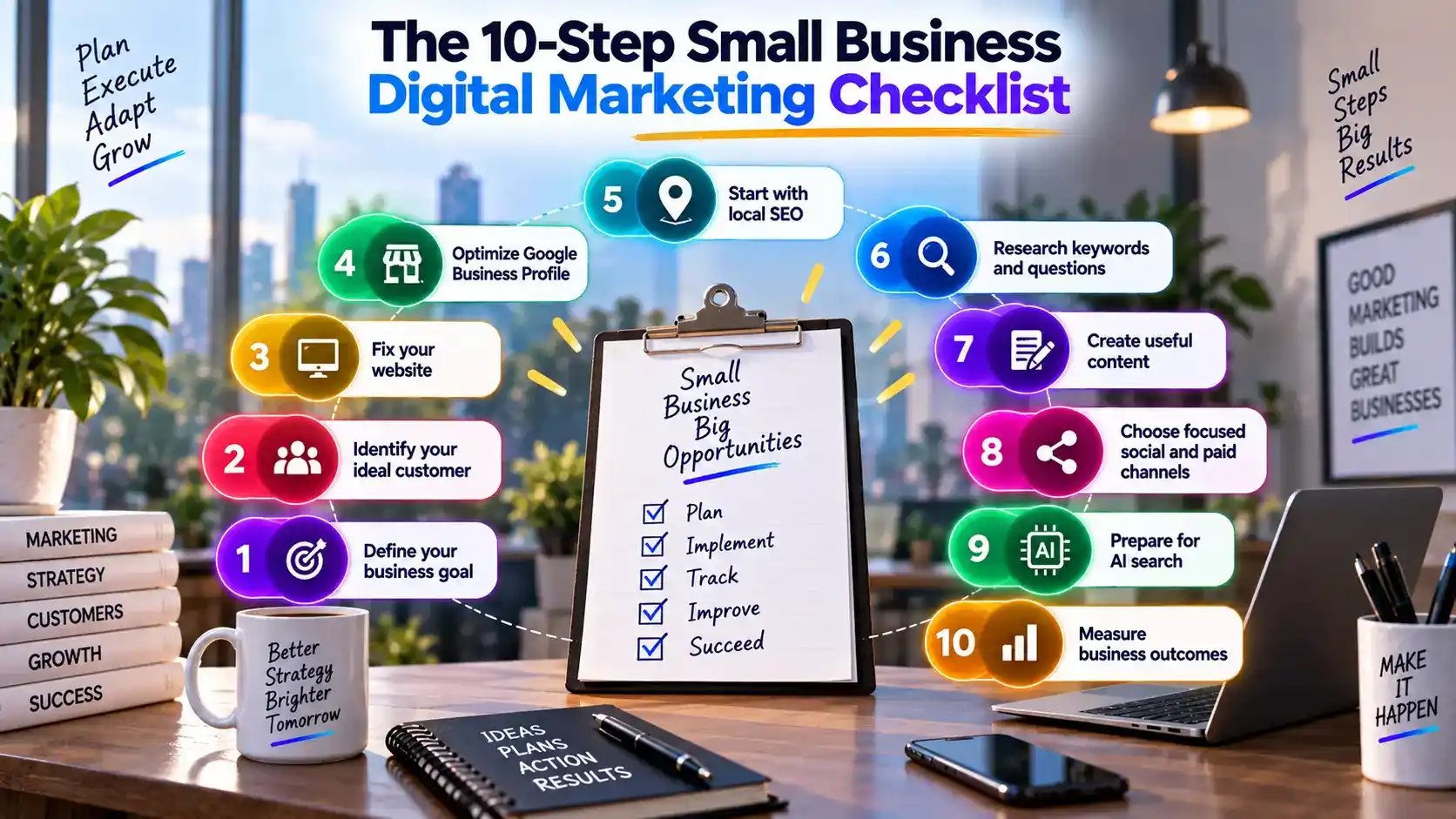
If you want a simplified version of the strategy, start here.
Know exactly what you want marketing to produce.
Understand location, demographics, needs, questions, intent, and behavior.
Make sure the foundation is technically sound and conversion-friendly.
Make your local business information accurate and complete.
Own the locations and services that matter most.
Understand what customers search for throughout their journey.
Answer real customer questions and demonstrate expertise.
Don’t try to be everywhere.
Build useful, authoritative content that can perform across traditional and generative search.
Track leads, calls, customers, acquisition costs, and ROI, not just traffic and followers.
Creating a digital marketing strategy for a small business in the U.S. doesn’t mean being active on every platform.
It means identifying where your customers are, what they need, and what marketing activity can most efficiently move them toward becoming a customer.
For many local and service-based businesses, the strongest starting point is:
Strong website
→ Technical SEO
→ Google Business Profile
→ Local SEO
→ Service and location pages
→ Customer-question content
→ Reviews and local authority
→ Focused social media
→ Strategic paid advertising
→ AEO/GEO and AI-search visibility
→ Conversion tracking
→ Continuous optimization
And throughout the process, keep asking one question:
Is this marketing activity helping us acquire the right customers at a sustainable cost?
That’s more important than how many blog posts you published, how many followers you gained, or how many keywords you rank for.
A small business doesn’t need to win every search.
It needs to become highly visible for the searches that matter to its customers and highly convincing once those customers arrive.
If you’re a U.S. small business looking to build a digital marketing strategy that combines SEO, Local SEO, content optimization, social media, paid advertising, AEO, and GEO, MetaSense Marketing can help you identify the highest-value opportunities and build a strategy around measurable growth.
The goal isn’t simply more online visibility. It’s more qualified traffic, more calls and leads, lower acquisition costs, and ultimately more customers and revenue.