For a small business, digital marketing can quickly become overwhelming.
One agency recommends SEO. Another says you need Google Ads. Someone else says social media is essential. Then there is content marketing, email marketing, Local SEO, AEO, GEO, digital PR, conversion optimization, and an endless list of other services.
Before long, a business owner can be spending thousands of dollars every month without knowing which activities are actually contributing to growth.
The problem isn’t that these services are useless.
The problem is that not every small business needs all of them at the same time.
A local plumber doesn’t need the same digital marketing strategy as a healthcare organization. A professional-services firm doesn’t need the same approach as an e-commerce startup. And a new business with no search visibility shouldn’t necessarily allocate its budget the same way as an established company with years of organic authority.
From my perspective as a Senior SEO Specialist, the right question isn’t:
“What digital marketing services can an agency sell me?”
It’s:
“Which digital marketing services can help my business reach the right customers, generate qualified leads, and produce a measurable return?”
That distinction can save a small business significant time and money.
In this guide, I’ll explain which digital marketing services small businesses actually need, what to prioritize first, what can wait, how the strategy changes by industry, and how SEO, Local SEO, Google Ads, content, social media, AEO, and GEO fit together.
For most U.S. small businesses, I’d start with five fundamentals:
Then, depending on the business, I’d add:
The exact mix should depend on:
A business shouldn’t pay for a service simply because it appears on an agency’s service page.
Large companies may have the resources to operate across:
A small business usually doesn’t.
It may have:
Trying to operate everywhere often leads to mediocre execution everywhere.
I’d rather see a local business dominate its most valuable local searches than create five social posts a day that generate no customers.
Focus is a competitive advantage for small businesses.
A useful way to think about small-business digital marketing is in three layers.
These form the foundation:
These help accelerate growth:
These can expand search and brand visibility:
This doesn’t mean every business has to follow the exact same sequence.
It means build the foundation before adding complexity.
Everything starts with your website.
Your website is where most digital marketing activities ultimately send customers.
If it’s difficult to use, difficult to understand, or difficult to trust, more traffic won’t necessarily produce more business.
A small-business website should clearly communicate:
Essential Website Elements
Your website should provide:
If you’re a plumber, make it easy to request a service.
If you’re a healthcare provider, make it easy to schedule an appointment.
If you’re a consultant, make it easy to book a consultation.
If you’re an e-commerce business, make purchasing straightforward.
The website should be built around the customer’s next action.
Technical SEO is the infrastructure that helps search engines discover, crawl, understand, and index your website.
For a small business, I would review:
Technical SEO isn’t always the most visible part of marketing.
Customers don’t see your canonical tags.
They don’t know whether your sitemap is properly configured.
But technical problems can prevent your content and pages from performing as well as they should.
Don’t Overcomplicate Technical SEO
A small business doesn’t necessarily need an enormous technical SEO project.
Prioritize problems that can materially affect:
Fix the issues that matter.
Keyword research isn’t simply finding words with high search volume.
It’s understanding:
What does the customer actually want when they search this phrase?
Consider these searches:
“What is HVAC?”
versus:
“HVAC repair near me.”
The first is informational.
The second is highly commercial.
Both can be valuable.
But they’re valuable at different stages of the customer journey.
Research Four Types of Search Intent
Informational
The user wants information.
Examples:
Commercial investigation
The user is comparing options.
Examples:
Transactional
The user is ready to take action.
Examples:
Local intent
The user wants a provider nearby.
Examples:
Your content strategy should address the different intents relevant to your business.
If your business depends on local customers, your Google Business Profile should be one of your priorities.
Google explains that local results are primarily influenced by relevance, distance, and prominence, and recommends keeping Business Profile information complete and accurate. Google also notes that reviews and positive ratings can contribute to local prominence.
Your profile should accurately represent:
But don’t stop at setup.
Continue maintaining it.
Respond to reviews.
Keep information accurate.
Add appropriate photos.
Monitor performance.
For a local small business, Local SEO is often one of the highest-priority services.
Instead of trying to rank nationally for:
“Plumber”
you may have a much stronger commercial opportunity targeting:
“Emergency plumber in Dallas”
or:
“Water heater repair near me”
Local SEO can involve:
Imagine two businesses.
Business A
Ranks nationally for an informational keyword but receives traffic from people who can’t become customers.
Business B
Ranks strongly for service searches within its actual market.
Business B may receive significantly fewer visitors but more qualified leads.
That’s why I care about relevant visibility, not just maximum visibility.
One of the most important assets on a small-business website is often overlooked:
Service pages.
A business shouldn’t rely entirely on its homepage.
If you offer:
Each important service should have a useful page where appropriate.
A good service page should explain:
Don’t create pages simply to target keywords.
Create pages that help customers make decisions.
Location pages can be valuable for businesses serving multiple markets.
But they need to provide real local value.
If you serve:
Don’t simply duplicate one page four times and replace the city name.
A useful location page might include:
The goal is local usefulness, not city-name repetition.
Content marketing can help small businesses attract customers before they’re ready to contact a company.
Think about the customer’s journey.
A homeowner may search:
“Why is my AC not cooling?”
Then:
“How much does AC repair cost?”
Then:
“Repair vs replacement?”
Then:
“Best HVAC company near me.”
If your business provides useful information throughout that journey, you create more opportunities to become part of the customer’s decision-making process.
Start with customer questions.
Ask:
Those questions can become:
Don’t create random content.
Build coverage around topics directly related to your business.
For an HVAC company:
Core topic
HVAC Services
Supporting topics
Then connect these pages through internal links.
This helps users navigate the website and helps search engines understand the relationship between your content.
One of the strongest opportunities for small businesses is answering questions that larger competitors overlook.
For example:
“How long does a water heater last?”
“How often should HVAC filters be changed?”
“How much does roof repair cost?”
“What should I ask before hiring a marketing agency?”
These questions are valuable because they reflect real customer concerns.
And they can support:
The objective isn’t to manipulate an algorithm.
It’s to become genuinely useful.
Getting people to your website is only half the job.
You also need to help them convert.
Look at:
Ask:
“If I were a potential customer, would I know exactly what to do next?”
If the answer is no, improve the conversion experience.
Google Ads can be particularly valuable when a business needs immediate visibility.
I would consider paid search for:
For example:
“Emergency HVAC repair near me”
can be extremely commercially valuable.
Paid search can capture that demand quickly.
But I wouldn’t recommend using Google Ads as an excuse to ignore SEO.
My preferred approach for many businesses is:
SEO foundation + strategic Google Ads
Not every small business needs every social platform.
Start with the audience.
Often useful for local businesses and community engagement.
Useful for visually driven businesses.
Often valuable for B2B and professional services.
YouTube
Excellent for businesses that can demonstrate expertise.
TikTok
Can be valuable for specific audiences and content formats.
The goal shouldn’t be:
“We need to be on every platform.”
The goal should be:
“Where can we reach the audience most effectively?”
For many local businesses, reputation is a major part of digital marketing.
Encourage satisfied customers to leave genuine, honest reviews.
Respond professionally to reviews.
Learn from negative feedback.
Don’t buy reviews.
Don’t manufacture reviews.
Don’t pressure customers into writing specific statements.
Google recommends businesses respond to reviews and notes that review count and positive ratings can contribute to local prominence.
Reputation isn’t simply an SEO tactic.
It’s a conversion factor.
A potential customer comparing two similar businesses may choose the one with stronger trust signals.
AEO is becoming increasingly relevant as users search for direct answers.
Instead of only optimizing for:
“HVAC repair”
you should also consider:
“How much does HVAC repair cost?”
“When should I replace my HVAC?”
“Why isn’t my AC cooling?”
AEO-focused content should:
This doesn’t mean adding an FAQ section to every page and expecting instant AI visibility.
The broader strategy is to make the entire website more useful for questions.
Generative Engine Optimization focuses on improving visibility and representation in AI-driven search experiences.
For a small business, this can involve:
AI search is evolving quickly, so I wouldn’t recommend chasing every new “AI optimization trick.”
Instead, build assets that make your business:
Useful + Relevant + Understandable + Credible + Mention-worthy
Google’s current guidance for AI features continues to emphasize established SEO fundamentals and useful, unique content.
This is not an optional service.
If you’re investing money into marketing, you need to know what happens afterward.
Track:
The exact tracking setup depends on the business.
But without measurement, you’re making marketing decisions based on assumptions.
Email may not be the first service I recommend to a brand-new local business with no audience.
But once a business has:
Email can become valuable.
Use it for:
The key is to build an audience that has a reason to hear from you.
As competition increases, simply having a website may not be enough.
Digital PR can help businesses earn:
For smaller businesses, this doesn’t necessarily mean trying to get featured in every major publication.
It can mean earning relevant recognition within the industries and communities that matter to your customers.
The answer changes significantly by business model.
Essential
Recommended
Advanced
Examples:
Priority
For these businesses, high-intent local searches can be particularly valuable.
Prioritize:
Healthcare content should receive particular attention to accuracy, expertise, trust, privacy, and applicable requirements.
Examples:
Prioritize:
A startup may need:
Paid search can provide faster market feedback while SEO builds the longer-term acquisition channel.
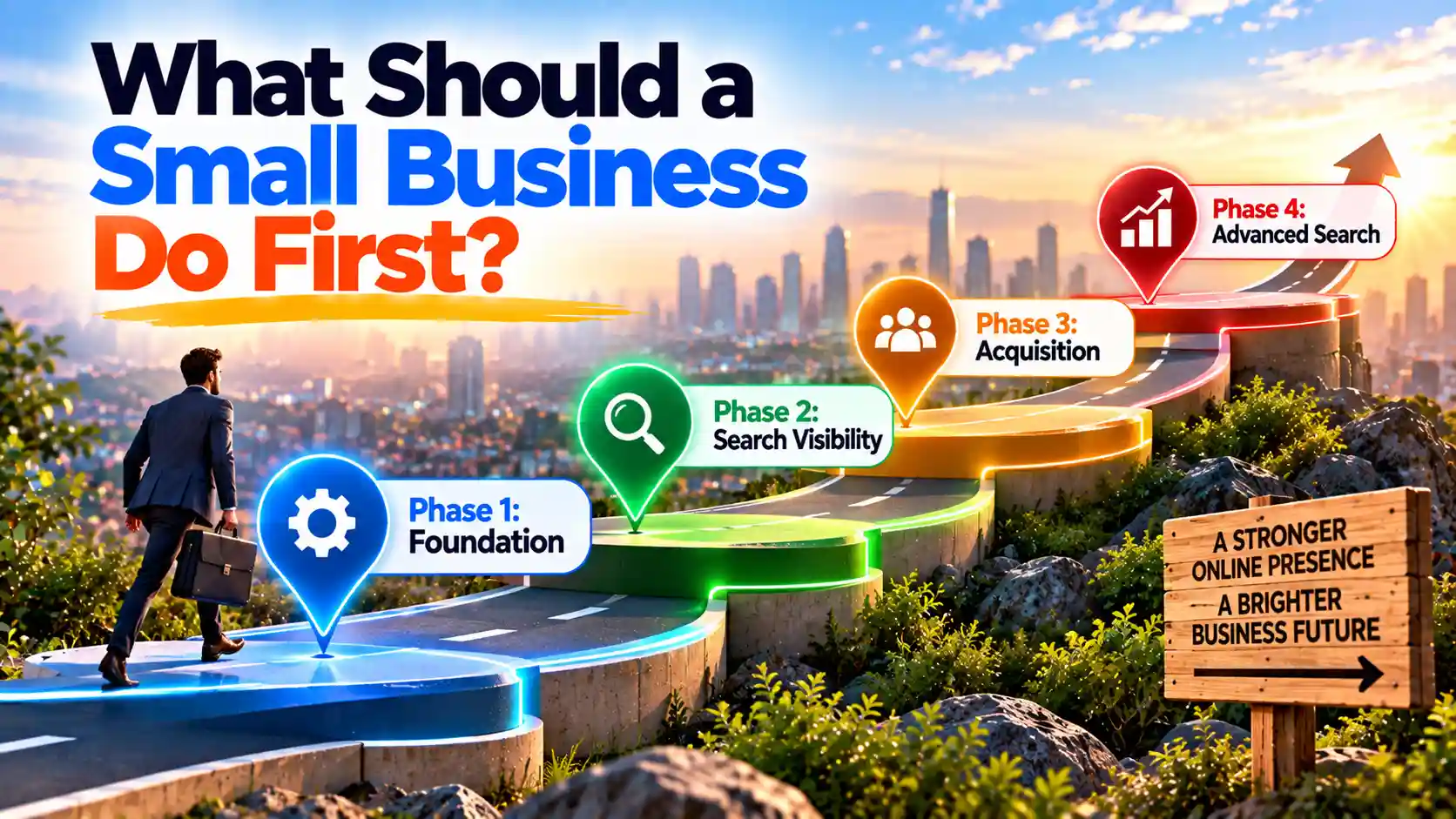
If I were starting with a small business today, I’d use this sequence.
Step 1
Define the business objective.
Step 2
Identify the ideal customer.
Step 3
Analyze competitors.
Step 4
Audit the website.
Step 5
Fix technical SEO.
Step 6
Set up conversion tracking.
Step 7
Optimize Google Business Profile if applicable.
Step 8
Research keywords and customer questions.
Step 9
Optimize core service pages.
Step 10
Build relevant location pages.
Step 11
Develop topical authority.
Step 12
Improve internal linking.
Step 13
Develop a review strategy.
Step 14
Launch strategic Google Ads where appropriate.
Step 15
Build focused social media.
Step 16
Expand content.
Step 17
Improve conversion rates.
Step 18
Expand AEO.
Step 19
Build GEO visibility.
Step 20
Develop digital PR and brand authority.
The order isn’t absolute.
If a business needs leads immediately, Google Ads may move earlier.
If it’s a local business, Local SEO may become the first priority.
That’s why strategy matters.
This is just as important.
Choose based on audience.
Focus on customer needs.
Local businesses should often dominate their relevant service areas first.
Technology should solve a problem.
Focus creates better execution.
Relevant authority is more important than arbitrary volume.
You need the right capabilities applied consistently.
Budget depends heavily on:
For the types of U.S. small businesses this article targets, I’d generally consider $1,000–$1,500 per month a practical minimum starting point for serious ongoing digital marketing, depending on the scope and competitive environment.
That doesn’t mean every business must spend exactly that amount.
It means businesses should understand that meaningful marketing requires resources.
A business spending $1,000/month should not expect the same breadth of work as a company investing $10,000/month.
If you have $1,000 per month, don’t spread it across:
Instead, identify the two or three activities most closely connected to revenue.
For a local plumber, that might be:
Local SEO + Google Business Profile + high-intent Google Ads
For a B2B professional-services firm:
SEO + content + LinkedIn
For a new e-commerce business:
Technical SEO + product optimization + paid search
Budget should determine focus, not simply reduce the quality of everything.
Don’t add a new service just because your competitor is doing it.
Add it when there’s a business reason.
For example:
Add Google Ads when:
You need faster demand capture.
Add content when:
Customers have meaningful questions and informational search demand exists.
Add social media when:
Your target audience is active on a relevant platform.
Add AEO when:
Question-based search is strategically important.
Add GEO when:
Your business wants to build visibility across generative AI experiences.
Add digital PR when:
Brand authority and relevant mentions can materially improve your market position.
Add conversion optimization when:
You’re generating traffic but not enough leads or sales.
This keeps the marketing strategy disciplined.
Imagine a business says:
“Our website gets traffic but we don’t generate enough leads.”
A poor recommendation might be:
“Let’s double your content production.”
But perhaps the real problem is:
More content wouldn’t necessarily fix that.
The correct approach is:
Diagnose → Identify bottleneck → Recommend solution → Measure
That’s how I believe digital marketing should work.
Our work with Berks Plumbing & HVAC Specialist is a good example of why small businesses shouldn’t think about marketing as simply purchasing individual services.
We focused on understanding what potential customers were searching for and how the website could better answer those needs.
The strategy included:
The campaign contributed to:
Approximately 10× Traffic Growth
and
More Than 2× Lead Generation
The website also gained visibility for:
The important lesson is that the result didn’t come from simply saying:
“Let’s create more content.”
The approach was:
Understand the customer → identify search demand → create useful answers → strengthen the website → build topical coverage → improve visibility → generate leads.
That’s what I believe small businesses should expect from a digital marketing strategy.
Every service should have a reason for existing.
Track:
Track:
Track:
Track:
Track:
Track where possible:
The exact metrics will vary.
But the principle remains:
Measure marketing against business objectives.
The biggest mistake a small business can make is assuming that successful digital marketing means doing everything.
It doesn’t.
A successful strategy starts with understanding:
Who are your customers?
What are they searching for?
Where are they searching?
What problems are they trying to solve?
What makes them choose one business over another?
What does it cost to acquire them?
Once you understand those questions, your marketing priorities become much clearer.
For many U.S. small businesses, I’d start with:
Website
→ Technical SEO
→ Google Business Profile
→ Local SEO
→ Service Pages
→ Customer-Question Content
→ Conversion Tracking
Then add:
Google Ads
→ Social Media
→ Content Marketing
→ Reputation
→ AEO
→ GEO
→ Digital PR
as the business grows and the data shows where additional investment can produce value.
The objective isn’t to make a small business visible everywhere.
It’s to make it highly visible where its customers are looking and make that visibility translate into qualified leads, customers, revenue, and sustainable growth.
At MetaSense Marketing, that’s the approach I would recommend: start with the business objective, understand the customer and search behavior, identify the biggest opportunity, build the foundation, and then expand the marketing strategy based on measurable results.
MetaSense Marketing provides digital marketing solutions designed to help businesses improve their online presence, traffic, and sales. Its iMetaDex™ platform is also positioned by the company as AI-driven technology focused on improving Google visibility. MetaSense Marketing
So before hiring an agency or purchasing another marketing package, ask yourself one question:
“Do I need more digital marketing services, or do I need a better digital marketing strategy?”
For most small businesses, strategy comes first.
The right services should follow.
Most small businesses should start with a strong website, technical SEO, search-intent research, conversion tracking, and Local SEO/Google Business Profile if they serve a geographic market. Additional services should depend on goals and audience.
Not every business needs the same level of SEO investment, but organic search can be valuable for businesses that depend on Google discovery and want sustainable traffic and lead generation.
If customers are primarily located within a defined service area, Local SEO should generally be a major consideration.
Not necessarily, but Google Ads can be highly useful when immediate visibility is needed, especially for high-intent, urgent, seasonal, competitive, or newly launched services.
For many businesses, I’d build the SEO foundation first and use Google Ads strategically when immediate demand capture is important. A combined strategy can provide both short-term and long-term benefits.
There is no universal number. For many U.S. small businesses, $1,000–$1,500 per month can be considered a practical minimum starting point for serious ongoing marketing, but competitive markets and broader strategies may require significantly more.
Only where the target audience is active and the channel supports business objectives. Not every company needs to be active on every social platform.
Not necessarily a traditional blog. But businesses should create useful content that addresses relevant customer questions, problems, comparisons, and informational searches.
AEO stands for Answer Engine Optimization. It focuses on creating content that clearly addresses user questions and can be useful in answer-oriented search experiences.
GEO generally refers to Generative Engine Optimization, which focuses on improving brand and content visibility across generative AI search experiences.
No. AEO builds on many established SEO principles, including useful content, clear information architecture, search intent, authority, and expertise.
Not necessarily as a standalone service. However, businesses should increasingly consider how their content, expertise, brand mentions, and authority appear across AI-driven search experiences.
There is no ideal number. A smaller number of genuinely useful, strategically targeted resources can be more valuable than large volumes of generic content.
Google Ads can generate visibility quickly, while SEO and content typically require more time. Many SEO campaigns need several months to develop meaningful traction, with stronger results often emerging over 6–12 months or longer.