Choosing a digital marketing agency is easy.
Choosing the right digital marketing agency is not.
Search for an agency online and you’ll find hundreds of companies promising:
The difficult part isn’t finding an agency.
The difficult part is determining which agency can actually understand your business, build the right strategy, execute it properly, and connect marketing activity to measurable business outcomes.
This matters particularly for U.S. businesses competing in increasingly crowded digital markets. A local home-service company, healthcare organization, professional-services firm, startup, and e-commerce company may all need digital marketing, but they should not necessarily receive the same strategy.
The U.S. Small Business Administration similarly emphasizes that marketing strategy should evolve around a company’s unique market, customers, competitive environment, and sales process rather than following a single formula.
From my perspective as a Senior SEO Specialist at MetaSense Marketing, one of the biggest mistakes businesses make is choosing an agency based on what the agency sells instead of what the business actually needs.
The right question isn’t:
“Which agency offers the most services?”
It’s:
“Which agency understands my business well enough to recommend the right services, execute them effectively, and prove their impact?”
This guide explains how to make that decision.
A digital marketing agency helps businesses use online channels to attract, engage, convert, and retain customers.
Depending on the agency and the client’s needs, services can include:
But here’s an important point:
You don’t necessarily need all of them.
A good agency should determine which combination makes sense for your business.
For example, a local HVAC company may benefit heavily from:
Local SEO + Google Business Profile + SEO + Google Ads + reviews + content.
A B2B technology company might need:
Technical SEO + content + thought leadership + LinkedIn + paid search + conversion optimization.
A healthcare organization could require:
Local SEO + service content + reputation management + SEO + paid search + AI-search optimization.
The strategy should follow the business.
Digital marketing isn’t simply an expense.
For many companies, it becomes a significant customer-acquisition investment.
If you spend $3,000 every month on marketing, that’s:
$36,000 per year.
If you spend $10,000 per month:
$120,000 per year.
The difference between a strong strategy and a poor one can therefore become substantial.
A poor agency relationship can result in:
A strong agency relationship can help create:
That’s why agency selection deserves the same level of care as choosing any other strategic business partner.
Before contacting an agency, answer one question:
What business problem are we trying to solve?
Don’t start with:
“We need SEO.”
Start with:
“We need 30 more qualified leads every month.”
Don’t start with:
“We need social media.”
Start with:
“We need to increase awareness among our target audience and generate qualified consultations.”
Don’t start with:
“We want to rank #1.”
Start with:
“We want to increase qualified organic traffic and convert that traffic into customers.”
Your goals might include:
The more specific the goal, the easier it becomes to evaluate an agency.
Write down:
Current situation:
Where are we today?
Problem:
What isn’t working?
Goal:
What do we want to achieve?
Audience:
Who are we trying to reach?
Market:
Where do those customers live or operate?
Budget:
What can we realistically invest?
Timeline:
How quickly do we need results?
Measurement:
How will we know the campaign is working?
This gives you a much stronger starting point for conversations with agencies.
Don’t let an agency convince you that you need every service in its portfolio.
Instead, ask:
“Which channels are most likely to help us achieve our business goal?”
Consider:
Consider:
Consider:
Consider:
Consider:
The important thing is prioritization.
If your website is technically broken, spending heavily on social media may not solve your biggest marketing problem.
If your Google Business Profile is incomplete, a local business may have more immediate opportunities in local SEO.
If you’re getting significant traffic but almost no leads, the problem may be conversion optimization rather than traffic generation.
A good agency should identify these distinctions.
Every agency website says some version of:
“We are experts in digital marketing.”
That’s not enough.
You need evidence.
Look for:
But don’t evaluate expertise purely by the number of services an agency lists.
A better question is:
“Can this agency explain why its strategy should work for my business?”
A good agency should be able to discuss:
If the agency presents the same strategy to every prospect, that’s a warning sign.
Industry experience can matter significantly.
A digital marketing strategy for a:
Healthcare provider
is different from one for a:
Plumbing company.
And a:
B2B SaaS startup
has a very different acquisition journey from a:
Local dental practice.
Look for an agency that understands your industry’s:
That doesn’t mean an agency must have worked exclusively in your industry.
But it should demonstrate an ability to understand the market quickly and translate that understanding into strategy.
This is one of the most important steps.
Don’t just look at logos.
Look at results.
A useful case study should explain:
What wasn’t working?
What did the business want?
What did the agency recommend?
What work was actually performed?
How long did it take?
What changed?
Did the campaign generate:
That’s much more useful than:
“We helped Company X achieve amazing results.”
Suppose an agency says:
“We increased organic traffic by 500%.”
Sounds impressive.
But ask:
“What was the starting point?”
Going from:
100 visitors → 600 visitors
is a 500% increase.
Going from:
100,000 → 600,000
is a very different accomplishment.
Always ask for context.
Our work with Berks Plumbing & HVAC Specialist provides an example of what I believe businesses should look for when evaluating an agency.
The objective wasn’t simply to increase keyword rankings.
We focused on understanding what potential customers were actually searching for and what information they needed before contacting the business.
The strategy included:
The campaign contributed to approximately:
10× Traffic Growth
and
More Than 2× Lead Generation
The website also gained increased visibility for:
The important lesson is not simply:
“The agency increased traffic.”
It’s:
The strategy connected search visibility with customer acquisition.
A plumbing or HVAC customer may begin with a problem rather than a company name.
They may search:
“Why is my AC blowing warm air?”
Then:
“How much does AC repair cost?”
Then:
“HVAC repair company near me.”
A strong digital marketing strategy can address that journey.
That’s the type of thinking I would want to see from an agency before hiring it.
This is one of the most important questions you can ask:
“How will you define success?”
An SEO agency might talk about:
A paid-media agency might discuss:
But ultimately, businesses care about:
Customers and revenue.
That’s why reporting should connect marketing metrics to business outcomes.
For example:
Organic visibility
→
Website traffic
→
Leads
→
Qualified leads
→
Customers
→
Revenue
The farther an agency can connect its reporting toward the business outcome, the more useful that reporting becomes.
Imagine your agency tells you:
“Organic traffic increased by 70%.”
Great.
But did leads increase?
What about phone calls?
What about quote requests?
What about customers?
If the agency can’t answer those questions, you don’t have enough information to evaluate ROI.
Before launching a campaign, establish appropriate tracking for:
Tracking requirements vary by business.
But no measurement should mean no accountability.
One of my favorite questions to ask an agency is:
“What will you do during the first 90 days?”
A strong answer should have structure.
For example:
Days 1–30
Days 31–60
Days 61–90
The exact plan will vary.
But an agency should be able to explain its initial priorities.
This is an overlooked question.
During a sales presentation, you may speak to:
A senior strategist.
After signing, your account might be managed almost entirely by:
Someone you have never met.
Ask:
You don’t necessarily need the agency’s most senior person doing every task.
But you should understand who is responsible for what.
A monthly report shouldn’t simply contain:
“You ranked #3 for Keyword X.”
You should understand:
A strong report should answer:
“What did you do, what happened, why did it happen, and what are we doing next?”
That’s much more valuable than a spreadsheet full of numbers.
Don’t choose an agency simply because it’s the cheapest.
At the same time, don’t assume the most expensive agency is automatically the best.
Evaluate:
Cost vs. scope vs. expertise vs. expected business value.
Ask:
The objective is to understand the total cost of the engagement, not just the headline monthly fee.
Cheap isn’t automatically bad.
But digital marketing requires resources.
If an agency promises:
for an unusually low monthly fee, ask:
“How much actual work can realistically be performed at this price?”
You may discover that much of the work is automated, outsourced, templated, or simply not being done.
A better question than:
“What’s the cheapest agency?”
is:
“Which agency gives us the strongest probability of achieving our business objectives at a sustainable cost?”
One of the biggest red flags is:
“We guarantee #1 Google rankings.”
Organic search is influenced by many factors outside an agency’s direct control.
No responsible agency should promise a specific ranking position as a certainty.
Instead, the agency should explain:
Strategy and accountability are more credible than guarantees.
SEO can produce early improvements.
But competitive SEO often requires time.
An agency promising:
“We’ll rank you for everything in 30 days.”
should immediately trigger questions.
Ask:
How?
For which keywords?
Based on what competition?
With what resources?
What happens if it doesn’t happen?
Sustainable SEO isn’t about promising the fastest result.
It’s about building the right foundation and compounding improvements.
Rankings matter.
But rankings aren’t the final business objective.
Suppose an agency gets you ranking for:
“What is digital marketing?”
You receive thousands of impressions.
But none of those users become customers.
Meanwhile, another page ranks for:
“Digital marketing agency for healthcare companies in New Jersey”
and generates 20 qualified leads.
Which page is more valuable?
Obviously, the second.
That’s why I evaluate SEO through:
Visibility → Relevant Traffic → Conversions → Leads → Customers
Not rankings alone.
The search landscape is changing.
Businesses should ask agencies:
“How are you adapting our strategy for AI search?”
That doesn’t mean accepting vague claims about “AI SEO.”
Ask specifically about:
Google’s 2026 documentation updates specifically clarify that its existing Search spam policies apply to generative AI responses as well, while continuing to emphasize established SEO practices.
That means businesses shouldn’t hire agencies selling magic AI shortcuts.
They should hire agencies that understand how traditional search fundamentals and emerging AI-search experiences intersect.
AI is now everywhere in marketing proposals.
You’ll hear:
AI-powered SEO.
AI content.
AI backlinks.
AI optimization.
AI ranking technology.
Technology can be valuable.
But ask:
“What does the technology actually do for my business?”
If an agency uses AI for:
that can be useful.
But technology shouldn’t replace:
The technology should make the strategy better, not become the strategy.
This isn’t an absolute test, but it’s worth doing.
If an agency claims to be excellent at SEO, look at:
If it claims expertise in local SEO, examine its own local presence where relevant.
If it claims expertise in conversion optimization, evaluate its own conversion experience.
You shouldn’t automatically reject an agency because its own marketing isn’t perfect.
But inconsistencies should lead to questions.
Testimonials are useful.
But they’re not enough.
A testimonial saying:
“Great team! Highly recommended!”
doesn’t tell you much.
A stronger testimonial explains:
Case studies are usually more informative because they provide context.
Ideally, look for a combination of:
Testimonials + Case Studies + Measurable Results
This is critical.
Before signing, understand who owns:
You should have appropriate ownership and access to your core business assets.
An agency should be a partner, not a gatekeeper.
Even an excellent strategy can fail if communication is poor.
Ask:
You don’t need daily meetings.
You need clear, predictable communication.
This is something I consider extremely valuable.
If you tell an agency:
“We want to rank for these 100 keywords.”
A weak agency might say:
“Absolutely.”
A stronger agency might say:
“Let’s first determine whether those keywords represent the customers and revenue opportunities you actually want.”
That’s strategy.
A good agency shouldn’t simply execute every request.
Sometimes it should explain why a different approach is likely to produce a better outcome.
An agency can understand SEO perfectly and still fail if it doesn’t understand the customer.
Ask:
The agency should be interested in these questions.
Because marketing isn’t really about algorithms.
It’s about people making decisions.
Competitive analysis should go beyond:
“Competitor A has more backlinks.”
Look at:
The U.S. Small Business Administration also recommends competitive analysis to understand competitors, market segments, strengths, weaknesses, barriers, and opportunities when developing a business strategy.
The goal isn’t simply to copy competitors.
It’s to identify where you can compete and differentiate.
If your customers come from a specific geographic area, ask the agency about:
Google states that local results are primarily influenced by relevance, distance, and prominence. It also recommends maintaining complete and accurate Business Profile information and responding to reviews.
This is why a local business shouldn’t evaluate an agency solely on traditional organic rankings.
Maps visibility matters too.
If you’re a multi-location business, ask how the agency handles location SEO.
A good agency should understand that:
Dallas page
and
Houston page
shouldn’t simply be identical pages with city names swapped.
Useful location content should provide genuine local value.
Ask the agency:
“How will you make our location pages genuinely useful and differentiated?”
The answer will tell you a lot about its SEO philosophy.
Ask:
Who writes our content?
Who reviews it?
How is expertise incorporated?
How is accuracy checked?
How are customer questions researched?
How are existing pages optimized?
How do you prevent generic content?
Content shouldn’t exist simply to increase word count.
Good content should:
AI can be a useful production and research tool.
But you should understand the agency’s process.
Ask:
“If AI is being used, where does human expertise enter the process?”
A strong process might include:
Research → AI assistance → Expert review → Original insights → Editing → Fact checking → Optimization → Publication
The important thing is the final product.
Is it:
Google’s current documentation makes clear that its spam policies apply to AI-generated search responses and that scaled content created primarily to manipulate rankings can violate its policies.
Digital marketing isn’t static.
Your competitors change.
Google changes.
Customer behavior changes.
AI search changes.
Your business changes.
A good agency should be able to adjust.
For example:
If SEO generates strong leads but Facebook doesn’t, invest more in SEO.
If Google Ads produces a profitable service category, scale it.
If a new AI search behavior emerges, adapt content.
If a location isn’t converting, investigate why.
A marketing strategy shouldn’t be locked permanently to the assumptions made on day one.
Before signing an agency, ask yourself:
Business fit
☐ Does the agency understand our business model?
☐ Does it understand our target audience?
☐ Does it understand our market?
Expertise
☐ Can it demonstrate relevant experience?
☐ Does it have credible case studies?
☐ Does it understand SEO, paid search, content and conversion strategy?
Strategy
☐ Has it explained why it recommends specific channels?
☐ Is the strategy customized?
☐ Does it have a clear first-90-day plan?
☐ Will conversions be tracked?
☐ Will leads and qualified leads be measured?
☐ Does reporting connect marketing activity to business outcomes?
Transparency
☐ Do we know who will manage the account?
☐ Do we have access to our accounts and data?
☐ Are deliverables clearly defined?
Pricing
☐ Do we understand the total cost?
☐ Are advertising costs separate?
☐ Are contract and cancellation terms clear?
Risk
☐ Does the agency avoid unrealistic guarantees?
☐ Does it explain realistic timelines?
☐ Does it avoid questionable SEO tactics?
Future readiness
☐ Does the agency understand AI search?
☐ Does it understand AEO/GEO?
☐ Can it adapt as search changes?
If you can’t answer several of these questions, don’t rush into signing.
If you only have time to ask ten questions, ask these:
Pay attention not only to the answers.
Pay attention to how specific the answers are.
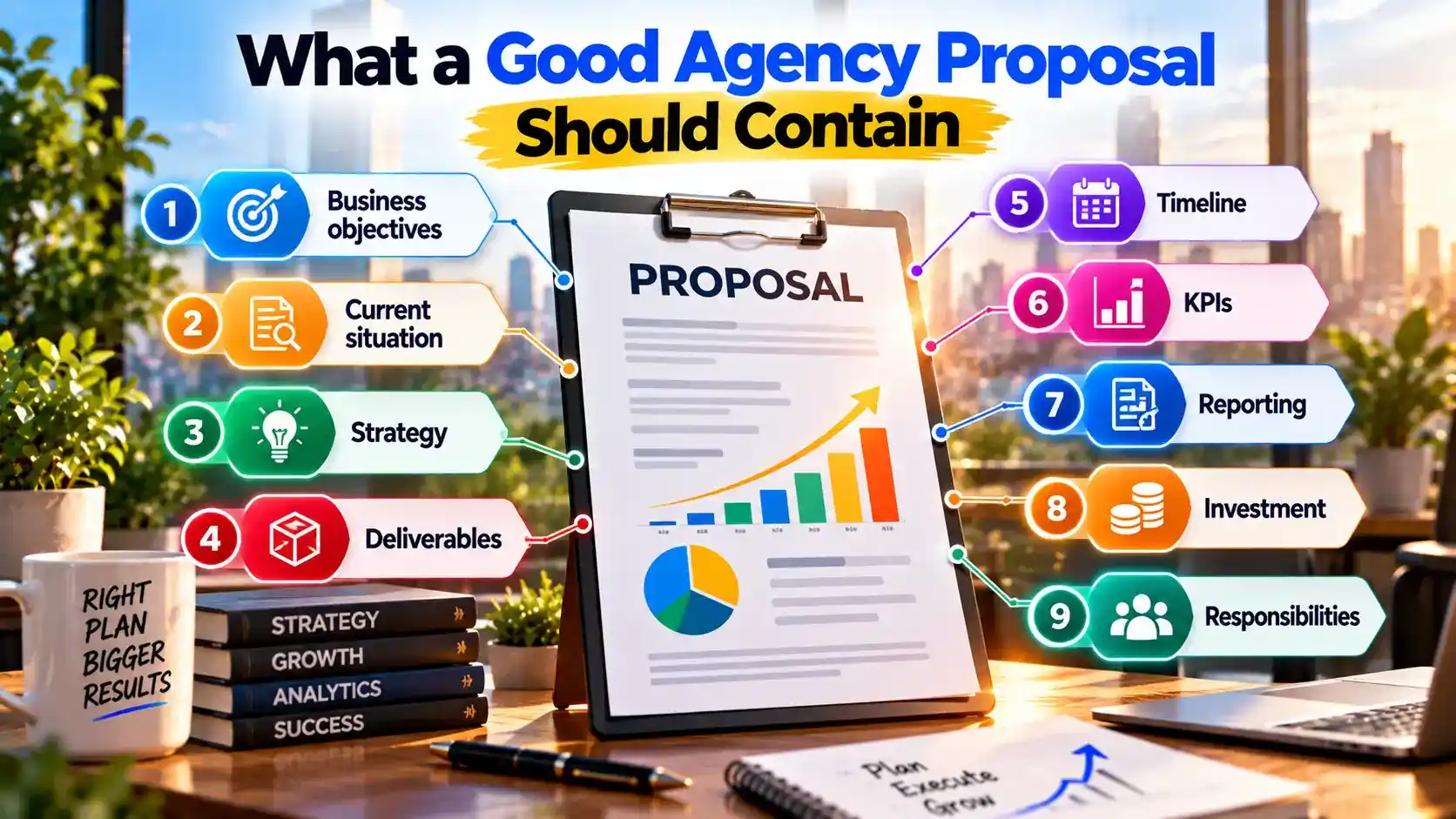
Before signing, you should ideally receive a proposal that clearly explains:
What are we trying to accomplish?
What problems and opportunities were identified?
What will the agency do and why?
What exactly will be completed?
What happens first, second and third?
What metrics will determine progress?
How will results be communicated?
What does the service cost?
What does the agency need from the client?
This reduces misunderstandings later.
Imagine you’re choosing between Agency A and Agency B.
Agency A is cheaper.
But that doesn’t tell you which is better.
You need to ask:
Which proposal has a stronger probability of generating profitable business outcomes?
That’s the comparison that matters.
Suppose an agency costs:
$500/month
but generates:
No qualified leads.
After one year:
$6,000 spent.
Now suppose another agency costs:
$2,500/month
and generates enough qualified business to produce:
$100,000 in attributable revenue.
That’s:
$30,000 invested → $100,000 revenue
The second agency costs five times more.
But the first agency may ultimately be more expensive because it produced little or no business value.
This is why agency selection should be based on ROI and capability, not simply monthly price.
At MetaSense Marketing, we don’t believe businesses need a generic checklist of services.
The strategy should begin with the business.
We look at factors such as:
From there, the strategy can incorporate the right combination of:
SEO
Local SEO
Content Optimization
Google Ads
Social Media
AEO
GEO
Conversion Optimization
Analytics
The objective isn’t to make a business “do more marketing.”
It’s to make its marketing work more intelligently.
MetaSense Marketing positions its digital marketing capabilities around improving online presence, traffic, and sales, while its iMetaDex™ platform is presented as an AI-driven technology for improving Google visibility.
That combination of marketing strategy and technology becomes increasingly relevant as search evolves beyond traditional blue links.
A digital marketing agency can create the best-looking proposal you’ve ever seen.
It can have:
But none of that guarantees business growth.
Ultimately, ask:
Can this agency demonstrate that it understands the relationship between marketing activity and business outcomes?
That’s what matters.
Our experience with Berks Plumbing & HVAC Specialist is one example of this approach.
The campaign achieved approximately 10× traffic growth and more than 2× lead generation, while also increasing visibility for question-based searches, Featured Snippets, and Google AI Overview answers.
The important part isn’t the number.
It’s the methodology behind the number:
Understand the audience → research demand → build the right content → optimize the website → improve visibility → measure conversions → refine the strategy.
The right digital marketing agency isn’t necessarily the one with:
It’s the agency that can understand:
Your business
→ Your customers
→ Your market
→ Your competition
→ Your search behavior
→ Your acquisition economics
→ Your growth objectives
and then turn that understanding into a measurable strategy.
Before signing a contract, look for evidence.
Ask difficult questions.
Request case studies.
Understand the deliverables.
Verify how results will be measured.
Ask who will actually perform the work.
Understand ownership and access.
And most importantly, don’t let an agency define success purely through rankings, impressions, clicks, or followers.
The real objective is business growth.
For a local business, that might mean more calls and appointments.
For a healthcare organization, it might mean more qualified inquiries.
For a professional-services firm, it might mean more consultations.
For a startup, it might mean lower customer acquisition costs and scalable demand.
For an e-commerce company, it might mean profitable revenue growth.
The right agency should understand that difference.
At MetaSense Marketing, our approach is to combine SEO, local search, content, paid media, AEO, GEO, and technology according to the specific needs of the business, not simply sell every available service.
If you’re evaluating digital marketing agencies and want a strategy built around visibility, qualified traffic, leads, conversions, and measurable business growth, connect with MetaSense Marketing to discuss your goals and identify the opportunities that make the most sense for your business.
The right digital marketing agency shouldn’t just promise to make you more visible. It should help make your business more discoverable, more credible, and more profitable.
Look for relevant experience, credible case studies, transparent reporting, a customized strategy, clear deliverables, measurable KPIs, and an understanding of your business, not just rankings and traffic.
Pricing varies significantly based on services, competition, market, scope, and agency expertise. Don’t compare agencies solely by monthly price. Compare the expected scope, resources, strategy, and business value.
It depends on your needs. A specialist can be valuable for a specific challenge, while a full-service agency can be useful when SEO, paid advertising, content, social media, website optimization, and AI-search strategy need to work together.
There’s no universal answer. Ask why a minimum term is necessary, what will be delivered during that period, how performance will be evaluated, and what the cancellation terms are.
A responsible agency should not guarantee a specific organic ranking position. Search results depend on many factors outside an agency’s direct control.
Reporting should be customized to the business, but can include organic traffic, rankings, conversions, leads, local visibility, paid performance, qualified leads, acquisition cost, and revenue where measurable.
No. Price should be considered alongside expertise, scope, strategy, expected outcomes, transparency, and ROI.
Ask how rankings translate into qualified traffic, leads, customers, and revenue. If the agency cannot make that connection, you may need a more business-focused approach.
Yes, particularly in specialized or regulated industries. However, an agency should also demonstrate the ability to understand new markets and develop a strategy based on research.
Generally, yes. Local SEO involves specific considerations such as Google Business Profile, reviews, local relevance, geographic targeting, and local search visibility. Google says local results are primarily based on relevance, distance, and prominence.
AEO, or Answer Engine Optimization, focuses on creating content that clearly answers user questions and can be surfaced in answer-oriented search experiences.
GEO, or Generative Engine Optimization, refers broadly to optimizing a brand’s digital presence and content for visibility in generative AI search experiences.
Not necessarily as separate standalone campaigns. Many of the fundamentals, useful content, clear answers, topical authority, expertise, structured information, and strong SEO, can support visibility across traditional and AI-driven search.