Search has changed significantly. Businesses are no longer competing only for traditional blue-link rankings. Customers may discover a company through Google Search, Google Maps, AI-generated search experiences, featured results, local listings, review platforms, social media, and other digital channels.
That is why hiring an SEO Agency in US is no longer simply about adding keywords to web pages or publishing a few blog posts every month.
A modern SEO strategy needs to address the entire search journey, from how search engines crawl and understand a website to how potential customers discover the business, evaluate its expertise, and ultimately become leads or customers.
A full-service SEO agency brings these different disciplines together. Depending on the business, this can include technical SEO, keyword research, content strategy, on-page optimization, Local SEO, link building, conversion optimization, analytics, competitor research, and optimization for emerging AI-driven search experiences.
For businesses operating in Philadelphia, New Jersey, or other competitive U.S. markets, this integrated approach can be particularly important because search visibility depends on more than one ranking factor.
Google states that structured data can help it understand page content and potentially make pages eligible for certain search features, while its documentation also emphasizes technical requirements, helpful content, and overall page experience.
So, what exactly should you expect from a full-service SEO agency?
Let’s break it down.
A full-service SEO agency provides a broad range of search engine optimization services under one strategy instead of focusing on a single SEO activity.
A basic SEO provider might focus primarily on:
A full-service SEO agency typically looks at the entire organic acquisition system.
That can include:
The objective is not simply to increase rankings.
The objective is to build search visibility that contributes to qualified traffic, leads, calls, sales, and long-term business growth.
Technical SEO is the foundation of an effective SEO campaign.
Even excellent content can struggle to perform if search engines cannot efficiently crawl, interpret, or index a website.
A full-service SEO Agency in US should therefore begin by understanding the technical condition of the website.
Technical SEO can include:
An SEO specialist examines whether important pages can be crawled and indexed correctly.
This may involve identifying:
XML sitemaps help search engines discover important URLs.
An SEO agency can audit the sitemap to ensure that it contains relevant, canonical, indexable URLs rather than outdated or problematic pages.
Clean and logical URL structures help users and search engines understand website organization.
For example:
example.com/services/seo/
is generally easier to understand than:
example.com/page?id=1837
Technical SEO also involves website performance and user experience.
Google’s current documentation recommends considering factors such as Core Web Vitals, mobile usability, secure browsing, intrusive interstitials, and overall page experience.
A technical SEO audit may therefore examine:
Structured data provides search engines with additional information about page content.
Depending on the website, an agency may implement appropriate structured data for things such as:
Google explains that structured data can help it understand page content and may make pages eligible for certain search features.
Technical SEO isn’t glamorous, but it can determine whether the rest of an SEO strategy has a solid foundation.
Keyword research is much more than finding keywords with high search volume.
A professional SEO agency needs to understand why someone searches for a particular phrase.
For example:
“SEO agency in Philadelphia”
has a different intent from:
“how much does SEO cost for a small business?”
And both are different from:
A full-service SEO strategy categorizes keywords according to intent.
The user wants information.
Examples:
The user is evaluating solutions.
Examples:
The user is closer to taking action.
Examples:
The user is looking for a particular company, website, or resource.
A strong SEO campaign maps these different intents to the appropriate pages.
That prevents the common mistake of trying to rank one page for hundreds of unrelated searches.
On-page SEO focuses on optimizing the actual content and structure of individual pages.
This includes more than inserting a target keyword into a title.
An SEO agency may optimize:
The goal is to make the page clearly communicate:
What is this page about?
Who is it for?
What question does it answer?
What action should the visitor take next?
For example, a page targeting SEO Services in Philadelphia should actually explain the SEO services being offered, the types of businesses served, the problems being solved, the process, and the expected engagement, not simply repeat “SEO Services in Philadelphia” throughout the page.
Modern SEO requires more than publishing random blog posts.
A full-service SEO agency develops a content ecosystem around the business.
Suppose a company provides SEO services.
Instead of publishing unrelated articles, the strategy could build topical coverage around:
This creates interconnected topical coverage.
Topical authority is the depth and breadth of useful content a website develops around a subject.
For example, an agency targeting healthcare businesses shouldn’t publish only one page titled “Healthcare SEO.”
It could build supporting content around:
The pages can then be connected through strategic internal linking.
This creates a much stronger content architecture than publishing isolated articles.
For businesses serving specific geographic areas, Local SEO can be one of the most important components of a full-service SEO strategy.
This is particularly relevant for businesses targeting:
A comprehensive Local SEO campaign can include:
Google states that local results are primarily influenced by relevance, distance, and prominence. Complete and accurate Business Profile information can help Google understand a business and match it to relevant searches.
This means Local SEO isn’t simply about putting a city name into a webpage.
It involves building consistent geographic relevance and authority across the business’s online presence.
Businesses competing for searches such as SEO Agency in Philadelphia need to understand that local search behavior is different from nationwide SEO.
A Philadelphia-focused strategy may involve:
The same principle applies to companies targeting SEO Services in Philadelphia.
New Jersey presents another interesting SEO environment because businesses may target customers across multiple cities and service areas.
Depending on the business model, an SEO campaign may need to address locations such as:
However, creating dozens of nearly identical city pages simply by replacing a city name is not a strong strategy.
Each location page should provide genuinely useful, location-specific information.
For local businesses, Google Business Profile should be treated as part of the overall search strategy rather than an isolated listing.
An agency can help with:
Google also notes that information in Business Profiles can come from multiple sources, including the business’s website, public information, third-party data, users, and business owners.
That makes consistency important.
Your website, Business Profile, directories, and other trusted sources should communicate an accurate representation of the business.
Links remain an important part of how websites build authority and discoverability.
However, modern link building should not be reduced to purchasing large quantities of low-quality backlinks.
A professional agency may focus on acquiring relevant mentions through:
The quality and relevance of the relationship matter.
For example, a local home-services company may benefit more from legitimate mentions on relevant local and industry websites than from hundreds of unrelated links from low-quality websites.
E-E-A-T stands for:
A strong SEO agency helps businesses demonstrate these qualities through their website and broader online presence.
This can include:
For YMYL industries such as healthcare, finance, and legal services, demonstrating credibility and trustworthy information is particularly important.
E-E-A-T should not be treated as a checkbox.
It should be built into the content and business communication strategy.
A full-service SEO agency should not optimize your website in isolation.
Competitor analysis helps identify:
The objective isn’t to copy competitors.
It is to understand the search landscape and determine where your business can create something more useful or differentiated.
Traffic is only valuable when it contributes to business objectives.
A website receiving 50,000 visitors but generating very few leads may have an SEO problem, or it may have a conversion problem.
This is where Conversion Rate Optimization becomes important.
An SEO agency can review:
For example, if an SEO campaign increases organic traffic but visitors cannot easily find the contact form or phone number, the business may not realize the full value of that traffic.
SEO should therefore connect visibility with conversion.
A professional SEO campaign needs measurable objectives.
Important metrics can include:
Google Search Console and analytics platforms can help businesses understand how users discover and interact with their websites. Google specifically recommends Search Console for monitoring search performance and understanding indexing.
A good monthly SEO report should answer a simple question:
What changed, why did it change, and what are we doing next?
Search is becoming increasingly conversational and multimodal.
Google now documents AI features within its Search ecosystem, and Search Console has continued expanding reporting around emerging search experiences.
This creates a new consideration for SEO teams.
Businesses need content that is:
Instead of writing an article solely around a keyword, an SEO agency can build content around the complete information journey.
For example, instead of creating only:
a broader content strategy could address:
This provides more opportunities to answer related questions throughout the customer journey.
Answer Engine Optimization, or AEO, focuses on making content useful and understandable for answer-oriented search experiences.
The strategy involves identifying questions customers actually ask and providing direct, useful answers.
AEO can involve:
The objective isn’t to create content specifically for machines.
The best AEO strategy starts with the user.
If your content directly and accurately answers a question that customers have, it has a stronger chance of being useful across multiple search experiences.
One important distinction: adding FAQ content or structured data does not guarantee inclusion in an AI Overview or a particular Google search feature. Google’s documentation and feature availability change over time, so SEO agencies should avoid making guaranteed AI visibility claims. Google also deprecated the FAQ rich result feature in 2026, which is a good example of why SEO strategies need to evolve with search.
Generative Engine Optimization, commonly called GEO, is another area receiving increasing attention.
The broader objective is to improve how a brand’s information can be discovered, understood, and represented in generative search experiences.
This may involve strengthening:
A useful way to think about modern search optimization is:
SEO gets your website discoverable.
AEO helps your content answer questions clearly.
GEO considers visibility across generative search experiences.
These disciplines overlap heavily and should generally be managed as one broader search visibility strategy rather than completely isolated marketing channels.
Not every business wants customers from one city.
Some companies need visibility across:
A full-service SEO Services in US strategy can therefore involve national SEO architecture.
This may include:
But scale should not come at the expense of quality.
Creating hundreds of thin location pages can create a poor user experience.
Each page should have a legitimate reason to exist.
Different industries have different search behaviors.
A full-service SEO agency may adapt its strategy according to the industry.
Healthcare organizations may need:
Plumbers, HVAC companies, electricians, roofers, and contractors may benefit from:
E-commerce SEO can involve:
B2B organizations may need:
SaaS companies often benefit from:
The SEO strategy should follow the business model, not the other way around.
Small businesses often don’t need every possible marketing channel immediately.
The strategy should be based on business objectives, competition, budget, geography, and customer behavior.
For many local businesses, the initial SEO priorities may be:
This prioritization prevents businesses from spending money on activities that aren’t aligned with their current stage.
SEO is one component of digital marketing.
A Digital Marketing Agency in US may offer a broader collection of services, including:
SEO focuses primarily on organic search visibility and the traffic and conversions that can result from it.
Digital marketing is broader.
For many businesses, these channels should work together.
For example:
SEO can build long-term organic visibility.
Google Ads can capture high-intent searches quickly.
Social media can support awareness and engagement.
Content marketing can educate prospects.
CRO can improve the percentage of visitors who become leads.
The best combination depends on the business.
SEO and paid search are not necessarily competing strategies.
They can complement each other.
A business may use Google Ads when:
At the same time, SEO can build organic visibility over the longer term.
This creates an acquisition strategy where paid search can capture immediate demand while SEO develops a broader organic asset.
The biggest difference is usually integration.
A specialist might perform keyword research.
Another provider might build links.
Another might write content.
Another might manage Google Business Profile.
A full-service SEO agency can coordinate these activities under one strategy.
For example:
Keyword research → Search intent → Website architecture → Content → Internal linking → Authority → Local SEO → Conversion optimization → Measurement
Each stage supports the others.
That is why choosing an SEO provider based only on the number of services listed on its website can be misleading.
The more important question is:
Can the agency connect these services to a coherent business strategy?
When evaluating an SEO Agency in US, don’t start with the cheapest monthly package.
Start with the business problem.
Ask:
An SEO strategy for a local plumber is different from one for a national SaaS company.
Ask how they determine what users actually want when searching.
A good strategy should be based on the current technical and content situation.
Ranking reports alone don’t tell you whether SEO is generating business.
Understand whether the work is performed by experienced SEO professionals, outsourced, automated, or a combination.
Ask whether the agency produces genuinely useful content or simply publishes keyword-focused articles.
Be cautious of promises involving thousands of backlinks.
If your business depends on customers in specific locations, local search should be part of the discussion.
Ask how their strategy addresses AI search, AEO, structured content, and evolving search behavior.
SEO involves many variables outside an agency’s direct control.
A professional agency should explain opportunities, risks, timelines, and measurement rather than promising guaranteed positions.
If your business operates in Philadelphia or New Jersey, geographic expertise can matter.
An SEO Agency in Philadelphia should understand the competitive local search environment and how customers search for services in the region.
Similarly, an SEO Agency in New Jersey should be able to develop location-specific strategies instead of simply replacing “Philadelphia” with “New Jersey” across templates.
When evaluating local SEO agencies, ask for:
The goal should be to build visibility among the customers who can actually purchase from you.
SEO does not have a universal timeline.
Results depend on:
A new website competing nationally for highly competitive keywords will generally face a different challenge from an established local business with strong reviews and existing authority.
Instead of asking only:
“How quickly can I rank?”
ask:
“What milestones should we expect as the campaign develops?”
Those milestones might include:
When we approach SEO strategically, the campaign can be organized into several stages.
This framework allows businesses to prioritize activities instead of trying to execute everything simultaneously.
One example from our work involved Berks Plumbing & HVAC Specialist.
The objective wasn’t simply to rank more pages.
The strategy focused on understanding what potential customers were asking, improving content around search intent, restructuring and optimizing existing content, building topical authority, strengthening internal linking, and creating more useful answers to customer questions.
The campaign helped the business gain visibility in Google AI Overview-type answers and question-based searches, alongside Featured Snippet visibility.
The broader organic performance also improved significantly, with traffic increasing by approximately 10x and leads increasing by more than 2x.
The important takeaway is that these results didn’t come from one isolated SEO tactic.
They came from combining:
This is the difference between treating SEO as a checklist and treating it as a growth channel.
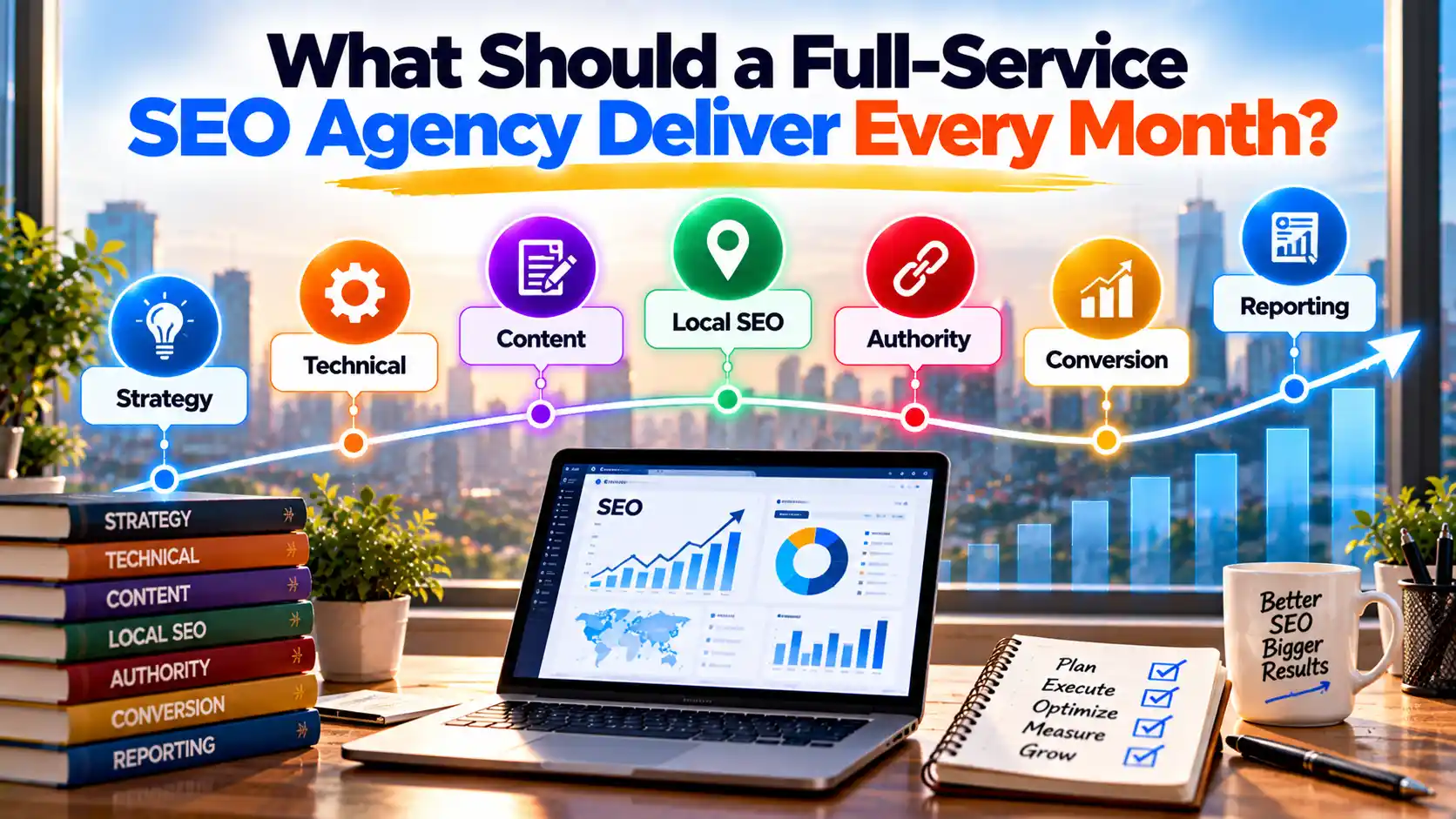
SEO deliverables vary according to the campaign, but a strong engagement may include:
The exact deliverables should be customized to the website rather than copied from a generic package.
A full-service SEO Agency in US should do much more than optimize keywords.
The modern SEO ecosystem includes:
The most important part is how these services work together.
A technically perfect website with weak content will struggle.
Great content without a sound technical foundation can underperform.
Strong rankings without conversion tracking make it difficult to measure business value.
And a large backlink profile without relevance or quality is not a substitute for a strong brand and useful website.
For businesses targeting SEO Services in US, SEO Agency in Philadelphia, SEO Services in Philadelphia, SEO Agency in New Jersey, or SEO Services in New Jersey, the right strategy should be based on the market, customer behavior, competition, business objectives, and search intent.
At MetaSense Marketing, we approach SEO as a business-growth channel rather than a collection of isolated tasks. The objective is to build sustainable search visibility, attract the right audience, improve the customer journey, and turn relevant search traffic into measurable business opportunities.
For businesses that need SEO alongside paid search, social media, content, conversion optimization, and broader digital growth, a coordinated Digital Marketing Agency in US can bring these channels together under one strategy.
The right SEO strategy isn’t about doing everything.
It’s about doing the right things, in the right order, for the right audience, and measuring whether they actually contribute to business growth.
A full-service SEO agency manages multiple areas of search engine optimization, including technical SEO, keyword research, on-page SEO, content strategy, Local SEO, authority development, analytics, conversion optimization, and emerging search optimization.
SEO pricing varies significantly based on the business, competition, geographic market, website size, objectives, and scope of work. A local small business will generally have different requirements from a national enterprise company.
Rather than choosing an SEO provider solely based on monthly price, businesses should compare the scope of work, expertise, reporting, strategy, and expected business objectives.
SEO can be valuable for small businesses when customers actively use search engines to discover products or services.
Local businesses can particularly benefit from Local SEO, Google Business Profile optimization, service pages, reviews, and location-focused content.
It depends on your needs.
If organic search is your primary growth channel, an SEO-focused agency may be appropriate.
If you need SEO, paid advertising, social media, content marketing, CRO, and other services, a full-service digital marketing agency may provide a broader solution.
SEO generally focuses on organic search visibility, while Local SEO focuses specifically on searches connected to geographic locations and local businesses.
Local SEO can involve Google Business Profile, local content, reviews, citations, location pages, and local authority.
No legitimate SEO strategy can guarantee a specific Google ranking.
Search results depend on numerous factors, including competition, search intent, website quality, authority, location, algorithmic changes, and user behavior.
An agency should instead focus on measurable improvements in visibility, qualified traffic, conversions, leads, and business outcomes.
Yes, but the search environment is evolving.
Google continues to develop AI-powered search experiences, while traditional search remains an important discovery channel. Google’s documentation now includes guidance around AI features, and Search Console continues to expand reporting for emerging search experiences.
The practical response is not to abandon traditional SEO.
It is to build technically sound websites and genuinely useful content that can serve users across multiple search experiences.
AEO and SEO overlap but are not completely identical terms.
SEO covers a broad range of activities designed to improve organic search visibility.
AEO places greater emphasis on answering questions clearly and making information useful for answer-oriented search experiences.
In practice, a modern search strategy can incorporate both.
No.
Location pages should exist when the business genuinely serves those locations and when the pages provide useful, unique information.
Creating large numbers of near-duplicate city pages purely to capture keywords can create a poor experience and does not automatically create local authority.